[.green-span]Credit Data API: Access Business and Consumer Credit in Real Time[.green-span]

A credit data API is a software interface that pulls credit scores, reports, and financial data directly into your application in real time. Instead of logging into bureau portals or downloading PDFs, you make a programmatic call and receive structured data back—ready to feed into your underwriting logic, prequalification flows, or fraud detection systems.
Most credit data APIs aggregate information from the three major bureaus: Equifax, Experian, and TransUnion. Some also pull from specialty bureaus, alternative data providers, or business credit sources. The API handles authentication with the bureau, executes the pull, and returns a standardized response your system can parse immediately.
What used to involve manual data entry and days of back-and-forth now happens in seconds. That speed changes how lending teams operate—and how borrowers experience the application process.
Business credit vs consumer credit data through an API
Business credit data and consumer credit data come from different sources and serve different purposes. Business credit covers company-level information: tradelines with vendors, PAYDEX scores, liens, UCC filings, and payment behavior. Consumer credit focuses on individuals: personal payment history, credit utilization, and scores like FICO or VantageScore.
The regulatory landscape differs too. Consumer credit pulls fall under the Fair Credit Reporting Act (FCRA), which requires permissible purpose and explicit consent. Business credit data typically has fewer restrictions, though specific use cases may still carry compliance requirements.
When building a lending product, you'll often pull both types. A small business loan application might require the owner's personal credit alongside the company's business credit profile.
Types of credit data you can access via API
Credit data APIs return far more than a single score. The data categories available shape what workflows you can build and what signals you can capture.
Credit reports and tradelines
Tradelines are individual credit accounts. Each tradeline shows the creditor, account type, credit limit, current balance, payment history, and account status. A full credit report bundles all tradelines together with inquiries, public records, and summary statistics.
When you pull a report via API, you receive this complete picture in a structured format—typically JSON—that your system can parse and store.
Credit scores and attributes
A credit score condenses tradeline data into a single number representing risk. Attributes are the granular data points behind that score: number of delinquencies, age of oldest account, total revolving utilization, and so on.
Many lenders use attributes to build custom scoring models rather than relying solely on bureau-generated scores. The API returns both, giving you flexibility in how you assess risk.
Identity and fraud signals
Modern credit APIs often bundle identity verification and fraud detection alongside credit pulls. This includes:
- KYC data: Name, address, SSN, and date of birth verification
- Synthetic identity flags: Indicators that an identity may be fabricated
- Fraud alerts: Warnings placed by consumers or bureaus
CatchingWith the FTC reporting a record $16 billion in fraud losses in 2025, catching fraud early reduces losses and keeps manual review queues manageable.
Alternative and cash flow data
For borrowers with thin credit files, alternative data—over 76 million consumers in the U.S. have minimal or no credit history—alternative data fills the gap. APIs can aggregate bank transaction data, rent payments, utility bills, and other non-traditional sources to paint a fuller picture of creditworthiness.
This matters especially in SMB lending, where traditional bureau data may be sparse or nonexistent for newer businesses.
Business firmographics and public records
Firmographics include company-level details: SIC/NAICS codes, employee counts, revenue estimates, years in business, and ownership structure. Public records cover liens, judgments, bankruptcies, and UCC filings.
Together, firmographics and public records help assess business health beyond payment behavior alone.
Benefits of real-time credit data API access
Real-time access changes the economics of lending operations. Here's what shifts when credit data flows directly into automated workflows.
Faster time to decision
Instant credit pulls eliminate the delays of manual data gathering. Decisioning that once took days can happen in minutes—or seconds—when the data arrives programmatically.
Pre-qualified offers hosted on Lendflow drive an average of 42% faster speed to funding compared to traditional workflows.
Higher application conversion
Speed matters to borrowers. When applicants receive decisions quickly, fewer abandon the process mid-application. Faster turnaround often translates directly to higher conversion rates.
Lower operational cost
Automation replaces manual data entry, PDF parsing, and re-keying errors. Teams stay lean as volume grows because the API handles repetitive work.
Lendflow's embedded finance customers operate with 80% smaller teams while converting similar funding volumes—a direct result of automating data orchestration and document handling.
Cleaner data for underwriting models
Standardized API responses reduce the data normalization work that eats up engineering time. Consistent schemas mean your models train on cleaner inputs and produce more reliable outputs.
How unified credit APIs simplify multi-bureau access
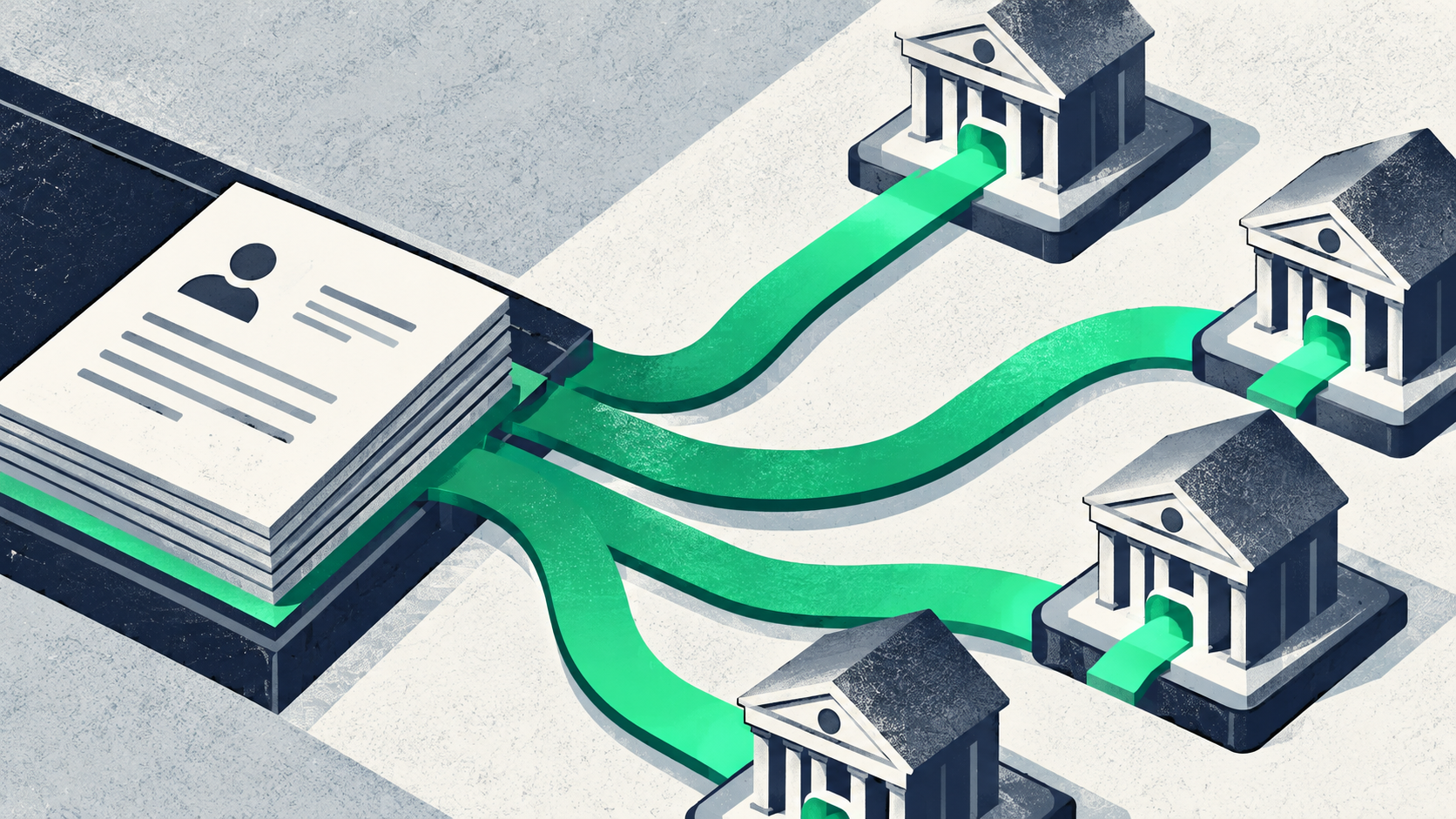
Managing separate contracts, credentials, and data formats for each bureau creates operational drag. A unified credit API provides a single integration point that aggregates data from multiple sources.
- Single integration: Connect once to access Equifax, Experian, TransUnion, and specialty bureaus without managing multiple vendor relationships.
- Normalized responses: Receive data in a consistent schema regardless of which bureau sourced it.
- Decline waterfalls: Automatically route to secondary sources when primary data is insufficient.
Lendflow's data orchestration layer works this way. Lenders connect with top integration partners in minutes and build decline waterfalls that ensure no deal leaves money on the table.
Compliance requirements for credit data APIs
Credit data access is regulated. Getting compliance wrong creates real risk, so understanding the requirements matters before you integrate.
FCRA and permissible purpose
The Fair Credit Reporting Act requires a valid legal reason—called permissible purpose—to pull consumer credit data. Common permissible purposes include credit decisions, employment screening, and insurance underwriting.
You'll document your permissible purpose during onboarding with any bureau or aggregator. Without it, you can't legally access consumer credit data.
Consumer consent and disclosures
Consumer credit pulls typically require explicit consent before the pull. Specific disclosures are also required afterward, especially if you take adverse action based on the data.
Your application flow handles consent capture. The API handles the pull. The compliance responsibility stays with you.
Soft pull vs hard pull through an API
A soft pull checks credit without impacting the consumer's score. Soft pulls are commonly used for prequalification and marketing offers.
A hard pull impacts the score and is used for final underwriting decisions. API parameters control which type of pull you execute, so your integration logic determines the borrower experience.
Audit readiness and data security
Lenders working with credit data typically maintain SOC 2 compliance, encrypt data in transit and at rest, and log audit trails for every pull. Regulators and bureau partners expect you to demonstrate compliant data handling on request.
Lendflow is SOC 2 Type II compliant, which means the platform meets rigorous standards for security, availability, and confidentiality.
Technical considerations for credit data API integration
Developers evaluate several factors when selecting and integrating a credit data API. Here's what to look for.
Authentication and access control
Most APIs use OAuth or API keys for authentication, often combined with IP allowlisting. Production credentials differ from sandbox credentials, so your deployment pipeline handles the environment switch.
Standardized JSON responses and data schemas
Predictable response formats reduce parsing errors and speed up integration. Well-documented schemas let your team map fields to internal data models without guesswork.
SDKs, sandboxes, and developer tooling
SDKs—pre-built libraries for common languages—accelerate integration. Sandbox environments allow testing without hitting live bureaus or incurring per-pull costs.
Rate limits, latency, and uptime
Typical APIs enforce rate limits to prevent abuse. Response times vary by data type, but sub-second latency is common for score-only pulls. SLA guarantees matter for production workloads where downtime impacts borrower experience.
How to integrate a credit data API
Integration follows a predictable sequence. Here's the typical path from evaluation to production.
1. Define use cases and permissible purpose
Start by documenting what data you need and why. This drives vendor selection, compliance documentation, and API configuration.
2. Review documentation and set up a sandbox
Obtain sandbox credentials and test basic calls before writing production code. Most providers offer interactive documentation and sample responses.
3. Implement authentication and consent capture
Build secure credential handling and borrower consent flows into your application. Consent capture happens in your UI; the API executes the pull.
4. Parse responses and map to your decisioning logic
Map API response fields to your underwriting rules or scoring models. Standardized schemas make this straightforward, but edge cases—like missing fields—require graceful handling.
5. Run compliance and regression tests
Validate that consent capture, data handling, and adverse action flows meet regulatory requirements. Regression tests catch breaking changes when APIs update.
6. Connect to your CRM and loan origination system
Push credit data directly to your LOS and CRM—skip manual re-entry. Lendflow's platform supports ready-made connectors that reduce this integration work.
7. Monitor performance and iterate models
Track pull success rates, latency, and decisioning outcomes. Refine models as data patterns change and new data sources become available.
Using credit data APIs in automated decisioning
Credit APIs power modern, automated decisioning workflows. Here's how they fit into the broader decisioning stack.
Real-time credit signals for live underwriting
Live credit pulls feed directly into decisioning engines with no stale data or batch delays. The borrower applies, the API pulls, and the engine decides—all in one flow.
Multi-source waterfalls across lenders and products
Decline waterfalls automatically route to secondary data sources or alternative lenders when primary data is insufficient. This approach maximizes approval opportunities without manual intervention.According to the Federal Reserve's 2025 Small Business Credit Survey, about one-third of small businesses face a funding gap despite applying for financing—this approach maximizes approval opportunities without manual intervention.
Lendflow's orchestration layer supports these waterfalls natively, connecting brands to a network of 75+ specialty and bank lenders through a single integration.
Explainable risk scoring and AI agents
Explainable scoring outputs reasons for decisions, not just a number. This transparency helps with compliance and borrower communication.
AI agents can automate document analysis, industry classification, and borrower communication alongside credit pulls. Lendflow's Trust Score provides an explainable composite risk score, while automation agents handle tasks like document extraction and follow-up communications.
Measuring the business impact of a credit data API
After integration, tracking ROI helps you understand what's working and where to optimize.
- Time-to-decision: Measure how quickly applications move from submission to offer.
- Approval rate changes: Track whether richer data improves or stabilizes approval rates.
- Operational cost per application: Calculate labor savings from automation.
- Conversion lift: Monitor whether faster decisions reduce borrower abandonment.
In the last 12 months, $1.5B+ in offers were made on Lendflow's platform—a signal that automated credit data workflows can scale.
Power embedded lending with Lendflow
Lendflow's data orchestration and unified API connect brands and lenders to credit data, automation, and decisioning in a single platform. Skip long build cycles—use plug-and-play widgets, landing pages, and APIs to launch embedded lending in days.
Embedded lending widgets can go live in under two weeks. Full API integrations typically take 30 to 45 days.
Book a demo to see how Lendflow can help you connect capital and grow.
Frequently asked questions about credit data APIs
What is the difference between a credit data API and a credit bureau API?
A credit bureau API connects directly to a single bureau like Equifax or Experian. A credit data API may aggregate data from multiple bureaus and alternative sources through a unified interface, simplifying multi-source access.
Is there a free credit data API?
Most production credit data APIs require paid contracts with bureaus or aggregators. Free options are typically limited to sandbox environments or developer trials.
How much does a credit data API cost?
Pricing varies by provider, data type, and volume. Expect per-pull fees or tiered subscription models based on your use case and pull volume.
Can a credit data API return both business and consumer credit data?
Yes, many unified credit APIs support both business and consumer credit pulls. Each may require separate compliance documentation and permissible purpose.
How fast can you go live with a credit data API?
Implementation timelines vary. Widget-based integrations can launch in under two weeks, while full API builds typically take 30 to 45 days depending on complexity.