[.green-span] The Role of Borrower Health Data in Modern Credit Underwriting [.green-span]

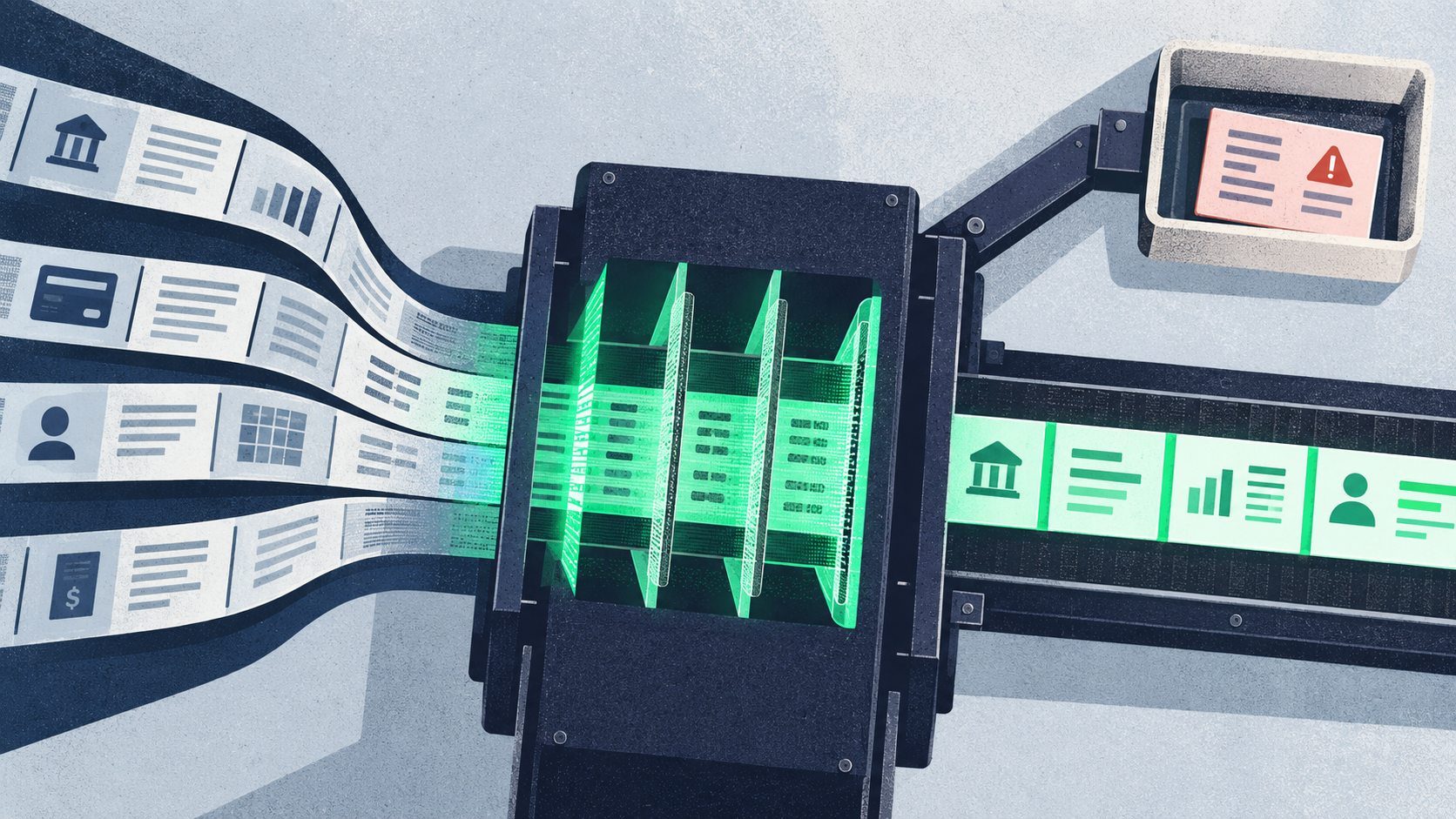
This composite view of financial condition, drawn from cash flow patterns, debt load, repayment behavior, and revenue trends, gives lenders a fuller picture than static bureau scores alone. Below, we'll cover the key signals that define borrower health, where the data comes from, and how to operationalize it in underwriting workflows.
What Is Borrower Health Data
Borrower health data is a composite view of a borrower's financial condition, pulled together from multiple sources like bank transactions, debt records, repayment history, and revenue trends. Unlike a single credit score from a bureau, borrower health data measures how well a person or business actually handles money—capturing financial health signals like spending, saving, borrowing, and planning behaviors over time.
The distinction matters. A credit score is a snapshot. Borrower health data is more like a video that shows whether someone is improving, holding steady, or heading toward trouble.
For lenders pursuing data-powered credit underwriting, this broader view reveals repayment capacity that static scores often miss. A small business with limited credit history but consistent cash flow might be a stronger risk than one with a decent score but volatile revenue. SMB underwriting data surfaces those differences.
Key Signals and Metrics That Define Borrower Health
Cash Flow and Bank Transaction Patterns
Cash flow is the clearest indicator of borrower health. Lenders examine inflows and outflows, average daily balances, and how consistently deposits arrive.
A business that receives regular deposits and maintains a buffer signals stability. Frequent overdrafts or wild swings in balance suggest stress, even when the credit score looks acceptable.
Debt Load and Financing Stacking Behavior
Stacking happens when a borrower holds multiple financing products at once—an MCA, a term loan, and a line of credit, for example. Some stacking is normal. Excessive stacking signals over-leverage. — according to the Federal Reserve's 2024 Small Business Credit Survey, denial for existing debt nearly doubled between 2021 and 2024.
Lenders who can see total debt load across products, not just their own exposure, get a clearer read on whether a borrower can realistically take on more.
Repayment Performance and Delinquency Trends
Payment history tells a richer story than just "paid" or "missed." Days past due, frequency of late payments, and the direction of the trend all factor in.
A borrower who was 30 days late six months ago but has been on time since looks different from one whose payments slip further behind each month.
Revenue Stability and Business Momentum
Revenue trends indicate whether a borrower can service new debt. Rising revenue with healthy margins is a positive signal. Flat or declining sales raise questions., and the Federal Reserve's 2025 Small Business Credit Survey found revenue expectations fell to their lowest since 2020.
Seasonality matters too. A landscaping company with predictable winter dips is different from a business with unexplained revenue drops.
Fraud and Identity Risk Indicators
Borrower health data also helps catch fraud. Synthetic identity markers,Borrower health data also helps catch fraud. Synthetic identity markers — responsible for ~$3.1 billion in projected 2026 losses — inconsistent business information, and verification mismatches can all indicate problems.
Cross-referencing what a borrower submits against aggregated data sources—using tools like a KYB verification waterfall—helps lenders spot red flags before funding.
Sources of Borrower Health Data
Bank and Accounting System Data
Bank account aggregation through open banking APIs provides direct visibility into transaction history, balances, and cash flow patterns. Integrations with accounting software like QuickBooks and Xero add another layer, showing invoices, expenses, and receivables.
Bank and accounting data tends to be real-time or near-real-time, which makes it far more current than bureau reports.
Credit Bureau and Trade Line Data
Traditional bureau data from Experian, Equifax, and TransUnion still plays a role. Business credit reports and trade lines provide baseline credit history and payment patterns.
Bureau data typically updates monthly or quarterly, though, which means it can lag behind actual borrower conditions by weeks.
Ecosystem and Cross-Lender Data
Some platforms aggregate data across multiple lenders and financing products, providing ecosystem-level visibility.
A lender using this type of data can see not just their own relationship with a borrower, but patterns across the borrower's full financing activity.
Lendflow's SMB Intelligence offering works this way, capturing approval trends, stacking behavior, and repayment performance across a network of 75+ lenders.
Alternative and Behavioral Data
Merchant processing data, invoicing platforms, and payroll systems offer non-traditional signals. A business processing consistent card transactions or running regular payroll demonstrates operational health that might not appear on a credit report.
- Merchant processing: Consistent transaction volume indicates steady customer demand
- Invoicing platforms: Outstanding receivables and collection patterns reveal cash conversion cycles
- Payroll systems: Regular payroll runs signal operational stability and employee retention
Borrower Health Data vs Traditional Credit Bureau Data
The two approaches serve different purposes and work best together.
Traditional bureau data establishes baseline creditworthiness. Borrower health data fills gaps, especially for SMBs with limited credit history or situations where recent changes haven't yet hit the bureau file.
Real-Time and Ecosystem-Level Borrower Health Signals
Real-time signals include live transaction data, current balances, and active financing activity. Instead of relying on a report that's weeks old, lenders can see what's happening now.
Ecosystem-level visibility goes further. Rather than seeing only their own portfolio, lenders gain insight into borrower activity across multiple financing relationships. Stacking behavior, repayment patterns with other lenders, and early warning signs that wouldn't appear in a single-lender view all become visible.
Dynamic monitoring means continuous updates rather than point-in-time pulls. A borrower whose cash flow drops or who takes on new debt elsewhere can be flagged before they miss a payment.
How Lenders Use Borrower Health Data in Credit Underwriting
Automated Credit Decisioning
Borrower health signals feed directly into decision models for instant or near-instant approvals. With automated credit decisioning, configurable rules trigger approvals, declines, or escalation to manual review based on specific thresholds.
Underwriting automation at this stage compresses what used to take days into minutes.
Portfolio Monitoring and Early Warning Signals
Live data helps detect deteriorating borrower health before defaults occur. A drop in daily balances, new financing activity, or slipping payment patterns can trigger alerts, giving lenders time to act.
Early warning systems work best when they pull from multiple data sources rather than relying on a single feed.
Fraud Detection and Verification
Cross-referencing borrower-submitted data against aggregated signals catches inconsistencies. If a borrower claims $500K in annual revenue but bank data shows $200K, that discrepancy surfaces automatically.
Fraud detection becomes more reliable when verification happens against multiple independent sources.
Personalized Offers and Pricing
Borrower health profiles enable tailored loan terms, amounts, and rates. Instead of one-size-fits-all pricing, lenders can offer better terms to stronger borrowers and adjust for higher-risk profiles.
Personalization also improves conversion. Borrowers who receive offers matched to their actual capacity are more likely to accept and perform well.
Benefits of Borrower Health Data for Approval Rates and Risk
Lenders using borrower health data typically see improvements across several dimensions:
- Higher approval rates for creditworthy borrowers: Thin-file or underserved SMBs qualify when cash flow data supplements bureau scores
- Reduced default risk: Real-time signals catch deterioration before it becomes delinquency
- Faster time-to-decision: Automated data aggregation eliminates manual document review delays
- Lower operational overhead: Teams process higher volume without adding headcount
Lendflow customers operate with 80% smaller teams while converting similar funding volumes, largely because automation handles work that previously required manual review.
Compliance, Consent, and Data Privacy Considerations
Borrower authorization is required before pulling or sharing data. Consent management workflows ensure borrowers understand what data is being accessed and for what purpose.
Data use is limited to permissible purposes, specifically credit evaluation. Using borrower health data for unrelated purposes creates compliance risk.
Security controls protect sensitive financial information. Encryption, SOC 2 compliance, and access controls are standard requirements. Lendflow maintains SOC 2 Type II certification.
Fair lending requirements apply regardless of data source. Lenders using borrower health data still verify that their models don't create disparate impact on protected classes.
How to Operationalize Borrower Health Data in Lending Workflows
1. Connect and Aggregate Borrower Data Sources
The first step is integrating bank aggregation, accounting platforms, and bureau APIs. Skip fragmented point-to-point integrations—a unified data layer that normalizes inputs from multiple sources reduces complexity and maintenance burden.
Credit underwriting software with pre-built connectors can cut implementation time from months to weeks.
2. Standardize and Enrich Data for Decisioning
Raw data from different sources arrives in different formats. Normalizing data formats and filling gaps where possible creates a consistent foundation for decisioning.
Derived signals like cash flow ratios and stacking indicators add context that raw data alone doesn't provide.
3. Configure Decision Models and Risk Scores
Building a decisioning workflow with rules and thresholds that trigger approvals, declines, or manual review based on borrower health signals is where the data becomes actionable. Decision models can be simple or sophisticated depending on the use case.
The key is making rules configurable so they can adapt as portfolio performance data accumulates.
4. Automate Monitoring and Borrower Communications
Setting up ongoing data pulls and automated alerts keeps borrower health data current. Workflow triggers can notify teams when health signals change or reach out to borrowers directly when action is needed.
Automation at this stage reduces manual monitoring work and catches issues earlier.
Power Smarter Underwriting With Lendflow
Lendflow's SMB Intelligence offering delivers ecosystem-level visibility into borrower health across 75+ lenders and multiple financing products. Instead of seeing only your own portfolio, you gain insight into approval trends, stacking behavior, repayment performance, and fraud indicators across the full financing lifecycle.
Combined with Lendflow Intelligence for decisioning and Lendflow Automate for workflow execution, teams can operationalize borrower health data without heavy engineering lift. Pre-built connectors, configurable decision models, and AI-powered document analysis mean faster implementation and leaner operations.
Pre-qualified offers hosted on Lendflow drive an average of 42% faster speed to funding. Book a demo to see how Lendflow can help you underwrite with real-time borrower health data.
FAQs About Borrower Health Data
What does borrower mean in lending?
A borrower is an individual or business that receives funds from a lender with an agreement to repay the principal plus interest over a defined term.
Does medical debt appear on a borrower's credit report?
Medical debt may appear on credit reports if sent to collections, though recent regulatory changes have removed many paid medical debts and smaller balances from bureau files.
Where can lenders find public borrower health data?
Public sources include credit bureaus, SEC filings for larger businesses, and government databases. Most borrower health data, however, requires permissioned access through aggregation platforms or direct borrower consent.
How is borrower health data different from alternative credit data?
Borrower health data is a broader category that includes alternative data like rent and utilities, but also encompasses real-time cash flow, cross-lender activity, and ecosystem-level signals not captured by alternative data alone.
How often should lenders refresh borrower health data?
Refresh frequency depends on the use case. Origination may require point-in-time pulls, while portfolio monitoring benefits from continuous or daily updates to catch early warning signals.