How Lenders Are Using SMB Underwriting Data to Make Smarter Credit Decisions
SMB underwriting data is the collection of financial, operational, and behavioral information lenders use to evaluate whether a small or medium-sized business can repay a loan. Unlike consumer lending, where FICO scores provide a standardized starting point, SMB underwriting requires pulling from multiple sources—bank transactions, tax returns, credit bureaus, and increasingly, real-time signals from payment processors and e-commerce platforms.
This guide covers the core data categories lenders rely on, how that data flows through the underwriting pipeline, and the practical ways teams are using richer signals to approve more borrowers, catch fraud earlier, and scale without adding headcount.
What is SMB underwriting data
SMB underwriting data refers to the financial and operational information lenders collect to determine whether a small or medium-sized business qualifies for financing. Unlike consumer lending, where a FICO score offers a standardized benchmark, SMB underwriting pulls from multiple sources: bank statements, tax returns, commercial credit reports, and increasingly, alternative data like payment processor activity or e-commerce metrics.
The goal is straightforward. Lenders want to answer one question: can this business generate enough cash to repay what it borrows? Because no universal business credit score exists, lenders combine traditional documents with open banking feeds and real-time signals to build a complete picture.
Why SMB underwriting carries more risk than consumer lending
Small businesses operate in environments that shift quickly. A single lost customer, a slow season, or a supply chain disruption can dramatically change a company's ability to repay. Consumer borrowers, by contrast, typically have steadier income streams and longer credit histories that make risk easier to quantify.
Several factors make SMB lending particularly tricky:
- Inconsistent cash flow: Revenue often fluctuates by season, customer, or project cycle
- Thin credit files: Many businesses lack years of commercial credit history
- Ownership complexity: Multiple owners, guarantors, and related entities add layers to the assessment
- Industry exposure: Default rates vary significantly by sector, so a restaurant carries different risk than a software company at the same revenue level
Given all of this, lenders invest heavily in data infrastructure. Without rich, timely signals, underwriting decisions often come down to guesswork. — a Federal Reserve Bank of Kansas City survey found 71% cite borrower financials as the most common loan denial reason.
The hidden cost of manual SMB underwriting
Manual underwriting slows everything down. Analysts spend hours chasing documents, copying data between systems, and making judgment calls that vary from one reviewer to the next. The process doesn't scale well, and inconsistencies creep in as volume grows.
Beyond the time cost, manual workflows create real business problems. Deals take longer to close, which frustrates borrowers. Qualified applicants get declined because data was incomplete or misinterpreted. And operational costs rise in lockstep with application volume, since every new deal requires roughly the same amount of human effort.
Core data sources lenders use to underwrite SMBs
Effective underwriting draws from multiple data categories. Each source reveals something different about the borrower's financial health, operational stability, and likelihood of repayment.
Bank transaction and cash flow data
Bank data shows what's actually happening in a business on a daily basis. Deposits, withdrawals, overdrafts, and account balances reveal liquidity patterns that financial statements alone can't capture. Open banking connections and automated bank statement analysis let lenders access this information in near real-time, rather than waiting for borrowers to compile and submit documents manually.
Business and personal credit bureau data
Commercial credit reports from providers like Dun & Bradstreet, Experian Business, and Equifax show how a business has handled obligations with suppliers and other creditors. For smaller businesses, lenders often pull personal credit on the owner or guarantor as well, since owner creditworthiness frequently predicts how the business will perform on its loan.
Accounting, tax, and financial statement data
Tax returns, profit and loss statements, and balance sheets verify the revenue and profitability claims a borrower makes on an application. Integrations with accounting platforms like QuickBooks or Xero speed up data extraction and reduce the back-and-forth of requesting documents.
KYC, KYB, and fraud signals
Know Your Customer (KYC) and Know Your Business (KYB) checks verify that the borrower is who they claim to be. KYC confirms individual identity, while KYB validates business registration, licensing, and beneficial ownership. Fraud screening at this stage catches red flags before a deal moves further into the pipeline.
Industry and NAICS classification data
NAICS codes categorize businesses by industry, which matters because risk profiles differ dramatically across sectors. A construction company and a healthcare practice might have similar revenues but face very different default probabilities. Accurate industry classification helps lenders apply the right risk models.default rates ranging from 3% to over 16% depending on sector. Accurate industry classification helps lenders apply the right risk models.
Real-time and alternative data signals
For borrowers with limited credit history, alternative data fills gaps. Payment processor activity, e-commerce platform metrics, shipping records, and online reviews all provide operational signals that traditional sources miss. A business with strong daily card transactions might qualify even without years of tax returns on file.
| Data Source | What It Reveals | Common Collection Method |
|---|---|---|
| Bank transactions | Cash flow health, liquidity | Open banking, statement upload |
| Credit bureau | Payment history, existing debt | API pull |
| Tax/accounting | Revenue, profitability | Integrations, document upload |
| KYC/KYB | Identity, ownership, fraud risk | Verification services |
| Industry classification | Sector risk exposure | NAICS lookup |
| Alternative data | Operational signals | Platform integrations |
How SMB underwriting data flows from application to decision
Understanding how data moves through the underwriting pipeline helps clarify where bottlenecks occur and where automation delivers the most value.
Step 1. Aggregate data across sources
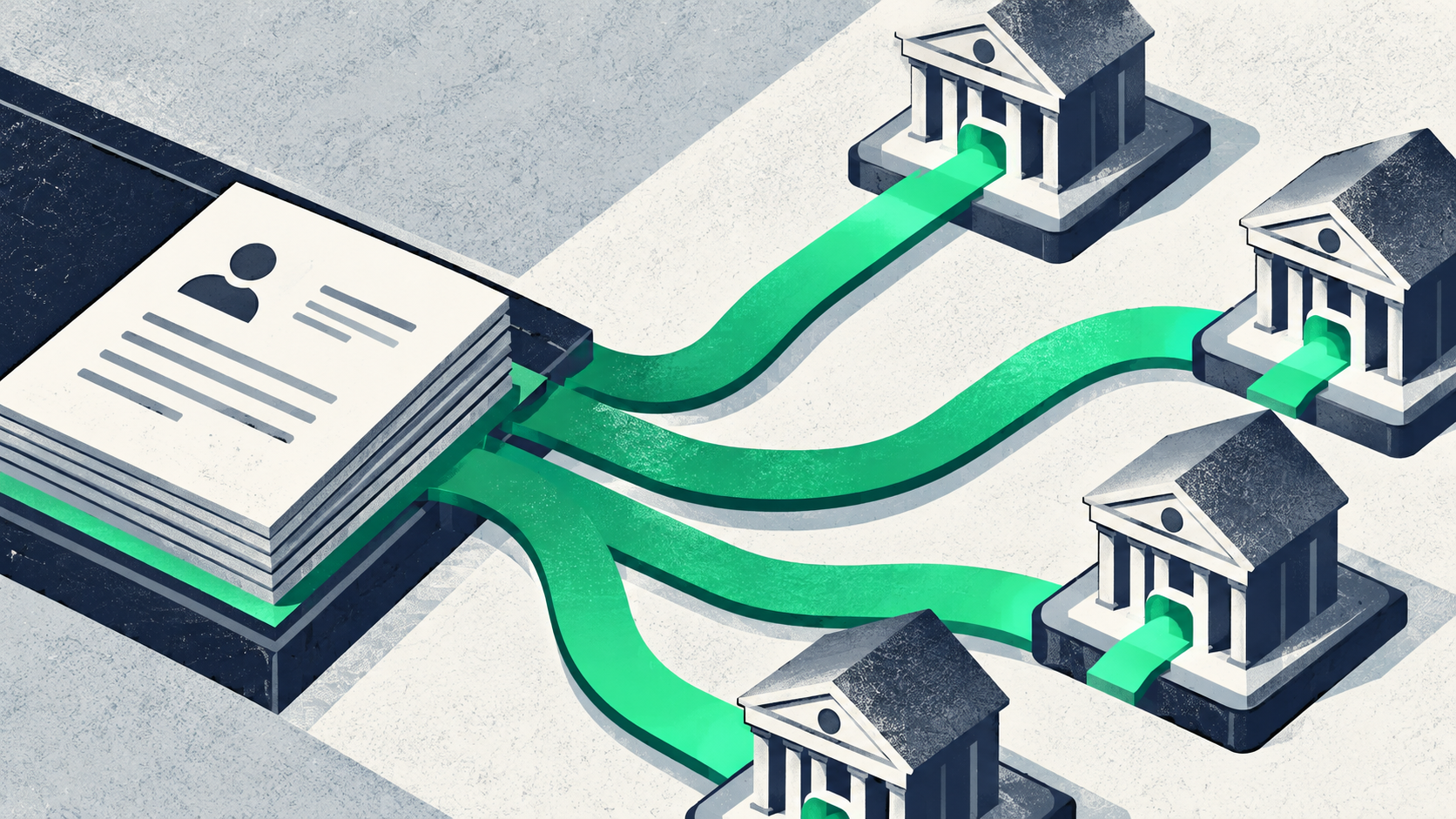
First, lenders pull information from multiple providers at once: credit bureaus, bank data aggregators, KYB services, and others. Orchestration platforms unify these requests into a single workflow, which eliminates the need to manage separate integrations for each data source.
Step 2. Enrich and standardize the data
Next, raw documents and API responses arrive in different formats. Data normalization converts everything into consistent fields that decisioning models can process. Document parsing extracts key values from PDFs, tax returns, and bank statements automatically, reducing manual data entry.
Step 3. Score risk with explainable models
After normalization, decisioning models generate risk scores from the aggregated data. Explainability matters here. Lenders want to understand why a particular score was assigned, both for compliance reasons and for handling borrower questions or appeals.
Step 4. Route decisions through automated workflows
Finally, approved applications move toward funding. Declines can trigger second-look logic, routing the deal to another lender with different risk criteria. Exception cases surface for human review. This routing ensures qualified borrowers don't fall through the cracks simply because they didn't fit one lender's specific box.
How lenders use SMB underwriting data to make smarter credit decisions
Data-driven underwriting changes what's possible. Here's how lenders apply underwriting signals in practice.
Approve more borrowers with thin files
Alternative data and cash flow analysis help lenders approve businesses that lack traditional credit history and cash flow analysis help lenders approve businesses that lack traditional credit history — according to Nova Credit's State of Alternative Data report, 90% of lenders say alternative data would help them approve more worthy borrowers. A company with strong daily deposits and consistent payment processor activity might qualify even without extensive tax documentation. This expands the pool of fundable borrowers without taking on excessive risk.
Catch fraud and stacking risk earlier
Stacking occurs when borrowers take multiple loans from different lenders simultaneously, often without disclosing existing obligations. Cross-referencing data sources surfaces this risk before funding. Lenders with visibility across multiple financing channels can spot stacking patterns that single-portfolio analysis misses entirely.
Build decline waterfalls and second-look routing
When one lender declines an application, the deal can automatically route to another lender with different criteria. This decline waterfall approach ensures deals aren't lost simply because they didn't fit one lender's parameters. The borrower gets another chance, and the originating platform captures value that would otherwise walk away.
Monitor borrower health after funding
Post-funding surveillance tracks cash flow, payment behavior, and early warning signals. Proactive monitoring helps lenders intervene before defaults occur, whether that means restructuring terms or reaching out to a borrower showing signs of distress.
Enforce credit policy consistently across underwriters
Automated decisioning removes analyst subjectivity. Every application gets evaluated against the same criteria, which improves audit readiness and reduces the compliance risk that comes with inconsistent human judgment.
Measurable outcomes of data-driven SMB underwriting
Lenders who operationalize underwriting data see concrete improvements across the lending lifecycle:
- Faster time-to-decision: Automated data flows eliminate manual bottlenecks
- Higher approval rates: Richer data unlocks creditworthy borrowers who would otherwise be declined
- Lower default rates: Better risk signals improve portfolio quality over time
- Reduced operational costs: Smaller teams can process higher volumes
- Improved audit readiness: Every decision is documented with supporting data
Common challenges with SMB underwriting data
Even with the right strategy, implementation comes with obstacles.
Fragmented data sources and silos
Juggling multiple vendor integrations creates maintenance overhead. When systems don't share information, analysts waste time reconciling conflicting data or manually transferring information between platforms.
Thin-file and incomplete borrower records
Many SMBs simply lack sufficient data for traditional scoring. Lenders either decline these borrowers or invest in alternative data strategies to fill gaps, which requires additional infrastructure and expertise.
Model drift and explainability gaps
Models degrade over time as market conditions change. A scoring model built during stable economic conditions might perform poorly during a downturn. Regulators also require lenders to explain adverse actions, which means opaque scoring creates compliance risk.
Integration and implementation overhead
Connecting data providers, maintaining APIs, and training teams on new systems takes time and resources. Platforms with pre-built connectors and low-code configuration reduce this burden, but the initial lift can still be significant.
What to look for in an SMB underwriting data platform
When evaluating infrastructure, lenders typically prioritize several capabilities:
- Breadth of data integrations: Access to credit bureaus, bank data, KYB, and alternative sources through a single connection
- Orchestration capabilities: Ability to pull from multiple sources in a unified workflow
- Configurable decisioning: Customizable rules and scoring models that match specific credit policies
- Explainability and compliance: Clear audit trails and adverse action support for regulatory requirements
- Speed to launch: Pre-built connectors and low-code configuration that reduce implementation timelines
- Ecosystem intelligence: Visibility beyond a single portfolio into broader SMB financing activity
Connect capital and decide smarter with Lendflow
Lendflow brings these capabilities together in an open-architecture platform built for embedded lending. Lendflow Intelligence handles decisioning, Lendflow Connect aggregates data across 75+ lenders and data providers, and Lendflow Automate orchestrates workflows from application through funding.
For lenders seeking ecosystem-level visibility, Lendflow's SMB Intelligence offering surfaces patterns across financing channels, including approval trends, stacking behavior, and repayment performance, that single-portfolio analysis can't reveal.
Book a demo to see how teams are using Lendflow to make smarter credit decisions with less operational overhead.
Frequently asked questions about SMB underwriting data
What does SMB mean in lending?
SMB stands for small and medium business. In lending, the term refers to financing products designed for businesses typically generating under a certain revenue threshold, distinct from enterprise or consumer lending.
What are the three types of underwriting?
The three primary types are manual underwriting, which relies on human-driven review; automated underwriting, which uses rules-based decisioning; and AI-driven underwriting, which employs machine learning models that adapt based on data patterns.
What are common red flags for SMB underwriters?
Red flags include negative cash flow trends, recent overdrafts, inconsistent revenue reporting, ownership discrepancies, and signs of loan stacking across multiple lenders.
Can embedded finance platforms share underwriting data with lenders?
Yes. Embedded finance platforms can pass borrower data to lenders through APIs, enabling lenders to underwrite deals originating from brand partners without requiring separate integrations.
How long does it take to launch automated SMB underwriting?
Implementation timelines vary, but platforms with pre-built connectors and configurable workflows can typically launch in weeks rather than months. Some widget-based deployments go live in under two weeks.