[.green-span]How to Optimize Your Underwriting Workflow for Maximum Speed and Accuracy[.green-span]

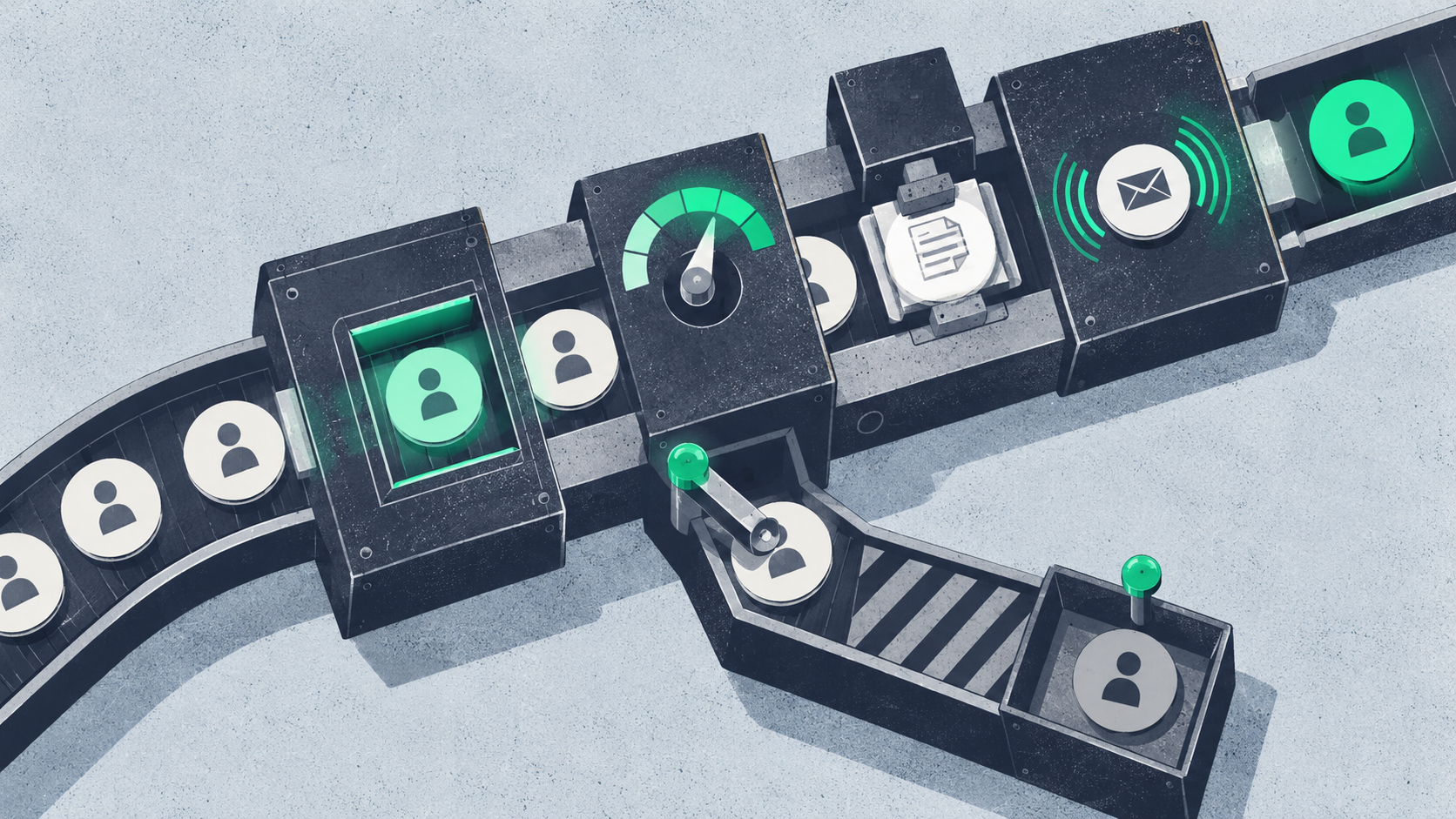
Optimizing these workflows means rethinking how data flows, where automation fits, and which steps actually require human judgment. This guide covers the bottlenecks that slow underwriting teams down, the automation strategies that compress time-to-decision, and the metrics that reveal whether your changes are working.
Why underwriting workflow optimization drives competitive advantage
Underwriting workflow optimization refers to the process of analyzing, refining, and automating how lending teams collect data, assess risk, and approve applications. The goal is straightforward: reduce manual effort, increase speed, and improve decision accuracy. When teams shift from document-heavy, manual methods to AI-driven digital workflows, they often see dramatic reductions in processing time and operational overhead.McKinsey estimates up to 80% efficiency gains in processing time and operational overhead.
Here's why this matters. Borrowers expect fast answers. The lender who delivers a decision first typically wins the deal, while teams still relying on scattered spreadsheets and email chains lose ground. The issue isn't poor credit judgment—it's a process that can't keep pace with borrower expectations.
Optimized workflows deliver three measurable advantages:
- Speed to funding: Faster decisions mean borrowers choose you over competitors still stuck in manual review cycles
- Operational efficiency: Smaller teams can handle larger volumes without sacrificing quality
- Risk accuracy: Better data flowing into decisions leads to better credit outcomes
Common bottlenecks that slow underwriting workflows
Before exploring solutions, it helps to identify what's actually causing delays. Most underwriting slowdowns trace back to a handful of recurring problems, and recognizing them is the first step toward fixing them.
Manual document collection and data entry
Chasing documents via email and manually entering data into systems creates both delays and errorsChasing documents via email and manually entering data into systems creates both delays and errors—56% of financial institutions cite manual data collection as their biggest lending challenge. Bank statements, tax returns, and IDs arrive in different formats, at different times, from different channels. Every manual touchpoint introduces lag and increases the chance of mistakes.
Think about it this way: if an underwriter spends 30 minutes per application just copying numbers from PDFs into a spreadsheet, that time adds up quickly across dozens or hundreds of applications.
Siloed systems and disconnected data
Data silos occur when information lives in separate systems that don't communicate with each other. Underwriters end up toggling between CRMs, spreadsheets, and lender portals, piecing together a complete picture of each applicant. This fragmentation slows decisions and increases the risk of missing critical signals buried in one system but invisible in another.
Inconsistent underwriting standards across teams
When different underwriters apply different criteria, outcomes become unpredictable. One reviewer might approve an application that another would decline. This inconsistency creates compliance risk and makes scaling difficult because there's no reliable baseline for what "approved" actually means.
Overwhelming application volumes
Volume spikes create backlogs when workflows depend on manual review. Without automation, every new application adds to the queue, and the queue only moves as fast as your team can click through each one.
Slow borrower communication and follow-up
Delays in requesting missing documents or updating applicants extend cycle times significantly. Borrowers left waiting often abandon applications entirely —roughly 68% of online applications never reach completion—or take their business to a competitor who responds faster.
Underwriting best practices to eliminate bottlenecks
Addressing the root causes of workflow friction requires a few foundational changes. None of these are complicated, but they do require intentional effort.
Standardize decisioning criteria across all applications
Documented, consistent underwriting guidelines remove subjective judgment from routine decisions. When everyone follows the same playbook, outcomes become predictable and auditable. This also makes training new team members much simpler because there's a clear reference point for how decisions get made.
Centralize data in a single platform
A unified view—one place where all applicant data, documents, and lender communications live—eliminates the toggling problem entirely. Platforms that aggregate data from multiple sources give underwriters everything they need without switching tabs or hunting through email threads.
Automate repetitive administrative tasks
Document requests, status updates, and data validation checks are prime candidates for automation. These tasks consume hours but add little value when done manually. Automating them frees underwriters to focus on actual credit analysis rather than administrative busywork.
How automated underwriting reduces time-to-decision
Automated underwriting uses technology to handle tasks previously done by hand. This is where speed gains compound because each automated step removes friction from the next step in the process.
Automated document extraction and validation
AI-powered tools pull structured data from PDFs, bank statements, and tax returns, eliminating manual data entry. What once took an underwriter 30 minutes can happen in seconds. Tools like Lendflow's Doc Analyzer extract and validate information automatically, flagging inconsistencies for human review only when necessary. Lendflow's Document Metadata and Validation checks documents at upload and notifies the applicant of issues on the spot. Reducing manual back-and-forth, improving the borrower experience, and saving countless hours for underwriters.
The key benefit here is consistency. Machines don't get tired or distracted, so extraction accuracy stays high even during volume spikes.
AI-powered industry classification
Accurate NAICS and SIC codes matter for risk assessment, but manual classification is tedious and error-prone. NAICS codes are standardized numerical codes that categorize businesses by industry type. Automation assigns these codes based on business descriptions and supporting documents, removing guesswork from the process.
Intelligent communication workflows
Automated outreach through email, SMS, or even voice keeps applications moving without manual intervention. When a document is missing, the system requests it. When a status changes, the borrower knows immediately. This kind of proactive communication prevents applications from stalling while waiting for someone to remember to send a follow-up email.
Accelerate decisioning with real-time data orchestration
Data orchestration connects multiple data providers through a single integration layer. Instead of managing separate vendor relationships for credit data, bank data, and business verification, teams pull everything through one connection.
Connecting disparate data sources instantly
Orchestration platforms let underwriters access credit bureaus, bank aggregators, and verification services in a single call. This eliminates the integration overhead that slows down traditional implementations where each data source requires its own setup and maintenance.
Building a unified data layer for credit signals
Live credit signals flowing into one system enable faster, more informed decisions. Rather than waiting on disconnected steps to complete sequentially, underwriters see a complete picture as data arrives in real time. This approach also reduces the risk of making decisions based on stale information.
AI-driven risk assessment for speed and accuracy
AI models evaluate risk faster than manual review while maintaining or improving accuracy. However, the value of AI in underwriting depends heavily on transparency.
Explainable risk scoring models
Explainability means understanding why a model made a particular decision. This matters for compliance and lender confidence because regulators and internal stakeholders want to know the reasoning behind approvals and declines. Transparent scoring provides clear rationale for each risk assessment rather than a black-box number that nobody can interpret.
Fraud detection and emerging risk signals
AI identifies patterns that humans often miss: inconsistent documents, unusual business characteristics, emerging risk factors. These signals surface automatically, allowing underwriters to focus attention where it matters most rather than reviewing every application with equal scrutiny.
Building automated workflows and decline waterfalls
Workflow automation in lending means rules-based systems that route applications automatically based on predefined criteria. Think of it as a decision tree that runs without human intervention for straightforward cases.
Preconfigured workflow templates for lending
Templates accelerate implementation because teams don't build from scratch. Drag-and-drop workflow builders let operations teams configure routing logic without engineering support, which means changes can happen quickly as business requirements evolve.
Second-look logic for declined applications
Decline waterfalls automatically route declined applications to alternative lenders. This captures revenue that would otherwise walk away. A borrower who doesn't qualify with one lender might be a perfect fit for another, and automated routing makes that handoff seamless.
How to improve borrower experience during underwriting
Workflow optimization isn't just about internal efficiency. It directly impacts how borrowers perceive your process and whether they complete their applications.
Simplifying the application process
Streamlined intake means fewer fields, smart forms, and embedded widgets that reduce friction. The less work borrowers do upfront, the more likely they are to finish the application. Long, complicated forms lead to abandonment.
Proactive status updates and automated outreach
Borrowers want visibility into where their application stands. Automated updates reduce inbound inquiries and build trust. When applicants know their status without having to call or email, they're less likely to shop around while waiting for a response.
Key underwriting KPIs to track performance
Optimization requires measurement. Without tracking the right metrics, it's impossible to know whether workflow changes are actually working.
Time-to-decision benchmarks
For SMB lending, traditional underwriting can take days or weeks. Optimized workflows with automation and real-time data orchestration compress this timeline significantly, sometimes to hours or minutes depending on the complexity of the application.
Conversion and approval rate tracking
Tracking conversion reveals where applications drop off in the process. A high approval rate combined with low funding suggests friction late in the process, perhaps during document collection or final verification steps.
Operational cost per application
This metric reveals true efficiency gains from automation. As volume grows, cost per application indicates whether you're scaling efficiently or simply adding headcount to keep up with demand.
Scale underwriting volume without growing your team
Handling more applications with the same team size is the ultimate outcome of workflow optimization. Teams using automated workflows and data orchestration can process significantly higher volumes without proportional increases in headcount.
- Document handling: Automated extraction replaces manual review, freeing underwriters for higher-value work
- Communication: AI-powered outreach handles routine follow-up without human intervention
- Decision support: Intelligent workflows route applications automatically, eliminating manual triage
Ready to see how workflow optimization works in practice? Book a demo to explore how Lendflow's automation capabilities help lending teams move faster without adding overhead.
FAQs about underwriting workflow optimization
What is an example of underwriting workflow optimization?
A common example is replacing manual document collection with automated extraction tools that pull data directly from bank statements and tax returns. This change alone can reduce review time from hours to minutes per application.
What are the four types of underwriting?
The four main types are loan underwriting (mortgages, personal loans, SMB financing), insurance underwriting, securities underwriting (IPOs, bond issuances), and forensic underwriting (fraud investigation and claims review).
What are common red flags for underwriters?
Red flags include inconsistent information across documents, unusually high debt-to-income ratios, recent significant changes in business revenue, and discrepancies between stated income and bank deposits.
How long does the underwriting process take for SMB loans?
Traditional SMB loan underwriting can take days or weeks. Optimized workflows with automation and real-time data orchestration can reduce time-to-decision to hours or minutes, depending on application complexity.
What is the difference between automated and manual underwriting?
Manual underwriting relies on human reviewers to evaluate documents and make credit decisions. Automated underwriting uses rules-based systems and AI to process applications with minimal human intervention, reserving manual review for edge cases that fall outside standard parameters.