[.green-span]Can data aggregation replace manual review in lending?[.green-span]
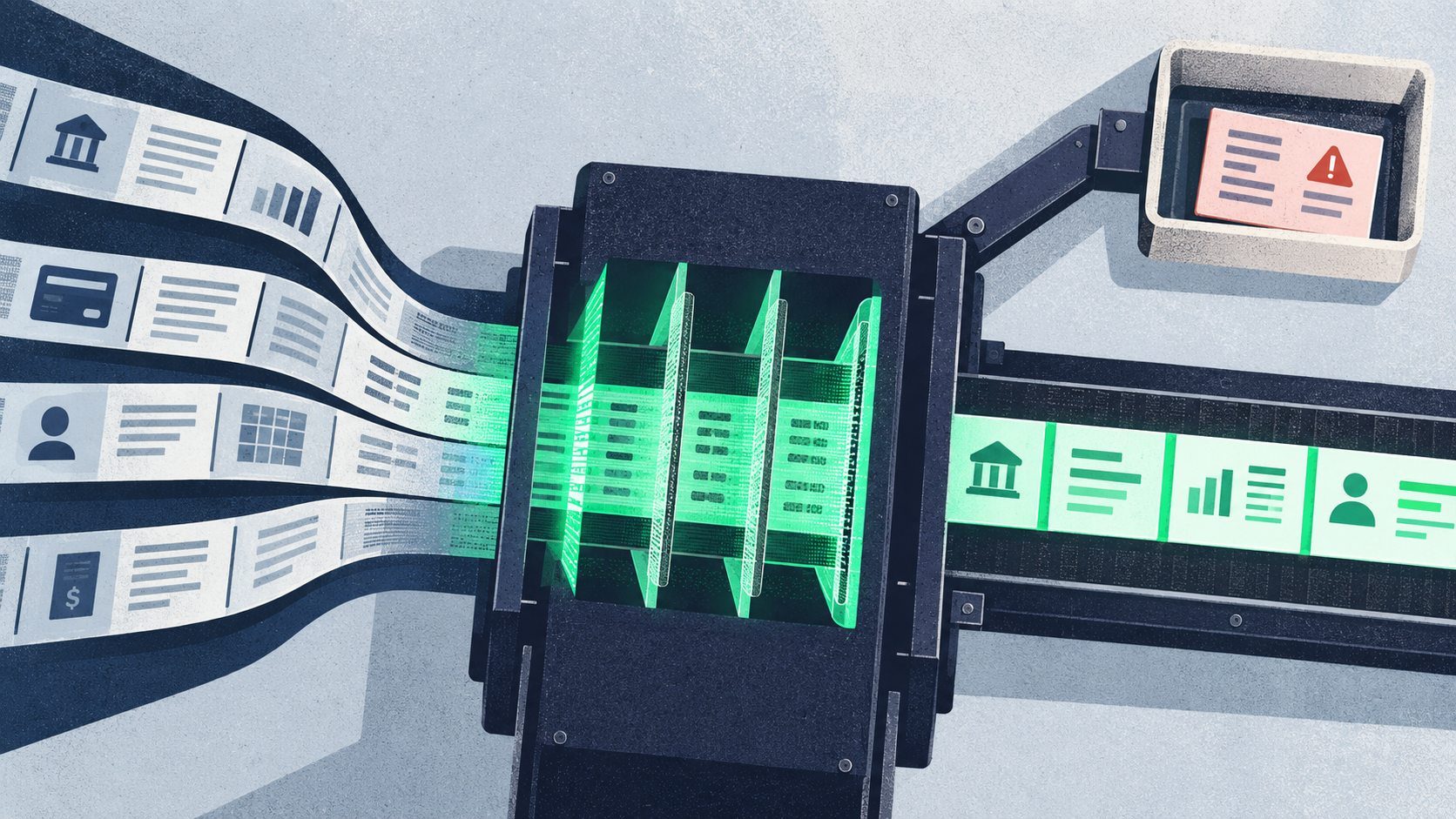
Mostly yes for routine work, but not entirely. Data aggregation and automation can replace much of the high-volume, rule-definable review that slows lending teams down: pulling bank data, extracting documents, verifying identity, and clearing low-stakes applications against clear rules. What they cannot replace is human judgment for ambiguous, high-consequence, or compliance-sensitive credit decisions. The honest answer is not automation versus people. It is risk-based routing, a hybrid model where machines handle volume and humans handle judgment. This article explains what aggregation automates, what manual review still means, and a practical framework for deciding what to automate and what to route to a person.
What data aggregation automates and what manual review still means
Start with where the time actually goes. In commercial underwriting, Accenture's longitudinal P&C survey found underwriters spend about 40% of their time on administrative work and only 30% on actual underwriting. That admin load is exactly what aggregation targets: gathering, normalizing, and validating data instead of analyzing it.
The cost case is real where it has been measured. In residential mortgage, Freddie Mac reports lenders that maximize automation originate loans about 14% ($1,500) cheaper with a five-day shorter cycle, and a fully digitized process can save up to 40% in costs. That figure is mortgage-specific, but the direction holds across lending: less manual handling means faster, cheaper origination.
What aggregation can replace
Data aggregation replaces the repetitive, structured parts of review:
- Data collection across sources: bank transactions, tax returns, IDs, accounting systems, and credit bureaus, pulled and normalized automatically.
- Document extraction: parsing PDFs, bank statements, and tax files into structured fields instead of manual keying.
- Rule-based screening: clearing or flagging applications against defined thresholds for low-stakes, high-volume cases.
- Signal enrichment: adding cash-flow and business signals that a human would otherwise assemble by hand.
Better data also improves the decision itself. FinRegLab found that cash-flow data from bank accounts predicts small-business loan performance more accurately than personal credit scores alone, especially for new or credit-constrained businesses. Aggregation is not just faster. It can be a more accurate foundation for underwriting.
That accuracy gain widens access, too. A National Bureau of Economic Research working paper found a cash-flow-intensive lender raised approval odds for entrepreneurs under 40 by 2.4 percentage points, roughly 12% of the mean, concentrated among low-FICO applicants. For SMB and embedded finance teams, richer aggregated data can open segments that traditional scores miss, without loosening standards.
What manual review still means
Manual review is human judgment applied where rules run out. It covers ambiguous files with conflicting signals, high-consequence exposures, exceptions and overrides, and any decision where a regulator will expect a defensible rationale. In corporate bank credit, McKinsey reports agentic AI can create a 40 to 80% productivity uplift per use case, and one institution cut financial-risk analysis time by 50%, yet leaders keep humans in the loop to preserve regulatory trust. The productivity gain and the human oversight are not in tension. They are the design.
The reviewer's role shifts rather than disappears. Instead of keying data and chasing documents, the human focuses on interpretation: weighing conflicting signals, judging whether an exception is warranted, and standing behind the rationale. Aggregation frees that capacity by clearing the routine work first, so scarce judgment goes to the files that actually need it.
Where Lendflow fits
Lendflow structures this hybrid across three layers. Lendflow Connect handles data aggregation and orchestration, linking brands to a network of 75+ lenders through a single, SOC 2 Type II integration. Lendflow Intelligence turns that data into decisions, delivering 35% operational cost savings, a 60% application conversion lift, and 85% faster time-to-decision. Lendflow Automate runs AI agents across the workflow, including Doc Analyzer for document extraction and the Trust Score, an explainable composite risk score, driving 80% faster document review and 65% faster time-to-decision.
The layering is the point. Connect removes the manual gathering, Intelligence applies consistent rules to clear routine files, and Automate handles extraction and scoring at volume. Ambiguous and high-consequence cases still surface to a reviewer, now with clean data and a transparent rationale already attached. The goal is not to remove people. It is to route routine work to machines and reserve human judgment for the decisions that need it.
A framework for deciding what to automate and what to route
Use this six-step process to draw the line between automated and manual review with intent, not by default.
1. Map review tasks by risk and rule-definability
List every task in your review workflow. Score each one on two axes: how high the consequence is if it goes wrong, and how clearly it can be defined as a rule. Low-risk, rule-definable tasks are automation candidates. High-consequence or judgment-heavy tasks stay with people. This map is the foundation for every decision that follows.
2. Automate data aggregation across sources
Consolidate collection first, because it is the largest, safest win. Pull bank data, tax documents, IDs, and business records automatically and normalize them into a single structured view. Lendflow Connect orchestrates these sources through one integration, which removes the fragmented, manual gathering that consumes underwriter time before any judgment happens.
3. Set automated decision rules for low-stakes, high-volume cases
For applications that sit clearly inside your risk appetite, let defined rules and models decide. These are the high-volume, low-ambiguity files where speed matters most and human review adds little. This is where demand is heading: the Federal Reserve's Small Business Credit Survey found small employer applicants seeking financing from online fintech lenders rose from 17% in 2020 to 29% in 2025, and that volume needs automated throughput.
4. Route ambiguous, high-consequence, and compliance-sensitive cases to humans
Build explicit routing rules that send the right files to people. Send conflicting-signal files, large exposures, thin-file or edge cases, and any decision with regulatory weight to a qualified reviewer. Automation should flag these confidently and hand them off with context, not force a decision it cannot defend.
5. Keep explainability and audit trails end to end
Every automated decision needs a reason a human can read and a record a regulator can review. Use decisioning that produces clear rationale, not opaque scores. The Trust Score is designed as an explainable composite, so a decline carries a traceable basis rather than a black-box output. Log inputs, rules, model versions, and outcomes at every step.
6. Monitor and refine continuously
Treat the automated/manual line as a living boundary. Track approval rates, override frequency, model drift, and outcome performance. When automation consistently gets a case type right, expand its scope. When human overrides cluster around a pattern, tighten the rules or pull that case type back to review. Refine on evidence, not assumption.
Best practices and common pitfalls
Lead with explainability, because compliance depends on it. Under CFPB Circular 2022-03, ECOA and Regulation B require creditors to give specific and accurate principal reasons for adverse action even when decisions rely on complex algorithms, and model opacity is no excuse. If your automation cannot produce a defensible reason for a decline, it is not ready to make that decision alone.
Monitor models continuously. Data shifts, borrower populations change, and a model that performed last quarter can drift. Set thresholds for review and revalidate on a schedule rather than waiting for outcomes to degrade.
Build fraud and data-quality checks into aggregation. More data sources mean more surface area for bad inputs. TransUnion reports U.S. lenders faced more than $3.3 billion in synthetic identity fraud exposure for the year ending 2024. Aggregation improves data quality and adds verification signals, but it does not eliminate fraud risk, so keep detection layered and active.
Do not automate away accountability. A named human owner should be responsible for every decision path, automated or not. Automation changes who does the routine work. It does not change who answers for the outcome.
Start narrow and expand on evidence. Automate one well-defined, high-volume task, prove it against outcomes, then extend scope. This protects performance and builds internal trust faster than a wholesale switch. Lendflow's embedded customers run with 80% smaller teams while converting similar volume, and that leverage comes from routing routine work to automation, not from removing oversight.
Avoid these common pitfalls:
- Automating high-consequence decisions before you can explain them.
- Treating aggregated data as clean without validation and fraud checks.
- Setting rules once and never revisiting override patterns or drift.
- Removing human reviewers entirely to cut headcount, then failing an adverse-action requirement.
So, can data aggregation replace manual review? It can replace most of the routine, high-volume, rule-definable work, and it should. Aggregation and automation collect data, extract documents, verify identity, and clear low-stakes applications faster and often more accurately than manual handling. What they cannot replace is human judgment for ambiguous, high-consequence, and compliance-sensitive decisions, where regulators expect a defensible rationale. The winning model is risk-based routing: automate the volume, reserve people for the judgment, and keep explainability and audit trails throughout. Lendflow is built for exactly this hybrid, connecting data, decisioning, and AI agents while keeping decisions transparent and accountable.
FAQs
Should you enable data aggregation?
Yes, in almost every case. Aggregation removes the manual data gathering that consumes most review time and gives you a cleaner, more complete foundation for decisions. Cash-flow data in particular can improve accuracy for small-business lending, especially for newer or credit-constrained borrowers.
Can AI replace human reviewers completely?
No, not for credit decisions. AI can handle high-volume, rule-definable review and dramatically cut cycle time, but ambiguous, high-consequence, and compliance-sensitive cases still require human judgment. Leading institutions deliberately keep humans in the loop to preserve regulatory trust.
How do you decide between manual and automated review?
Map each task by risk and rule-definability. Automate low-stakes, high-volume, clearly defined work. Route ambiguous, high-exposure, and regulation-sensitive cases to qualified reviewers. Then monitor override patterns and outcomes, and adjust the boundary as evidence accumulates.
What are the compliance limits on automation?
You must be able to explain every decision. ECOA and Regulation B require specific, accurate principal reasons for adverse action even when complex algorithms drive the decision, and opacity is not a defense. Use explainable decisioning and keep full audit trails.
How does automation improve data quality?
Automated aggregation normalizes data across sources, reduces manual keying errors, and adds verification and enrichment signals in real time. That produces a more consistent, complete basis for underwriting. It strengthens fraud detection, but it does not eliminate fraud risk, so keep verification layered.