[.green-span]A Practical Guide to Automated Credit Decisioning[.green-span]
The difference between manual and automated decisioning shows up in speed, consistency, and the ability to scale without proportionally growing headcount. This guide covers how the credit decisioning process works, what components make up a modern decisioning platform, and how to evaluate solutions that fit your lending or embedded finance goals.
What Is Automated Credit Decisioning
Credit decisioning is the process lenders use to evaluate a borrower's creditworthiness. It aggregates financial data and behavioral metrics to determine whether to approve a loan, set interest rates, and establish borrowing limits while actively managing risk. When this process is automated, technology takes over—using pre-defined rules, scoring models, and real-time data to evaluate applications without manual intervention.
Think of it as the difference between a loan officer reviewing a stack of paperwork over several days versus a system that pulls the same information, runs it through decision logic, and returns an answer in seconds.
The core function breaks down into three parts:
- Creditworthiness evaluation: Assessing the likelihood that a borrower will repay based on historical and current financial behavior.
- Data aggregation: Pulling together credit bureau reports, bank statements, income verification, and business financials into a unified view.
- Decision output: Generating an approval, denial, or conditional offer along with pricing and terms
Why Automated Credit Decisioning Matters for Modern Lenders
Lenders operating with automated decisioning consistently outperform those relying on manual processes. The gap shows up in three areas: speed, consistency, and the ability to handle more volume without hiring proportionally more people.
On speed, automated systems deliver answers in seconds or minutes. Manual review often takes days, which creates friction for borrowers who may simply go elsewhere who may simply go elsewhere. The Federal Reserve's 2025 Small Business Credit Survey confirms this shift, with 29% of applicants seeking online lenders for faster decisions. Consistency improves because standardized rules engines apply the same criteria to every applicant, reducing variability between underwriters and supporting regulatory compliance.
Perhaps most importantly, decisioning doesn't stop at approval. Automated platforms can monitor borrower behavior over time and adjust credit limits or terms as conditions change—something that's nearly impossible to do manually at scale.
How the Credit Decisioning Process Works
Modern credit decisioning relies on technology-led orchestration and predictive analytics. The process follows a sequential workflow from application intake through funding and ongoing servicing. Each step builds on the previous one.
Step 1. Data Collection and Aggregation
The process begins with data ingestion. The system pulls applicant details from multiple sources into a single view, typically including credit bureau reports, income verification, debt-to-income ratios, and cash flow history.
For SMB lending, the underwriting data set expands to include bank statements, tax returns, and business financials. The goal is to build a complete picture without requiring the borrower to submit documents manually across multiple disconnected systems.
Step 2. Risk Scoring and Assessment
Next, risk scoring models calculate the probability of default (PD)—a metric representing the likelihood that a borrower will fail to repay within a given timeframe. PD is calculated using standardized algorithms that weigh factors like payment history, credit utilization, and time in business.
The output is a numerical score that feeds into the next stage of evaluation. Higher scores typically indicate lower risk, though the specific thresholds vary by lender and product type.
Step 3. Policy and Rules Evaluation
The calculated risk score then passes through predefined institutional rules. These rules determine approval, rejection, or required risk mitigation based on the lender's risk appetite and product parameters.
Policy engines are configurable. Lenders can adjust thresholds, add exceptions, or create tiered pricing without rewriting code. This flexibility allows teams to respond to market conditions or portfolio performance without waiting on engineering cycles.
Step 4. Approval, Decline, or Waterfall Routing
Workflow orchestration automatically routes straightforward applications for immediate approval while flagging complex or borderline cases for manual underwriting. This keeps human reviewers focused on decisions that actually require judgment.
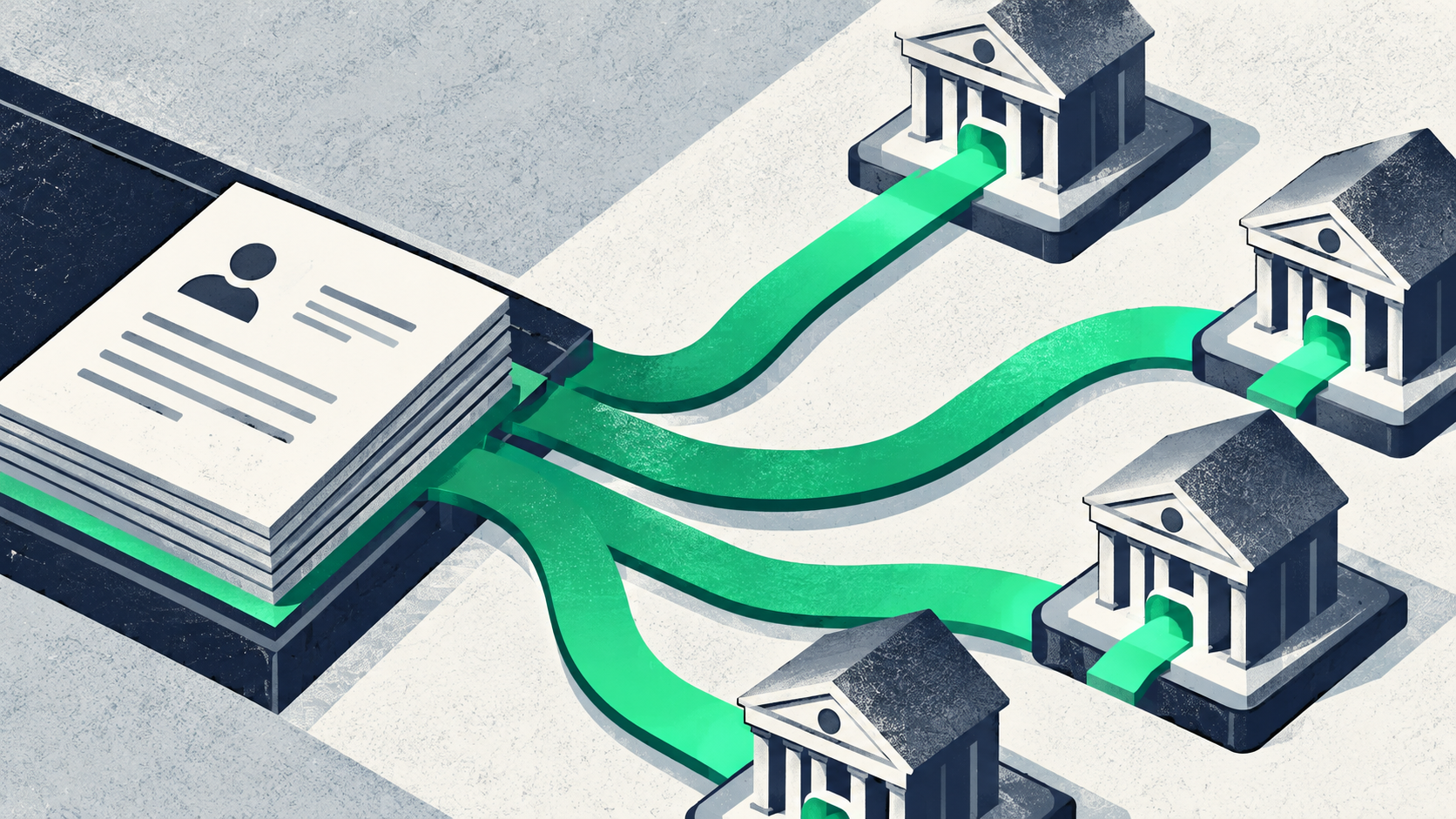
Decline waterfalls take this further. Instead of simply rejecting an application, the system routes declined applicants to alternative lenders or products that may be a better fit. This approach ensures that deals aren't lost entirely when they don't match the first lender's criteria.
Step 5. Continuous Monitoring and Servicing
Decisioning doesn't end at approval. Systems evaluate factors dynamically over the customer's lifecycle, adjusting credit limits or terms based on shifting behavioral or macroeconomic signals.
This ongoing monitoring helps lenders manage portfolio risk proactively. Rather than reacting after problems emerge, teams can identify early warning signs and take action before losses materialize.
The 5 Cs of Credit Decisioning
The 5 Cs represent the most widely known framework for evaluating creditworthiness. Whether assessed manually or through automated systems, these factors form the foundation of lending decisions.
Character
Character reflects the borrower's reputation and track record. This includes credit history, payment behavior, and references. It answers a simple question: has this borrower demonstrated reliability in the past?
Capacity
Capacity measures the borrower's ability to repay. Lenders look at income, cash flow, and debt-to-income ratio to determine whether the borrower can handle the proposed payment alongside existing obligations.
Capital
Capital refers to the borrower's own investment or equity stake. A borrower with skin in the game presents lower risk because they have something to lose if the venture fails.
Collateral
Collateral includes assets pledged to secure the loan. If the borrower defaults, the lender can recover value from these assets. Equipment, real estate, and receivables commonly serve this purpose in SMB lending.
Conditions
Conditions encompass external factors like loan purpose, industry conditions, and the broader economic environment. A strong borrower in a declining industry may still present elevated risk due to circumstances outside their control.With credit losses projected at $655 billion for 2026, a strong borrower in a declining industry may still present elevated risk due to circumstances outside their control.
Limitations of Manual Credit Decisioning
Manual processes create bottlenecks that compound as volume grows. The pain points are predictable and tend to get worse over time.
- Slow processing times: Applications sit in queues while underwriters work through backlogs. Borrowers lose patience, and conversion rates suffer.
- Inconsistent underwriting: Different reviewers apply different standards, creating compliance risk and unpredictable outcomes for similar applicants.
- Scaling constraints: Adding volume means adding headcount. Operational costs grow linearly with loan production.
- Compliance gaps: Undocumented decisions are difficult to audit. Regulators expect clear records of how each decision was made and why.
Key Components of an Automated Credit Decisioning Platform
A credit decisioning platform combines multiple layers working together. Understanding the architecture helps teams evaluate solutions and identify gaps in their current stack.
Data Orchestration Layer
The data orchestration layer serves as the integration hub. It connects to credit bureaus, bank data providers, and document sources through a single endpoint. Pre-built connectors and APIs eliminate the complexity of managing dozens of individual integrations.
Without this layer, teams often end up with fragmented systems and data silos that slow down decisioning and create reconciliation headaches.
Configurable Risk Models
Risk models can be tuned to the lender's risk appetite and product type. Term loans, MCAs, invoice factoring, and equipment financing each require different parameters and weighting.
The key is configurability without heavy engineering. Product teams can adjust models based on portfolio performance without waiting months for development cycles.
Policy and Decision Engine
The rules engine is where lenders define approval criteria, pricing tiers, and exception handling. Modern platforms allow rules to be updated without code changes, which means product teams can iterate quickly as market conditions shift.
Workflow Automation and AI Agents
Automation handles document extraction, industry classification, borrower communications, and stipulation tracking. AI agents function as specialized tools for specific tasks—analyzing bank statements, classifying NAICS codes, or generating explainable risk scores.
Lendflow's Doc Analyzer and Trust Score agents, for example, can reduce document review time significantly while providing transparent scoring that supports compliance requirements.
Monitoring, Reporting, and Analytics
Dashboards, alerts, and analytics provide visibility into portfolio performance, approval rates, and decisioning trends over time. This layer turns operational data into strategic insight that informs both credit policy and business decisions.
How Real-Time Data and AI Power Credit Decisioning
The shift from batch processing to real-time decisioning changes what's possible. Live data and AI enable decisions in minutes rather than days.
Real-time pulls from credit bureaus and bank data providers ensure decisions reflect current conditions, not stale snapshots from weeks ago. AI document analysis extracts structured data from PDFs, tax returns, and bank files, reducing the manual review burden on operations teams.
Predictive models adapt as new data flows in, improving accuracy over time and catching patterns that human reviewers might miss. The combination of live data and learning algorithms creates a decisioning system that gets better with volume rather than worse.
How Automated Credit Decisioning Reduces Fraud and Bad Debt
Fraud protection is a critical function of automated decisioning. Systems apply identity verification, anomaly detection, and financing stacking analysis consistently across every application.
Manual processes struggle to catch sophisticated fraud patterns, especially when fraudsters submit applications across multiple lenders simultaneously. Automated platforms flag inconsistencies—like multiple applications across lenders or mismatched business data—before funding occurs.
Lendflow's SMB Intelligence offering provides ecosystem-level visibility into financing activity, helping lenders identify stacking behavior and fraud indicators that wouldn't be visible within a single portfolio.
How to Choose a Credit Decisioning Platform
Selecting the right platform depends on your team's priorities and existing infrastructure. A few criteria help narrow the field.
Speed to Implementation
Fast deployment matters, especially for teams that want to test embedded lending without committing to a multi-month build. Look for plug-and-play tools like widgets and landing pages that launch in days, plus full API integrations that complete in weeks rather than quarters.
Open Architecture and Integrations
The ability to connect to multiple data providers, lenders, and existing systems through a single integration reduces complexity. Open architecture avoids vendor lock-in and makes it easier to add new data sources or lender relationships over time.
Explainability and Compliance
Decisioning has to be auditable and explainable for regulatory compliance. Adverse action notices and fair lending requirements demand clear documentation of how each decision was made. Look for platforms that provide transparent scoring and audit trails.
Embedded and White-Label Capabilities
BrandsWith Bain & Company projecting embedded finance to exceed $7 trillion in US transactions by 2026, brands and platforms offering financing natively benefit from branded borrower experiences and flexible go-to-market modes. Options typically include referral, co-brand, or full white-label configurations depending on how deeply the financing experience integrates with the core product.
Proven Outcomes and ROI
Measurable results matter more than feature lists. Look for platforms with documented proof points around faster funding, higher approval rates, and lower operational costs.
Measurable Outcomes From Automated Credit Decisioning
Platforms built for automation deliver measurable improvements. Lendflow customers have generated $1.5B+ in offers on the platform, with pre-qualified offers driving 42% faster speed to funding. Embedded finance customers operate with 80% smaller teams while converting similar funding volumes.
<table>
  <thead>
    <tr>
      <th>Metric</th>
      <th>Manual Process</th>
      <th>Automated Decisioning</th>
    </tr>
  </thead>
  <tbody>
    <tr>
      <td>Time to decision</td>
      <td>Days</td>
      <td>Minutes</td>
    </tr>
    <tr>
      <td>Team size required</td>
      <td>Large</td>
      <td>Lean</td>
    </tr>
    <tr>
      <td>Consistency</td>
      <td>Variable</td>
      <td>Standardized</td>
    </tr>
    <tr>
      <td>Scalability</td>
      <td>Limited</td>
      <td>High volume ready</td>
    </tr>
  </tbody>
</table>
Launch Automated Credit Decisioning With Lendflow
Lendflow brings together data orchestration, AI-powered decisioning, and workflow automation in a single platform. Lendflow Intelligence serves as the decisioning brain, transforming raw data into lending decisions that move from days to minutes.
The platform supports term loans, MCAs, invoice factoring, equipment financing, SBA loans, and lines of credit. Implementation timelines range from under two weeks for widgets to 30–45 days for full API integration.
Lendflow is recognized as a Best Embedded Lending Solution (Banking Tech Awards 2026), winner of Best Overall Embedded Finance Platform (Tearsheet Big Bank Theory Awards 2025).
Book a demo to see how Lendflow can help your team scale smarter.
Frequently Asked Questions About Credit Decisioning
What is the difference between credit decisioning and credit scoring?
Credit scoring generates a numerical score representing risk. Credit decisioning is the broader process that uses that score alongside other data and rules to make an approval or denial decision. Scoring is one input; decisioning is the complete workflow.
What is EAD vs PD vs LGD in credit risk?
PD (Probability of Default) estimates the likelihood of non-payment. LGD (Loss Given Default) estimates the percentage lost if default occurs. EAD (Exposure at Default) estimates the total amount at risk. All three are core credit risk parameters used in portfolio management and regulatory capital calculations.
How long does it take to implement an automated credit decisioning platform?
Implementation timelines vary by complexity. Plug-and-play widgets can launch in under two weeks. Full API integrations typically take 30–45 days depending on configuration requirements and the number of data sources involved.
Is automated credit decisioning explainable for regulatory compliance?
Yes. Modern platforms provide explainable risk scores and audit trails that document how each decision was made. This documentation supports fair lending requirements and adverse action disclosures.
Can embedded finance platforms offer credit decisioning without becoming a lender?
Yes. Platforms can embed credit decisioning by connecting to a network of lenders through orchestration tools. This approach enables financing experiences without holding loans on the platform's own balance sheet.