[.green-span]Who Provides Financial Data APIs for Lenders? A Provider Guide[.green-span]
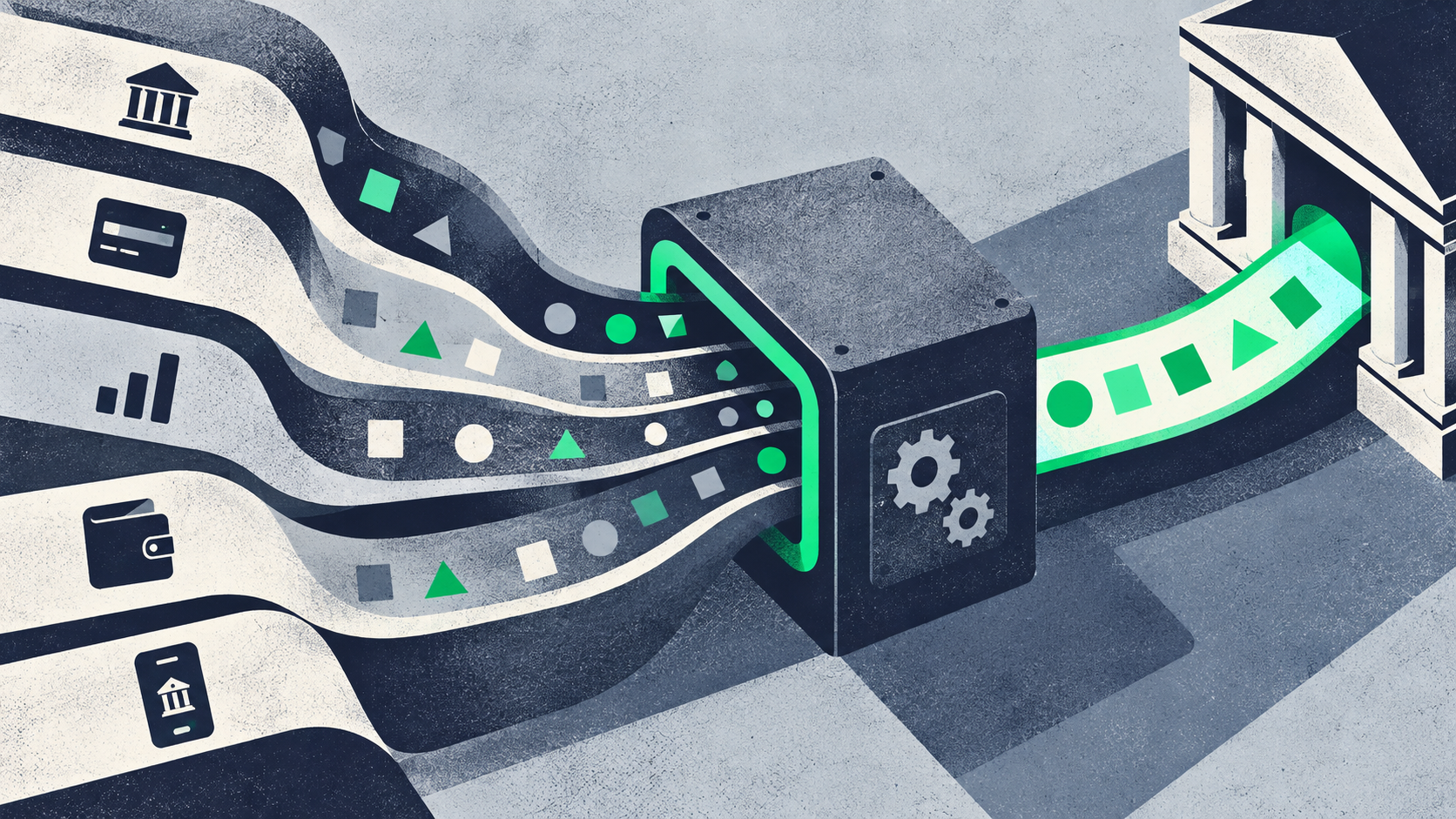
Financial data APIs for lenders come from five groups: open banking aggregators and networks, credit bureaus, cash-flow analytics firms, verification providers, and accounting data platforms. Examples include Plaid, MX, Akoya, Experian, Equifax, TransUnion, Dun & Bradstreet, Ocrolus, Argyle, Pinwheel, Middesk, Codat, and FIS Accounting Data as a Service. Orchestration platforms like Lendflow connect many of these sources through one integration.
So when someone asks who provides financial data APIs for lenders, the honest answer is that no single company covers every type of data. Most lenders combine several providers, and the right mix depends on the loans they make and the borrowers they serve.
An API, or application programming interface, is a set of rules that lets one software system request data from another. In lending, a finance API lets a loan application pull a borrower's bank, credit, or business data automatically, with the right permission in place.
This guide maps each provider group, explains open banking and its rules, and closes with a framework for choosing providers. For a deeper look at how pulled data feeds credit decisions, read our guide to financial data aggregation for underwriting.
How Open Banking Replaced Screen Scraping
Open banking is the practice of letting people and businesses share their bank data with outside companies through secure, permissioned connections. It is the foundation for most of the APIs in finance that lenders use today.
Before APIs became common, many apps relied on screen scraping. With screen scraping, the borrower handed over a bank username and password so the app could log in and copy data from the bank's website. This method worked, but the third party held the borrower's login details, and the connection often broke whenever a bank redesigned its site.
Consumer-permissioned APIs solve both problems. The borrower approves access on the bank's own screen, and the bank issues a token. A token is a digital key that grants limited access without sharing a password, and the borrower can revoke it later.
The Financial Data Exchange (FDX) is an industry group that publishes a common technical standard for these APIs. A shared standard means lenders and aggregators can connect to many banks in the same way instead of building a custom link for each one.
The Consumer Financial Protection Bureau (CFPB) is the federal agency that oversees consumer financial products. The CFPB reconsideration notice states the Bureau estimated "more than 100 million consumers have used consumer-authorized data access" in the U.S. as of 2024. That notice also revisits the Section 1033 open banking rule, which the CFPB published in November 2024.
In April 2025, the FDX adoption report said "roughly 114 million customer connections are now happening through APIs aligned to the FDX standard." That figure is self-reported by FDX members in the U.S. and Canada, and it counts connections rather than individual people. The CFPB and FDX numbers measure different things, so they should not be compared directly.
The Main Types of Financial Data API Providers
Most lenders need more than one type of data to make a sound credit decision. Bank data shows how money moves, and credit data shows how a borrower has repaid in the past. Verification data confirms the borrower is who they claim to be.
The table below maps the main financial services APIs by category, the data each returns, and where each one fits in the lending process.
Open Banking and Account Aggregation APIs
A data aggregator is a company that connects to many banks and credit unions and returns their account data through a single API. Lenders use aggregators to see balances and transaction history and to confirm the account where loan funds will be sent.
Plaid offers Plaid Link, a tool that connects customers' financial accounts to an app or service. MX provides APIs for consumer-permissioned data access and account aggregation.
Mastercard Open Finance supports financial data sharing for consumer and small business applications through Finicity, a Mastercard company. Akoya works differently, as a data access network that connects financial institutions to fintechs and aggregators through permissioned APIs.
Account aggregation also powers instant account verification, which confirms in seconds that a borrower owns a bank account. This replaces the older test of sending small deposits and waiting days for the borrower to confirm the amounts. Bank data is most useful when paired with credit history, which is why many teams start by combining Plaid and bureau data.
Credit Bureau and Business Credit APIs
A credit bureau is a company that collects payment history from lenders and sells credit reports and scores. Experian offers consumer and commercial credit data APIs through its developer portal. Equifax offers commercial APIs for business credit scoring, reporting, and verification.
TransUnion provides consumer credit information that lenders use to evaluate credit capacity and financial behavior. Dun & Bradstreet offers verified business data built around its D-U-N-S Number, a persistent business identifier.
Consumer reports are governed by the Fair Credit Reporting Act (FCRA), which you can read in the FTC Fair Credit Reporting Act text. Our guide to credit data APIs explains how these integrations work in more detail.
Cash-Flow and Document Analysis APIs
Cash-flow underwriting means judging a borrower's ability to repay by studying the money that moves in and out of their accounts. It adds a view of current financial health that a credit report alone may not show.
Ocrolus is one example, with automated bank statement analysis that surfaces structured cash-flow insights. This helps when borrowers upload statements instead of linking accounts.
This data matters most for thin-file borrowers, meaning people or businesses with little credit history. A credit-invisible consumer has no credit record at a nationwide bureau at all. The CFPB credit invisibles correction states: "The estimated share of credit invisibles in December 2020 was 2.7 percent (7.0 million consumers)."
The same CFPB report places about 9.8% of adults in an unscored group, though that share depends on the scoring model used. For small businesses, the FinRegLab cash-flow underwriting study found: "Models that added cash-flow variables ... predicted default risk more accurately across all borrower segments analyzed." The study covered more than 38,000 loans from two fintech lenders and measured how well models predicted risk, rather than approval rates.
Income, Employment, and KYB Verification APIs
Income and employment APIs connect to payroll systems, with the borrower's consent, to confirm what a person earns and where they work. Argyle offers an API for direct-source payroll and employment data. Pinwheel offers Pinwheel Verify, an API for income and employment verification pulled from payroll providers.
KYB, short for Know Your Business, is the process of confirming a business is legally registered, active, and owned by the people who claim it. Middesk offers a KYB API that confirms business identity and screens against sanctions lists.
No single KYB source has a record for every business, especially for new or very small companies. Lendflow's KYB waterfall verification, called Trust Score, checks a business against several sources in order, so one provider's gap does not stop the review.
Accounting Data APIs for Small Business Lending
Accounting data APIs connect to the bookkeeping software a small business already uses. They let lenders read a profit and loss statement, which shows revenue and expenses. They also show receivables, which is money that customers still owe the business.
Codat offers a Lending API that connects to borrowers' accounting, banking, and commerce platforms. FIS Accounting Data as a Service, formerly Railz, is a financial data API for pulling data from accounting systems.
This financial API integration is especially helpful for invoice factoring and lines of credit, where a lender needs to see unpaid invoices. For many small business loans, accounting records fill in details that bank and bureau data leave out.
Why Lenders Use an Orchestration Layer Instead of Single Integrations
Lendflow reports its unified lending data platform customers see 35% operational cost savings, 60% application conversion lift, and 85% faster time-to-decision.
An orchestration layer is software that connects to many data providers and combines their results into one workflow and one decision. Lendflow is not a data provider or a credit bureau, and it does not replace Plaid, Experian, or Middesk. Instead, it sits on top of those sources so lenders can use them together without building each connection by hand.
Integrating providers one by one creates several common problems:
- Integration drag: Each provider has its own contract, data format, and error codes, so every new source adds weeks of engineering work.
- Data silos: Results land in separate systems, which forces underwriters to piece together one borrower across many screens.
- Lost deals: Without automatic fallbacks, a missing record or a single decline can end an application that another option would fund.
In Lendflow's Second Look Marketplace, declined applications are re-scored and routed to the best alternative lender based on product fit and risk appetite.
Lendflow's borrower data enrichment combines signals from across the lending ecosystem to help lenders validate applications and spot emerging risk. Its Multi-Lender Visibility feature shows approval trends, borrower behavior, and financing activity beyond a lender's own portfolio.
Demand for fast, data-driven lending keeps growing among small businesses. Per the Fed Small Business Credit Survey, the fintech share of applicants rose "from 17% in the 2020 survey to 29% in the 2025 survey." That figure measures where small business applicants applied, not the share of total lending volume.
Risks and Regulation Lenders Should Watch
Financial data APIs make lending faster, but they also bring legal and operational risks. Those risks matter more while U.S. open banking rules keep changing.
A 2022 Federal Reserve Bank of Kansas City briefing flagged competition, security, and privacy as risks tied to data aggregators. Lenders should keep three of these risks in mind:
- Concentration: The Kansas City Fed warned in 2022 that if few large aggregators dominate, they could charge service providers and smaller institutions higher fees.
- Security: The CFPB reconsideration notice cited above says digital data systems create more threats to how data is stored and sent.
- Privacy: The same CFPB notice observes that a person's financial transactions reveal a great deal about their habits and lifestyle.
Section 1033 is the part of the Dodd-Frank Act that gives consumers rights to access and share their financial data. The 2024 rule described in the CFPB notice above originally set compliance dates between April 2026 and April 2030.
The rule then faced a legal challenge from bank groups. The Cozen 1033 status analysis notes: "A federal court has enjoined the CFPB from enforcing the rule while the Bureau undertakes a reconsideration process."
As of August 2026, the CFPB had sent its reconsideration of the rule to the White House for review, according to a CBA 1033 update. The rule was not in effect at that time, so lenders should check its current status before making compliance plans.
Data access is also starting to carry bank fees. In September 2025, Plaid and JPMorgan announced an agreement under which Plaid pays JPMorgan fees for data access, as Payments Dive reported. Lenders should ask providers how data-access fees affect their pricing.
Token-based consent is a practical safeguard while the rules change. Tokens let borrowers grant limited access, see what they shared, and revoke it so borrowers stay in control of their data.
How to Evaluate a Financial Data API Provider
Use this six-step framework to score every provider against the same criteria before signing a contract.
- Data coverage: Check which banks, bureaus, and business types the provider reaches, including small business data such as KYB and accounting records.
- Data freshness and latency: Ask how current the data is and how fast the API responds, since stale balances can mislead a decision.
- Compliance and security: Look for SOC 2 Type II reports, FCRA handling for consumer reports, and clear records of borrower consent.
- Total pricing: Compare per-call fees and monthly minimums, and ask how bank data-access fees affect the provider's pricing.
- Integration effort: Estimate the engineering time for each connection, including testing, error handling, and long-term upkeep.
- Fallback and waterfall support: Confirm what happens when a source has no record and whether the system can try the next provider automatically.
SOC 2 Type II is an independent audit that tests how well a company protects customer data over several months. It is a common baseline for any vendor that handles borrower financial information.
Lendflow's embedded lending APIs meet SOC 2 Type II standards and connect brands to 75+ lenders through a single integration. Teams can launch widgets in under two weeks or a full API in 30 to 45 days.
Lendflow reports these Lendflow platform results for its customers:
- $1.5B+ in offers: Lendflow reports this amount in offers made on the platform in the last 12 months, as of March 2025.
- 42% faster speed to funding: Lendflow reports this average for pre-qualified offers hosted on Lendflow.
- 80% smaller teams: Lendflow reports its embedded finance customers have smaller teams while converting similar funding volumes.
Best Practices for Integrating Lending Data APIs
Good integrations start with clear goals and planned fallbacks, which help lenders get value from data without adding cost or risk.
- Start with the lending decision: List the questions underwriting must answer first, then choose only the data sources that answer them.
- Layer bank, bureau, and KYB data: Each source covers gaps in the others, so combined data gives a fuller picture of borrower risk.
- Build waterfalls before launch: Set the order of backup providers early so a missing record does not stall an application.
- Monitor consent and connections: Track when tokens expire or borrowers revoke access, and prompt borrowers to reconnect when needed.
Watch for these common mistakes when adding new data sources:
- Pulling data you never use: Extra API calls add cost and privacy risk without improving the final decision.
- Relying on one provider: A single outage or coverage gap can stop every application in the pipeline.
- Ignoring data-access fees: Not asking providers how bank data-access fees affect their pricing can leave gaps in a product's unit economics.
- Overlooking thin-file borrowers: Cash-flow and accounting data can help lenders assess applicants that credit reports alone cannot score.
Key Takeaways on Financial Data API Providers
Financial data APIs for lenders come from five groups: open banking aggregators and networks, credit bureaus, cash-flow analytics firms, verification providers, and accounting data platforms. Each group answers a different underwriting question, so most lenders need several of them working together.
Open banking is shifting away from screen scraping toward permissioned APIs built on the FDX standard. Meanwhile, Section 1033 was under reconsideration as of August 2026, and JPMorgan Chase agreed in 2025 to charge Plaid fees for data access.
The simplest path is to evaluate providers on coverage, freshness, compliance, pricing, effort, and fallbacks. An orchestration layer like Lendflow then connects those sources through one integration and turns their data into faster, more consistent decisions.
FAQs About Financial Data APIs for Lenders
What Is the Best API for Financial Data?
No single API is best for every lender, because each provider specializes in one type of data. Most lenders pair a bank data aggregator such as Plaid or MX with a credit bureau and a KYB provider, often through an orchestration layer.
What Are Some APIs That Can Be Used for Lending?
Common lending APIs include Plaid, MX, and the Akoya network for bank data, Experian, Equifax, and TransUnion for credit, and Ocrolus for document analysis. Lenders also use Argyle and Pinwheel for income, Middesk for KYB, and Codat or FIS Accounting Data as a Service for accounting data.
Do Banks Provide APIs?
Yes, many large banks offer consumer-permissioned data APIs, often aligned to the FDX standard, and lenders usually reach them through an aggregator. JPMorgan Chase agreed in 2025 to charge Plaid fees for data access, with charges expected to begin in September 2025.
How Do Data Aggregators Improve Loan Applications?
Data aggregators pull verified bank data directly from the source, so borrowers upload fewer documents and lenders spend less time on manual review. This makes applications faster to complete and gives underwriters a more accurate view of cash flow.
What Is Instant Account Verification?
Instant account verification confirms in seconds that a borrower owns a bank account by connecting to the bank through an API. It replaces the older method of sending small test deposits and waiting days for the borrower to confirm them.