[.green-span]SBA Acquisition Financing for Business Brokers: A 2026 Guide to Closing Financed Deals[.green-span]
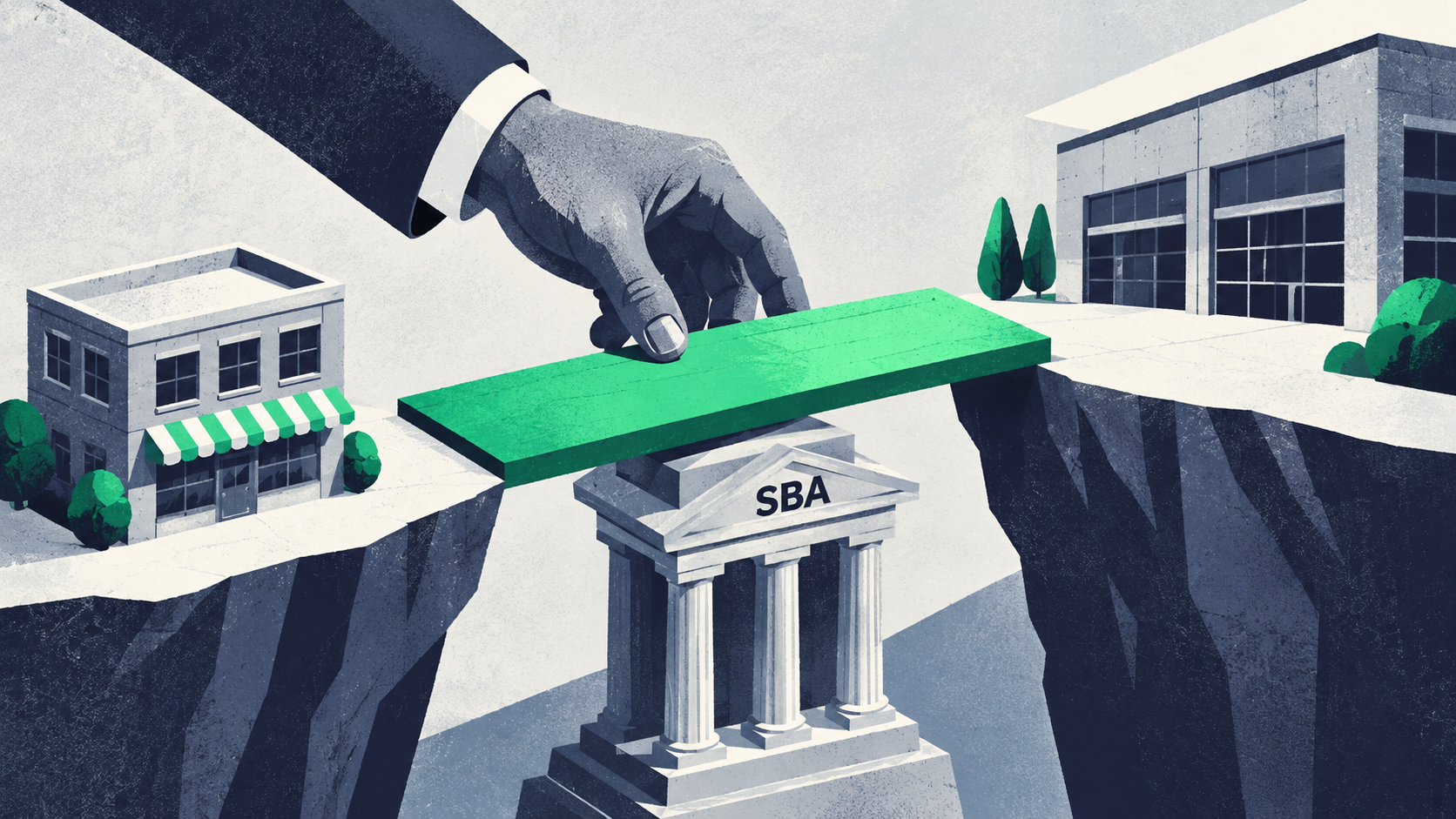
SBA acquisition financing is a lender-issued, SBA-guaranteed loan, mainly 7(a), that funds a complete or partial change of ownership. It can cover goodwill, and the buyer can put in as little as 10% equity. For business brokers, that turns more qualified buyers into funded closings.
A buyer with strong operating skills but limited cash can compete when an SBA loan for business acquisition covers most of the purchase price. That widens the buyer pool for every listing and keeps deals moving past the LOI.
The program also has scale behind it. The U.S. Small Business Administration reported record FY2025 lending volume, with 84,400 7(a) and 504 loans worth $45 billion.
Treat financing as part of your transaction process from day one. Line up the lender path while you qualify the buyer. Then the LOI starts a process that is already in motion.
SBA 7(a) vs. 504: Pick the right structure for the deal
SBA loans for business acquisitions mainly run through 7(a), because it can finance goodwill, working capital, and the purchase itself. The 504 program funds fixed assets, so it fits an acquisition only when the deal includes real estate or long-life equipment.
SBA's eCFR regulations at 13 CFR 120.212 set the 7(a) maturity limits at 10 years or less for most uses. Loans that finance real estate or equipment with a useful life over 10 years can run up to 25 years.
SBA's eCFR regulations at 13 CFR 120.931 set the 504 lending limits at $5 million per borrower, or $5.5 million per project for small manufacturers and energy projects. The 7(a) maturity row applies the 13 CFR 120.212 limits: 10 years or less, or up to 25 years for real estate.
Combine the programs when the buyer purchases both the operating business and its building. One structure pairs a 7(a) loan for goodwill and working capital with a 504 loan for the real estate.
SBA SOP 50 10 8.1 requires real estate in a change of ownership to be a separate loan or use blended amortization. Confirm the structure with the lender early.
Loan terms, rates, and equity injection brokers should know
Buyers ask about the SBA down payment first and the rate second. Brokers who answer both accurately set expectations before the LOI and avoid surprises in underwriting.
The figures below are program limits. Individual SBA lenders can, and often do, set stricter terms.
Loan size and rate caps
SBA's eCFR regulations at 13 CFR 120.151 set the 7(a) maximum loan amount at $5 million per loan. Under 13 CFR 120.210, the SBA guaranty percentages are up to 85% on loans of $150,000 or less and up to 75% above that.
- Loan size: A single 7(a) loan tops out at $5 million, so larger deals need more equity or added financing.
- Guaranty: SBA guarantees up to 85% or 75% of the loan, depending on size, which lowers lender risk.
- Rate cap: SBA's eCFR regulations at 13 CFR 120.214 set maximum variable interest rates of base rate plus 3 points above $350,000.
- Term: An SBA loan for acquisition without real estate typically carries a 10-year term.
Under 13 CFR 120.214, the base rate is prime or SBA's optional peg rate. Many acquisition loans exceed $350,000, so the 3-point cap usually applies, while smaller loans carry higher caps of up to 6.5 points.
Equity injection and seller notes
The U.S. Small Business Administration's SBA SOP 50 10 8.1 requires a 10% equity injection on initial acquisitions. It applies to loans numbered on or after Oct. 1, 2026, while earlier loan numbers follow SOP 50 10 8. The injection is based on total project cost and cannot be reduced or eliminated for initial acquisitions.
Seller financing is where most confusion sits. Here is how SOP 8.1 treats it:
- Seller note as equity: It counts only if subordinated and on full standby, with no principal or interest, for the loan term.
- Seller note cap: Standby seller debt and similar sources can cover no more than half of the required injection.
- Practical math: On a 10% injection, a standby seller note can fund up to 5% of project cost.
- Seller transition: In a complete change of ownership, the seller can stay only as a consultant, for up to 24 months in aggregate.
- Agent fees: Fees the buyer pays to an agent or advisor do not count toward equity.
- Lender overlays: Some banks require more than the 10% SOP minimum, so confirm the lender's policy before the LOI.
How SBA lenders underwrite an acquisition
Lenders underwrite an SBA loan business acquisition differently from a working capital request. They need the purchase price, buyer equity, any seller financing, and the target's revenue and cash flow or SDE.
They also review the buyer's background and supporting documents such as tax returns and financial statements. Lendflow's acquisition workflow collects those same items at intake, so the file reaches lenders complete.
Buyer eligibility and translatable experience
Lenders often want direct industry experience for higher-risk sectors. For lower-risk businesses, translatable experience such as general management can be enough.
When experience is thin, brokers can strengthen the file. These mitigants help:
- Seller transition: A consulting agreement with the seller transfers customer relationships and operating knowledge.
- Existing management: A strong team that stays after closing reduces key-person risk.
- Training plan: Documented pre-close training shows how the buyer will close skill gaps.
- Staged buyout: A partial purchase first lets the buyer learn the business before taking full control.
Under 13 CFR 120.160, every owner with 20% or more of the business generally must guarantee the loan. Confirm the ownership split early so guarantors are clear before underwriting starts.
Declining revenue and harder deals
Lenders often still consider a business with a down year. They ask why performance fell and whether fundamentals such as customers, margins, and staff still hold.
Many lenders ask for a larger down payment or more seller financing when the trend is weak. Brokers help by documenting the cause, such as a lost contract or a one-time expense, along with a credible recovery plan.
Why not all SBA lenders are the same
Lendflow for Brokers connects deals to 75+ vetted lenders and delivers 2.4× competitive offers per deal. That spread matters because SBA lenders do not all say yes to the same file.
Every SBA lender follows the same SOP, yet each bank layers its own credit policy on top. One lender may ask for more equity, another may limit unsecured debt, and a third may avoid an industry entirely.
SBA's eCFR regulations at 13 CFR 120.450 set the Preferred Lenders Program rules for designated lenders with delegated authority. They process and close SBA loans with less SBA documentation and prior approval. That speeds decisions, though under 13 CFR 120.452 the PLP lender responsibilities include all eligibility and creditworthiness decisions.
SBA brokers win by matching each deal to the right lender. Skip shopping files one bank at a time—use multi-lender access to put one complete file in front of many lenders. Lendflow's guide to building the right lender network covers how to choose and organize those relationships.
The broker's role—and how brokers get paid
A business broker handles the sale, while an SBA loan broker or referral agent helps the buyer secure financing. Brokers who handle both source and qualify buyers, package the deal, and route it to lenders. Their compensation is typically tied to funded deals and should be disclosed per lender and SBA requirements.
So how do SBA loan brokers get paid? Under SBA SOP 50 10 8.1, each referral agent, including loan packagers, must disclose its customer and all fees on SBA Form 159. An agent can be paid by the applicant or the lender, but not both.
Fees the borrower pays to an agent also cannot count toward the equity injection. Whether a sale-side commission belongs on Form 159 depends on the services performed, so confirm with the lender or counsel.
Track every payout without spreadsheets. Lendflow for brokers includes transparent commission tracking, and brokers on the platform see +42% monthly deal volume growth. Lendflow's overview of business broker lender partnerships explains how brokers and lenders work together on the platform.
From LOI to close: Shorten the SBA timeline
The timeline for an SBA loan for business acquisition varies with how quickly documents are provided, third-party reports such as appraisals, and deal complexity. Preferred lenders with delegated authority can often move faster.
Brokers can't speed up a third-party report, but they control the workflow. Lendflow for Brokers cuts time to close deals by 35%.
Prepare the buyer before the LOI
Before setting up a lender call, get the buyer ready. A prepared buyer answers lender questions once instead of across weeks of follow-up.
- Organized financials: Personal tax returns, financial statements, and proof of equity are ready before the first lender call.
- Updated résumé: The résumé maps management and industry experience to what the target business needs.
- Quick turnaround: The buyer commits to answering lender requests within a day or two.
- Business knowledge: The buyer understands the target's customers, margins, and staffing well enough to discuss them with a lender.
Start financing early. Lendflow's business acquisition financing workflow supports buyers who are still exploring, under LOI, or under contract, so the lender path forms in parallel with negotiations.
Package the file once—route it to many lenders
Email threads scatter documents and stall answers. Skip the inbox chaos—use Lendflow's widgets, landing pages, and APIs to run SBA acquisition financing for business brokers from one complete file.
Each step mirrors how lenders review a deal. The workflow runs in seven steps:
- Deal details: The broker enters the purchase price and cash contribution.
- Target business: The file captures industry, location, revenue, and cash flow or SDE.
- Buyer information: The buyer's background and ownership details are added.
- Document upload: Tax returns and financial statements are uploaded in one place.
- Review: The broker confirms deal stage, purchase price, cash contribution, seller note, and loan amount.
- Lender routing: The file goes to Lendflow's lender network.
- Offers and closing: Offers land in a centralized portal and stay there through closing and funding.
Lendflow's AI document processing analyzes uploaded financials, so teams spend less time on manual document handling. Pre-qualified offers hosted on Lendflow drive an average of 42% faster speed to funding.
Lendflow's unified borrower platform keeps buyers in one place to review offers through closing. Brokers can white-label the experience under their own brand, backed by a platform that saw $1.5B+ in offers in the last 12 months (as of March 2025).
FAQs
Can you get an SBA loan for a business acquisition?
Yes. The SBA 7(a) program can finance a complete or partial change of ownership, including goodwill.
What is the typical down payment for an SBA acquisition loan?
SBA SOP 50 10 8.1 sets a 10% minimum equity injection for initial acquisitions, based on total project cost. Some lenders require more.
What is the 20% rule for SBA loans?
SBA's eCFR regulations at 13 CFR 120.160 set the 20% guaranty requirement, so holders of at least 20% ownership generally must guarantee the loan. Under SOP 8.1, a selling owner who keeps less than 20% in a partial buyout must give a full guaranty for at least two years.
Can a seller note count toward the equity injection?
Yes, if it is subordinated and on full standby for the full term of the SBA loan. It can cover no more than half of the required injection.
Should buyers use an SBA loan broker or go directly to a bank?
Going direct works for a simple deal with a lender the buyer already knows. When credit policies differ or the deal is complex, multi-lender access surfaces more offers and a better fit.
How long does it take to close an SBA acquisition loan?
Timelines vary with how quickly documents are provided, third-party reports such as appraisals, and deal complexity. Preferred lenders with delegated authority can often move faster.
Build financing into every deal
Financing decides whether a buyer can close, so build it into your process before the LOI. Lendflow for Brokers gives you 75+ vetted lenders, one acquisition workflow, and transparent commission tracking.
Book a demo or talk to our team to see how Lendflow can help you close more financed deals. You can launch the experience under your own brand with the white-label option.