[.green-span]SBA Loan Document Checklist: Every Document You Need, Stage by Stage[.green-span]
What Goes on an SBA Loan Document Checklist
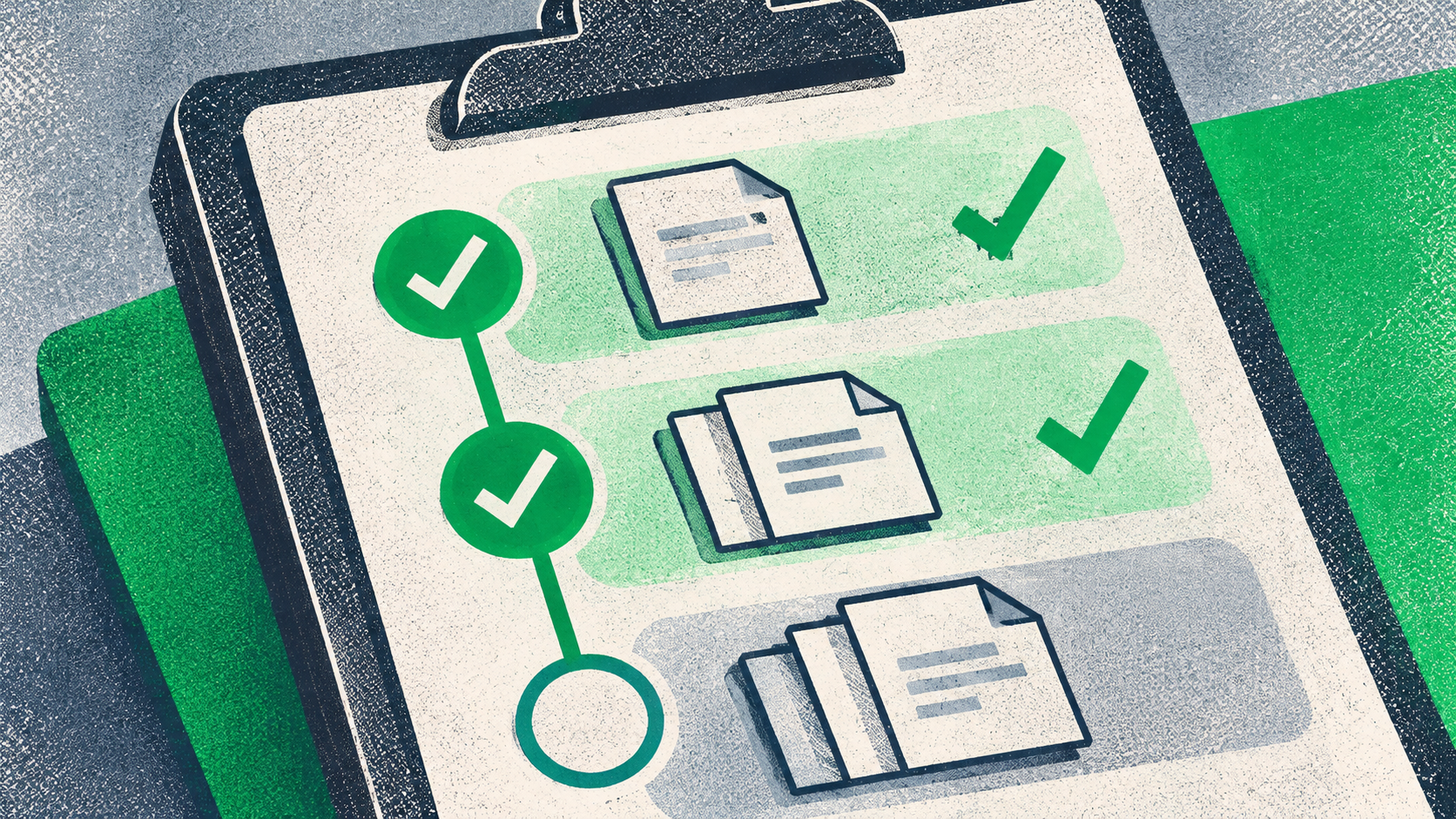
An SBA loan document checklist typically includes SBA Form 1919, SBA Form 413, a business plan, and your formation and legal documents. Lenders also commonly request personal and business tax returns (often three years), a year-to-date P&L and balance sheet, and bank statements. Many add a debt schedule, A/R and A/P aging reports, collateral documents, and credit reports.
For 7(a) loans, SBA provides a loan guarantee to lenders—you apply through your lender. The U.S. Small Business Administration's overview of types of 7(a) loans states that SBA Form 1919 is required for every loan.
The U.S. Small Business Administration's SBA loan programs overview says your lender provides the full list of eligibility requirements. SBA also notes application contents vary with loan size and lender processing method.
The documents beyond Form 1919 are commonly requested by lenders—not universal SBA mandates—so confirm your exact list early. Treat your file as data a lender verifies—not paperwork you hand over. Every number should match across tax returns, financial statements, and bank records.
Confirm Eligibility and Pick Your SBA Program First
Eligibility and program choice decide which documents apply. Settle both first—it prevents rework later.
Core SBA eligibility requirements
The U.S. Small Business Administration's SBA 7(a) loan requirements list five baseline criteria. Your business must meet each one:
- Operating business: Your company must be up and running.
- For-profit: The business must operate for profit.
- U.S. location: The business must be located in the United States.
- Small by SBA standards: You must qualify as small under SBA size requirements.
- Creditworthy: You must be creditworthy and show a reasonable ability to repay.
The same SBA page sets the 7(a) maximum loan amount at $5 million. Your documents prove each criterion.
7(a) vs. Express vs. 504: which documents change
Your program shifts which documents carry the most weight. Plan your file around it.
The U.S. Small Business Administration describes the SBA 504 loan program as long-term, fixed rate financing for major fixed assets. These loans come only through Certified Development Companies (CDCs) and can't fund working capital or inventory.
Buying an existing company? Our guide to SBA loans for business acquisitions covers the deal-specific documents.
The Master SBA Loan Document Checklist
Build your file in one pass. Each group answers a lender question—who you are, what the business is, how it performs, and what secures the loan.
Owner and personal documents
These documents show the lender who stands behind the business. Your lender confirms which owners must provide each one.
- SBA Form 1919: Required for every 7(a) loan, per SBA.
- SBA Form 413: Your personal financial statement.
- Management resumes: Experience of the people running the business.
- Personal tax returns: Typically three years for each owner your lender identifies.
- Credit authorization: Signed permission for the lender to pull personal credit.
- Personal guarantee: Your commitment to repay if the business can't.
The U.S. Small Business Administration uses the SBA Form 413 personal financial statement to assess applicants' repayment ability and creditworthiness. It applies to 7(a), 504, and other SBA programs.
Business and legal documents
These documents prove the business exists and operates legally. They also show your plan for the money.
- Business plan: Operations, market, and financial projections tied to the loan's purpose.
- Formation documents: Articles of incorporation or organization, plus your operating agreement or bylaws.
- EIN verification: IRS confirmation of your employer identification number.
- Licenses and permits: Current registrations for your industry and location.
- Leases: Agreements for any property the business occupies.
- Franchise agreements: Required if you operate a franchise.
- Third-party contracts: Major customer or supplier agreements that support revenue.
Financial documents
Financial records show how the business performs. From Lendflow's perspective, clean, consistent statements are easier to verify—manually or with automated document analysis.
- Business tax returns: Typically two to three years of filed federal returns.
- YTD P&L and balance sheet: Current through a recent month-end.
- Business bank statements: Recent months that match your reported revenue.
- A/R and A/P aging: Who owes you, who you owe, and how long balances are outstanding.
- Business debt schedule: Every loan, lease, and credit line with balances and payments.
- Business credit report: Your company's payment and credit history.
Deposits get close scrutiny, so learn how lenders verify bank statements. Also check what shows up on business credit reports before your lender pulls one.
Collateral documents and 504 extras
Collateral documents describe what secures the loan. They also establish what each asset is worth.
- Property records: Addresses, ownership documents, and current valuations for real estate.
- Equipment lists: Make, model, serial number, and estimated value.
- 504 project documents: Purchase contracts, appraisals, and environmental reviews coordinated through your CDC.
504 projects add a fixed-asset layer. Your CDC sets the exact list.
SBA Loan Document Checklist by Application Stage
Lenders don't need every document on day one, and stages vary by lender. Staged requests match each document to the decision it supports.
Lendflow perspective: automating document handling cuts manual work and repeat requests at each stage. Staged requests are one way SBA lenders grow deal flow without adding operational overhead.
How Lenders Read Your Documents: Cash Flow and Debt Service Coverage
The U.S. Small Business Administration's SBA lending regulations (13 CFR 120.150) say loans must be so sound as to reasonably assure repayment. Under that rule, lenders may consider credit history, earnings or cash flow, and, where applicable, collateral.
Debt service coverage ratio (DSCR) is a common lender metric—not an SBA formula—for whether cash flow can cover debt. It divides operating cash flow by required payments on all business debt, including the new loan.
Here's an illustrative example only: a business with $180,000 in annual operating cash flow and $120,000 in annual debt payments has a DSCR of 1.5. Minimums vary by lender.
Lenders reconcile your tax returns, P&L, and bank statements to confirm that figure. Gaps between sources trigger questions—resolve them before you submit.
Lendflow's platform supports live credit signals and document analysis, so lenders can check consistency across sources as data flows in. For the full process, see how lenders underwrite small business loans.
Questions Your Lender Will Ask
The U.S. Small Business Administration's SBA Lender Match checklist suggests preparing a business plan, amount and use of funds, credit history, financial projections, and collateral. Expect questions on each—back every answer with a document.
- Business plan: Why you need financing now; SBA notes most lenders expect one for startup funding.
- Amount and use of funds: How much you need and how you'll spend it, supported by quotes or contracts.
- Credit history: Your personal and business credit record, supported by recent reports.
- Financial projections: How the loan affects future cash flow, supported by your projections.
- Assets and suppliers: What you own and who you depend on, supported by asset lists and supplier agreements.
- Existing debt and creditors: Who you owe and on what terms, supported by your debt schedule.
- Management team: Industry experience and track record, supported by resumes.
How to Improve Your Chances of SBA Approval
The Federal Reserve Banks' 2025 Report on Employer Firms covers 2024 survey data on small business financing. Among firms denied all or some financing, 41% cited too much debt in 2024, versus 22% in 2021.
The Federal Reserve Banks' newer 2026 report, covering 2025 survey data, found 42% of applicants received the full amount of financing they sought. These figures cover all employer-firm financing—not SBA loans alone—but the lesson applies.
Strong files share the same habits. Use these steps to build yours:
- Pull credit early: Review personal and business reports and correct errors before you apply.
- Reconcile financials: Make tax returns, P&L, and bank statements tell the same story.
- Model total debt: Calculate DSCR with the new loan included before your lender does.
- Organize a single digital file: Name, date, and group documents by checklist category.
- Submit through a unified borrower experience: One portal cuts duplicate requests and lost files.
Lendflow's pre-qualified offers drive an average of 42% faster speed to funding. Lenders using AI document analysis tools flag inconsistencies early and save hours of manual review. The Lendflow Borrower Platform gives borrowers one unified submission experience.
FAQs
What documents do I need for an SBA loan?
Lenders commonly request SBA Forms 1919 and 413, a business plan, formation documents, tax returns, financial statements, bank statements, and a debt schedule. Your lender provides the full list, which varies by loan size.
Do you need collateral for an SBA loan?
Per SBA's types of 7(a) loans page, SBA doesn't require collateral for 7(a) Small loans of $50,000 or less (International Trade loans excepted). For larger loans, lenders follow SBA collateral rules and will tell you what's needed.
Is it hard to get approved for an SBA loan?
SBA loans come with eligibility and documentation requirements, so approval takes preparation. Complete, consistent documentation and manageable debt improve your odds.
What is the difference between SBA 7(a), Express, and 504 loans?
7(a) loans are the versatile option, up to $5 million. SBA Express covers loans up to $500,000 using mainly the lender's own forms, while 504 loans finance major fixed assets through CDCs.