[.green-span]What shows up on a business credit report[.green-span]
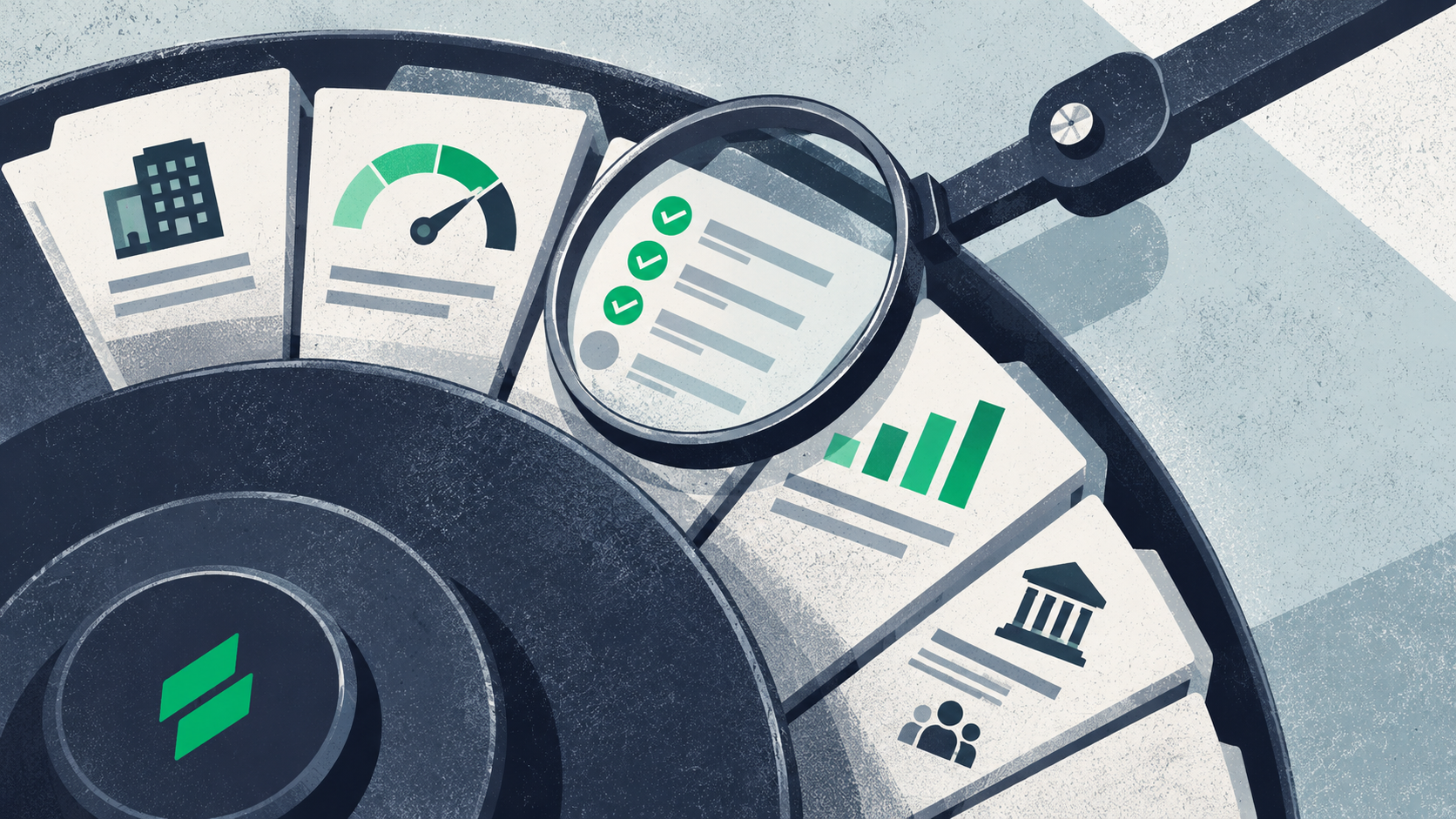
A business credit report shows your company's profile, credit accounts and trade lines, payment history, public records, financial information, credit scores, and recent inquiries. Unlike a personal credit report, it is a public record, so lenders, suppliers, insurers, and partners can pull it to gauge how you handle obligations. Payment history usually carries the most weight, and public records like liens or bankruptcies signal distress. New businesses without a file are often judged on the owner's personal credit until the company builds its own history. This guide breaks down every section, the major scoring models and their ranges, the three main bureaus, how to read your own report, and how lenders turn this data into fast, consistent decisions.
What shows up on a business credit report, section by section
A business credit report is a summary of a company's creditworthiness built from data that vendors, lenders, courts, and public agencies report. Here is what each section contains.
How it differs from a personal credit report
The distinction matters before you read a single line. A business credit report is a public record, so anyone can pull it, while a personal credit report is protected and requires permission. The two also stay separate: your business file does not show the owner's personal debts, and your personal file does not show your company's trade lines. There is one common exception. New businesses without an established file are often evaluated on the owner's personal credit until the company builds its own history.
Company profile and business information
This section identifies the business and its size. Expect the following details:
- Legal name, DBAs, address, and phone number
- Incorporation details, ownership structure, and subsidiaries
- Number of employees and annual sales
- SIC or NAICS industry classification
- Years the company has been on file
Credit summary, accounts, and trade lines
This is the record of how your business borrows and pays. It typically includes:
- Loans, leases, and business credit cards
- Trade lines with suppliers and vendors
- Account balances, credit limits, and payment terms
- Account status such as open, closed, or delinquent
Payment history
Payment history is the most heavily weighted part of most reports. It tracks a multi-year record of invoice activity, outstanding balances, and payment terms. A key metric here is Days Beyond Terms, or DBT, which measures how many days beyond agreed terms a business pays its suppliers.
Bureaus compare your DBT against industry averages, so paying early or on time directly strengthens this section. Because this data flows in from suppliers and lenders over time, a single late payment rarely defines the picture. A consistent pattern does. That is why long-term discipline moves your score more than any one-off fix.
Public records
Public records are drawn from federal, state, and county courts nationwide. They include:
- Liens and judgments
- Bankruptcies and collections
- UCC filings
Negative public records are strong warning signs. They tell lenders and suppliers that a business may be under financial pressure.
Financial information
This section reflects the company's financial footing. It often covers annual sales, revenue, and debt levels, and sometimes fuller financial statements. Lenders use it to size credit against the business's capacity to repay.
Business credit scores and risk indicators
Reports summarize risk with one or more scores. Ranges vary by model, so read each one in context:
- Dun & Bradstreet PAYDEX: 0 to 100, where 80 or above indicates payments made on time or early.
- Experian Intelliscore Plus: 0 to 100, where a higher score signals lower risk.
- Equifax Business: the modern Equifax Business Credit Industry Report 2.0 includes OneScore for Commercial, roughly 300 to 650, where lower means higher risk, plus a Business Failure Score of 1,001 to 1,610 that predicts the risk of closing within 12 months. The older Equifax Business Credit Risk Score ran 101 to 992, so expect scoring models to keep evolving.
- FICO SBSS (Small Business Scoring Service): 0 to 300, used by the SBA to prescreen 7(a) loan applicants.
Inquiries
This section logs recent inquiries from creditors and lenders. Checking your own report is a soft inquiry and does not affect your score, so you can monitor it as often as you like.
What does not show up
A business credit report is not a catch-all. It generally excludes:
- Personal financial data of the owners, which stays on personal credit reports
- Accounts with vendors that do not report to the bureaus
- Certain private transactions
How to get, read, and use a business credit report
Getting and acting on your report follows a clear sequence. Use this framework, then see how lenders work with the same data.
Step 1: Know the three major bureaus
Three bureaus dominate business credit, and access differs by provider:
- Dun & Bradstreet: requires a D-U-N-S Number and offers a free basic option.
- Experian Business: paid, with products ranging from about a $40 one-time report up to roughly $1,500 per year.
- Equifax Business: paid, and now accessible to owners through reseller eCredable for $49.95.
Step 2: Pull your report
Start with Dun & Bradstreet, which is free once you have a D-U-N-S Number, then add Experian and Equifax as budget allows. Remember that pulling your own report is a soft inquiry, so it never hurts your score.
Step 3: Read it critically
Review each section in order. Check that your company profile is accurate, scan trade lines and balances, and study payment history and DBT against industry norms. Flag any public records or errors that could drag down a score.
Step 4: Understand how lenders pull and use the data
Lenders read the same report, but they combine it with bank data, financials, and other signals to decide fast. This is where the process often breaks down, because juggling separate bureau contracts and manual review slows underwriting from minutes to days.
Lendflow closes that gap for lending and underwriting teams. Lendflow Connect is an embedded lending orchestration layer that connects to a network of data partners and 75+ lenders through a single API, so teams can pull Experian, Equifax, and Dun & Bradstreet data in one integration instead of managing each bureau separately. It has powered $1.5B+ in funding across 12K+ SMBs.
Lendflow Intelligence turns that credit and business data into automated decisions, cutting time-to-decision from days to minutes. Teams using it see 35% operational cost savings, a 60% lift in application conversion, and 85% faster time-to-decision.
Lendflow Automate adds AI agents that speed up review. The Trust Score Agent produces an explainable composite risk score, Doc Analyzer reviews documents 80% faster, and Industry Map handles NAICS and SIC classification. Together these tools deliver 65% faster time-to-decision. Lendflow is not a credit bureau; it aggregates and transforms ecosystem data rather than issuing reports.
The payoff is consistency and speed. When bureau data, financials, and bank signals flow through one pipeline, underwriting teams score every applicant the same way and move from days to minutes without adding headcount.
Step 5: Act on what you find
Use the report to fix errors, negotiate terms, and prioritize the accounts that move your score most. If you are a lender, standardize how you weigh each section so decisions stay consistent across your team. Set clear thresholds for scores, DBT, and public records, then let automation apply them uniformly. That turns a static report into a repeatable decision.
Best practices to build and protect business credit
Strong business credit is built deliberately. These practices target the sections that carry the most weight.
- Pay on time or early. Payment history is the biggest lever, so on-time payments and a low DBT lift your score directly.
- Keep utilization under 30%. Low balances relative to limits signal healthy credit management.
- Borrow from lenders that report. Choose lenders and vendors that report to the bureaus, or your good behavior never reaches your file.
- Monitor regularly and dispute errors. Soft inquiries are free, so check often and correct mistakes before they cost you an approval.
- Get a D-U-N-S Number. It is the entry point to a Dun & Bradstreet file and to much of the business credit ecosystem.
Common pitfalls include assuming personal and business credit are linked, relying on vendors that do not report, and ignoring public records until a lender flags them. Avoiding these keeps your file clean and lender-ready.
Timing matters too. Business credit takes months to build, so start before you need financing rather than during an application. Open a small number of reporting trade lines early, pay them ahead of terms, and let the history accumulate. When a lender pulls your file, that track record does the talking.
Conclusion
A business credit report is a public snapshot of how your company manages money. It shows your business profile, credit accounts and trade lines, payment history, public records, financial information, credit scores, and inquiries, while keeping owners' personal finances separate. Payment history and public records carry the most weight, so pay on time, borrow from lenders that report, and monitor your file for errors. For lending teams, the bigger opportunity is turning that raw report into fast, consistent decisions. Lendflow helps by aggregating bureau data, scoring it, and automating review, so underwriting moves from days to minutes.
FAQs
Is a business credit report public?
Yes. Unlike a personal credit report, a business credit report is a public record, so lenders, suppliers, insurers, and partners can pull it.
Does checking my own business credit report hurt my score?
No. Pulling your own report is a soft inquiry that does not affect your score, so you can monitor it as often as you want.
Which business credit scores should I know?
The main ones are Dun & Bradstreet PAYDEX (0 to 100), Experian Intelliscore Plus (0 to 100), Equifax Business scores, and FICO SBSS (0 to 300) used by the SBA.
What does not appear on a business credit report?
It excludes owners' personal financial data, accounts with vendors that do not report to the bureaus, and certain private transactions.
How do lenders use a business credit report?
Lenders combine report data with bank and financial signals to assess risk. Platforms like Lendflow aggregate bureau data, score it, and automate review to speed decisions.