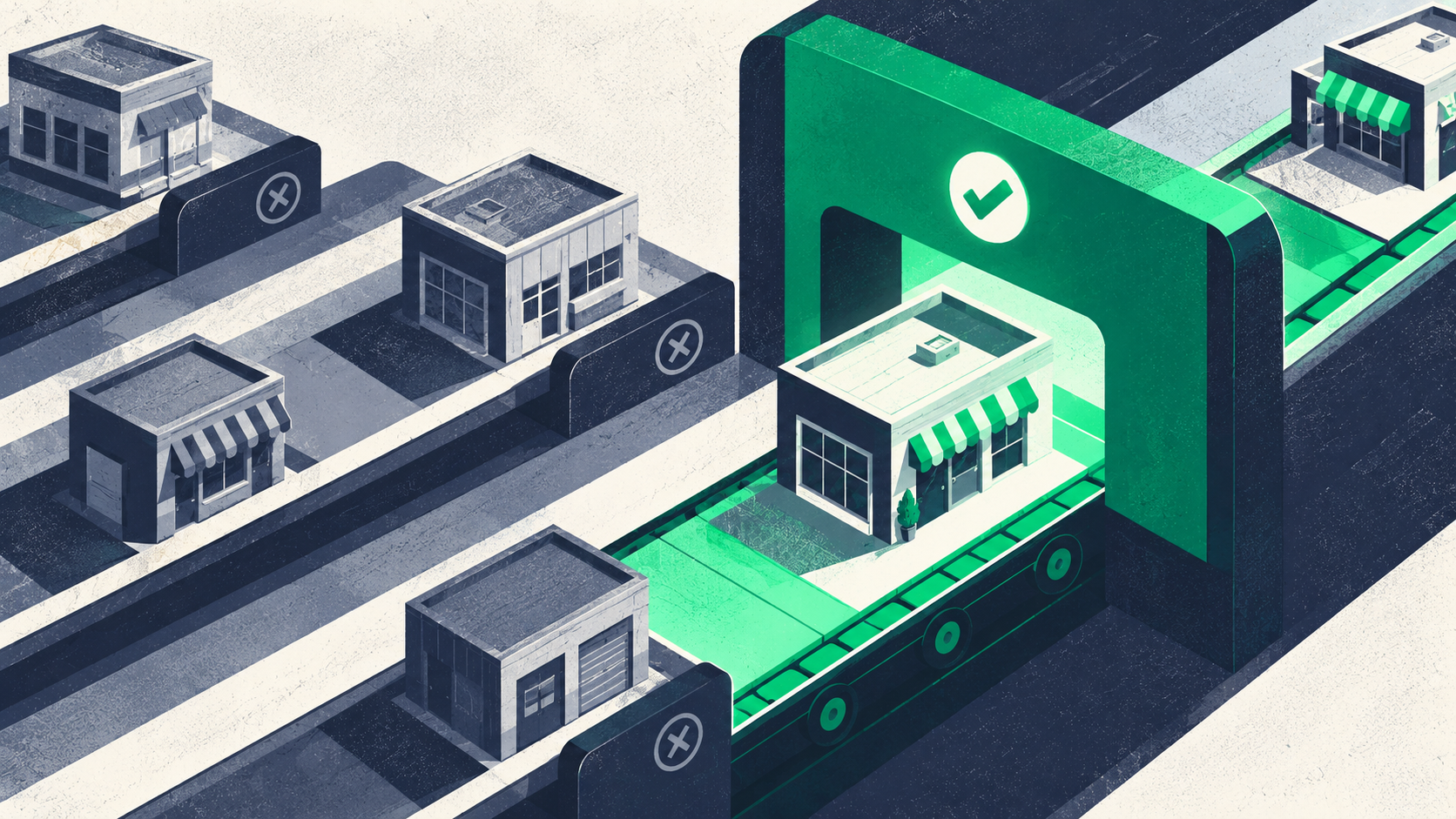
[.green-span]How to set up risk-based pricing for business loans[.green-span]

To set up risk-based pricing for business loans, define the risk factors you will score, then group borrowers into a grade or tier scale. Build each rate from a cost stack: cost of funds, expected loss, operating and servicing cost, capital, and target margin. Map each grade to a price band, document the basis for every difference, apply ECOA and Regulation B, then test and monitor results.
This guide is for credit, risk, product, and lending leaders at small-business lenders, fintechs, banks, credit unions, and embedded lenders. It covers how risk-based pricing compares with flat and judgmental pricing, which business-borrower factors belong in your grades, and how to build the cost stack. It also walks through a hypothetical grade-to-price table and the compliance and model-governance points to confirm as of October 2026.
How risk-based pricing for business loans works
Risk-based pricing ties each borrower's rate to a documented assessment of risk and cost. Two borrowers with different risk profiles get different prices, and the lender can show why.
Risk-based pricing vs flat and judgmental pricing
Most business lenders use one of three pricing approaches. The table below compares them.
Judgmental pricing carries a specific compliance exposure. OCC guidance on subprime lending (foundational, 1999) warns that officer pricing without a documented risk or cost basis "will significantly increase the compliance" risk. That bulletin was written for national banks, but the principle carries over to business-loan pricing by analogy.
Business-borrower risk factors that drive price
Many credit teams organize business risk around the C's of credit: character, capacity, capital, collateral, and conditions. In practice, those categories translate into a set of scoreable inputs:
- Business credit scores: bureau scores on the business's trade and payment history.
- Cash flow and bank data: deposit trends, balances, volatility, and NSF activity from operating accounts.
- Debt service coverage: the ratio of cash available for debt service to required payments.
- Time in business: operating history as a proxy for stability and survival risk.
- Industry: sector-level risk, which depends on accurate NAICS or SIC classification.
- Collateral: the type, value, and liquidity of assets securing the loan.
- Guarantor credit: the personal credit and financial strength of owners who guarantee the loan.
The NCUA Examiner's Guide on credit risk rating systems calls for both quantitative and qualitative factors. Its quantitative examples include "debt service coverage, debt-to-worth, or liquidity." Qualitative factors, such as management depth or industry conditions, round out the grade.
Per a NAGGL summary of SBA procedural notices, SBA discontinued the required FICO SBSS prescreen for 7(a) Small Loans effective March 1, 2026. The revised requirements include debt service coverage, two months of bank activity, and projected earnings.
How Lendflow supports risk-based pricing
85% faster time-to-decision. Lendflow reports that teams using Lendflow Intelligence see 85% faster time-to-decision, 35% operational cost savings, and a 60% lift in application conversion.
Risk-based pricing runs on three layers: data, decisions, and execution. Lendflow splits that work across three products:
- Lendflow Connect: aggregates credit, bank, and business data into one feed through widgets, landing pages, and APIs.
- Lendflow Intelligence: runs configurable decision models that assign grades and apply pricing logic, with justification for each decision.
- Lendflow Automate: executes the workflow with AI agents for document extraction, industry classification, and an explainable Trust Score.
Underneath, the Lendflow Data Graph supplies applicant insight through tools like Industry Map, Doc ICE, and Trust Score. Accurate industry codes matter here, because a misclassified business lands in the wrong grade and the wrong price band.
Steps to set up risk-based pricing for business loans
The eight steps below build a live, monitored pricing program on top of clean data. Each step produces an artifact your credit committee and examiners can review.
Step 1: Define your risk factors and data sources
Pick the factors from the list above that predict loss for your products, and name the data source for each. Specify how every input is calculated, such as the lookback window for bank data or the definition of cash available for debt service.
Skip manual pulls. Use a data aggregation layer so every application reaches the model with the same fields.
Step 2: Build a risk grade scale
Group borrowers into grades with clear boundaries. The NCUA Examiner's Guide notes that "most ratings systems have between six and ten ratings," and says ratings should guide loan pricing.
Write minimum and maximum criteria for each grade. The OCC subprime-lending bulletin says credit grades "should contain minimum and maximum criteria for each category," with pricing guidelines by grade. Define which grade sits outside your credit policy and is declined.
Step 3: Build the rate from a cost stack
Each grade's price should cover five components:
- Cost of funds: what you pay for the capital you lend, whether deposits, warehouse lines, or forward-flow partners.
- Expected loss: the average loss you expect for the grade.
- Operating and servicing cost: acquisition, underwriting, servicing, and collection expense.
- Capital cost: the return required on capital held against the loan.
- Target margin: the profit you need after all other costs.
The OCC bulletin supports the funding, capital, and operating-cost components of this stack. It says profitability projections should include overhead, "acquisition, servicing, and collection expenses," allowance allocations, and "funding and capital costs."
Expected loss is commonly framed as probability of default × loss given default × exposure at default. Here is a hypothetical example for one grade:
- Expected loss: a 2% default probability × 45% loss given default = 0.9% of the balance.
- Spread over cost of funds: 0.9% expected loss + 1.5% operating cost + 1.0% capital + 1.5% margin = 4.9 points.
The OCC bulletin also says pricing should reflect "higher prepayment speeds." Factor prepayment into products where early payoff cuts the interest you collect.
Step 4: Map grades to price bands
Translate each grade's cost stack into a price band with a floor and a ceiling. The band gives underwriters limited room for structure, term, or relationship factors without leaving the documented range.
The table below is a hypothetical example for illustration only. It does not reflect real market rates or any lender's pricing.
Set a rule for each edge case: what happens at a band boundary, who approves an exception, and how exceptions get logged.
Step 5: Document the pricing basis
Write down why each band sits where it does. The OCC bulletin says pricing differentials should be supported through "clearly documented analyses" showing returns compensate for the risk taken.
Your pricing file should hold the grade definitions, cost-stack assumptions, loss data behind each expected-loss figure, and an exceptions log. Consistent documentation also helps you show that each price traces to a stated risk or cost basis if pricing is questioned.
Step 6: Apply ECOA and Regulation B
ECOA and Regulation B apply to business credit, and adverse action notice duties split at $1 million in gross revenue. Under 12 CFR 1002.9, the rules work as follows:
- Revenue of $1 million or less: follow the 30-day framework; the action statement may be oral, and the right-to-reasons disclosure may come at application.
- Revenue over $1 million: notify the applicant within a reasonable time; give written reasons if requested in writing within 60 days.
- All applicants: reasons must be specific; saying the applicant missed a qualifying score is insufficient.
Build specific reason codes into your grade-to-price engine so every decline maps to the factors that drove it. Confirm with counsel how your notices handle counteroffers at a higher price.
The FCRA risk-based pricing notice rule (12 CFR 1022.70 to 1022.75) excludes credit primarily for a business purpose. Other FCRA duties may still apply, such as when you pull consumer reports on guarantors, so consult counsel.
Plan for Section 1071 data collection as well. Per the CFPB, a May 1, 2026 final rule extended the compliance date to January 1, 2028. Coverage depends on your origination volume and products, so confirm your status against the final rule with counsel.
Step 7: Validate your scoring model
If a statistical score or default model drives your grades, validate it before launch. On April 17, 2026, the Fed, OCC, and FDIC issued SR 26-2. It "supersedes and replaces SR letter 11-7."
The OCC issued it as OCC Bulletin 2026-13.
For banks supervised by the Fed, OCC, or FDIC, the guidance is principles-based and non-enforceable. It is expected to be most relevant to banks over $30 billion in assets, with expectations scaled to materiality. Its validation practices include:
- Conceptual soundness: confirm the model's design and inputs make sense for the portfolio.
- Outcomes analysis: compare predictions with actual results, including back-testing.
- Ongoing monitoring: track performance and drift after deployment.
- Vendor model review: validate third-party models too.
The guidance excludes "simple arithmetic calculations" and "deterministic rule-based processes" from its model definition. A purely rule-based rate matrix may fall outside it, while a statistical score falls inside.
Credit unions follow NCUA guidance instead. It says to "carefully evaluate and periodically validate any automated commercial credit scoring systems." Non-bank lenders should confirm expectations with counsel.
Step 8: Monitor performance and reprice
Track each grade against its assumptions every month or quarter. Watch these signals:
- Loss rates by grade: actual losses versus the expected-loss figure in each band.
- Grade migration: how often borrowers move between grades after origination.
- Override rate: how often pricing exceptions occur, and who approves them.
- Pull-through by band: how often offers turn into funded loans at each price.
When cost of funds moves or losses drift from plan, update the cost stack and document the change.
Best practices for risk-based pricing
Price every loan from the same rulebook. These recommendations keep a risk-based pricing program consistent, explainable, and current.
Keep grade definitions tight
Each grade needs boundaries an analyst can apply the same way twice. Vague criteria like "acceptable cash flow" invite inconsistent grading and price drift.
Limit overrides
Set an exceptions policy with approval levels and a reason field. Review override patterns by officer, channel, and grade at least quarterly.
Show borrowers the full cost
Clear price disclosure builds trust. The Federal Reserve Banks' Small Business Credit Survey (2025 survey, a convenience sample of employer firms) shows the gap. Among online-lender borrowers, 60% said costs were higher than expected, versus 37% at small banks and 32% at large banks.
Automate data and decisions together
Fragmented data breaks consistent pricing. Connect data, grading, and pricing logic in one pipeline using Lendflow Connect and Lendflow Intelligence so every applicant is priced on the same inputs.
Avoid common pitfalls
- Too many grades: thin data per grade makes loss estimates unreliable.
- Stale cost of funds: bands that ignore funding changes quietly erode margin.
- Missing reason codes: generic decline reasons fall short of Reg B's specificity requirement.
- Outdated guidance: citing SR 11-7 as current after its April 2026 replacement.
- Unclassified industries: wrong NAICS codes put borrowers in the wrong band.
Conclusion
Risk-based pricing for business loans is a repeatable chain. Score the risk, assign a grade, build the price from costs, and document every step. The cost stack keeps each band tied to real economics, and the documentation keeps every price explainable to examiners and borrowers.
Compliance sets the guardrails. Build Reg B reason codes into the engine and plan for the January 1, 2028 Section 1071 compliance date. Scale validation to your model reliance, then monitor each grade and reprice when the data moves.
Frequently asked questions
What is risk-based pricing for business loans?
Risk-based pricing sets each business loan's rate based on a documented assessment of the borrower's risk and the lender's costs. Higher-risk grades carry higher price bands to cover expected loss.
How many risk grades should a pricing system have?
The NCUA Examiner's Guide notes that most rating systems have six to 10 grades. Choose enough grades to separate risk while keeping enough loans in each grade to measure losses.
Does the FCRA risk-based pricing notice rule apply to business loans?
The FCRA risk-based pricing notice rule excludes credit primarily for a business purpose. Other FCRA duties may apply, such as when you use a guarantor's consumer report, so consult counsel.
Is SR 11-7 still the model risk guidance for banks?
No. As of October 2026, SR 26-2 and OCC Bulletin 2026-13 replaced SR 11-7 and OCC 2011-12 on April 17, 2026.
When does Section 1071 compliance begin?
Per the CFPB, the compliance date is January 1, 2028. Confirm whether your institution is covered with counsel.