[.green-span]What Ai4 2026 Revealed About the Next Era of AI in Lending[.green-span]
For financial services, the conversation is no longer simply, Where can we use AI? It is increasingly, How do we embed AI into core workflows in a way that is scalable, explainable, and trusted?
Ai4's banking programming covered AI-powered credit scoring and underwriting, back-office automation, model risk, explainability, financial inclusion, and AI agents. Broader discussions also focused on the infrastructure, data, and governance required to move AI from experimentation into production.
Several themes stood out for lenders, fintechs, and embedded finance platforms.
1. AI Agents Are Becoming an Operating Layer
Agentic AI was one of the most prominent themes at Ai4, with discussions focused on autonomous workflows, orchestration, tool-using agents, integrations, human-in-the-loop controls, and multi-agent systems. For lending organizations, the significance is that AI is moving beyond automating isolated tasks and toward coordinating multiple steps across a workflow.
A lending agent could identify missing information, collect documents, extract financial data, apply eligibility rules, communicate with a borrower, route an application, and escalate exceptions to a human when necessary. The real value comes from connecting these actions into a coordinated process rather than introducing separate tools for each individual task.
This closely aligns with Lendflow's approach to AI lending automation, which combines machine learning, document processing, workflow orchestration, and AI-powered communications. Specialized capabilities can work together through a shared orchestration layer while maintaining permissions, auditability, and opportunities for human intervention.
For lenders, the advantage will increasingly come from orchestrating intelligence across the lending lifecycle, not simply adding another AI tool.
2. Underwriting Is Becoming a Data and Intelligence Problem
Ai4's banking track addressed the growing role of AI in credit scoring and underwriting, alongside discussions about alternative data, risk management, compliance, and financial AI infrastructure. Together, these topics reflect a broader change in how lenders can evaluate borrowers and make credit decisions.
Modern underwriting can incorporate bank transaction data, accounting information, credit bureau records, KYB data, payment processor activity, application behavior, and other real-time signals. For SMB lenders in particular, this can provide a more complete picture than traditional credit files alone, especially when cash flow, revenue patterns, and business activity can change quickly.
The goal is not simply to give AI access to more data. Lending organizations need infrastructure that can turn fragmented information into consistent, decision-ready intelligence that can be used throughout the underwriting process.
Lendflow Intelligence is built around this concept by connecting data sources, translating those inputs into risk insights and decisions, and enabling automated workflows to act on the results. As AI capabilities continue to improve, the quality, accessibility, and organization of the underlying data will increasingly determine the quality of the lending decisions built on top of it.
3. Proprietary Data Is Becoming a Strategic AI Asset
Ai4 also devoted significant attention to the role of proprietary data and retrieval-augmented generation, including how organizations can connect large language models with internal datasets, databases, documents, and structured information. This has significant implications for financial services, where much of an organization's most valuable context exists within its own systems.
A general-purpose model may understand lending concepts, but it does not automatically understand a lender's policies, portfolio history, funding criteria, borrower relationships, or operational processes. Connecting AI to that internal knowledge can make it much more useful for underwriting, operations, servicing, and other lending workflows.
For lending organizations, the next phase of AI will therefore be less about asking a generic model financial questions and more about securely connecting AI to the information already flowing through the lending ecosystem. When data is accessible across systems, AI can retrieve the appropriate context, understand what is happening within a deal, and help coordinate the next action.
Data connectivity is quickly becoming a foundation for more intelligent and agentic lending workflows.
4. Explainability Is a Requirement for Scaling AI
Governance was another core part of the enterprise AI conversation at Ai4, including explainability, model risk, bias, monitoring, auditing, and regulatory compliance. These considerations are especially important in lending, where AI-supported systems can influence decisions about access to capital.
As lenders automate more of the decisioning process, teams still need to understand how outcomes were reached, apply policies consistently, monitor models over time, and maintain clear records of decisions. Human-in-the-loop workflows can help balance automation with oversight by allowing routine applications to move efficiently while escalating exceptions, uncertain outcomes, or higher-risk actions for review.
Lendflow's approach follows a similar model, using automation for repeatable processes while allowing underwriters to focus on cases that require additional judgment. Explainable risk assessments, decision trails, and configurable workflows can give teams greater visibility into automated processes without sacrificing the efficiency those systems provide.
Governance should not be viewed simply as a barrier to AI adoption. As financial institutions move from experimentation to production, strong governance is part of what makes scaled adoption possible.
5. AI Is Being Measured by ROI, Not Novelty
Another important theme at Ai4 was the shift from AI experimentation toward measurable business outcomes. Organizations are increasingly evaluating which use cases should move from pilot to production based on their financial impact, operational value, and total cost of ownership.
For lenders, those outcomes can be measured through practical questions: Are applications reaching decisions faster? Can teams manage higher volumes more efficiently? Are manual touchpoints decreasing? Is borrower drop-off improving? Is the cost to process and fund each loan declining?
These measures move the conversation away from AI for AI's sake and toward tangible operational improvements. Faster decisions, lower operating costs, better borrower experiences, and more scalable lending programs are ultimately more meaningful than the sophistication of the technology itself.
The Bigger Trend: Lending Is Becoming an Intelligent, Orchestrated System
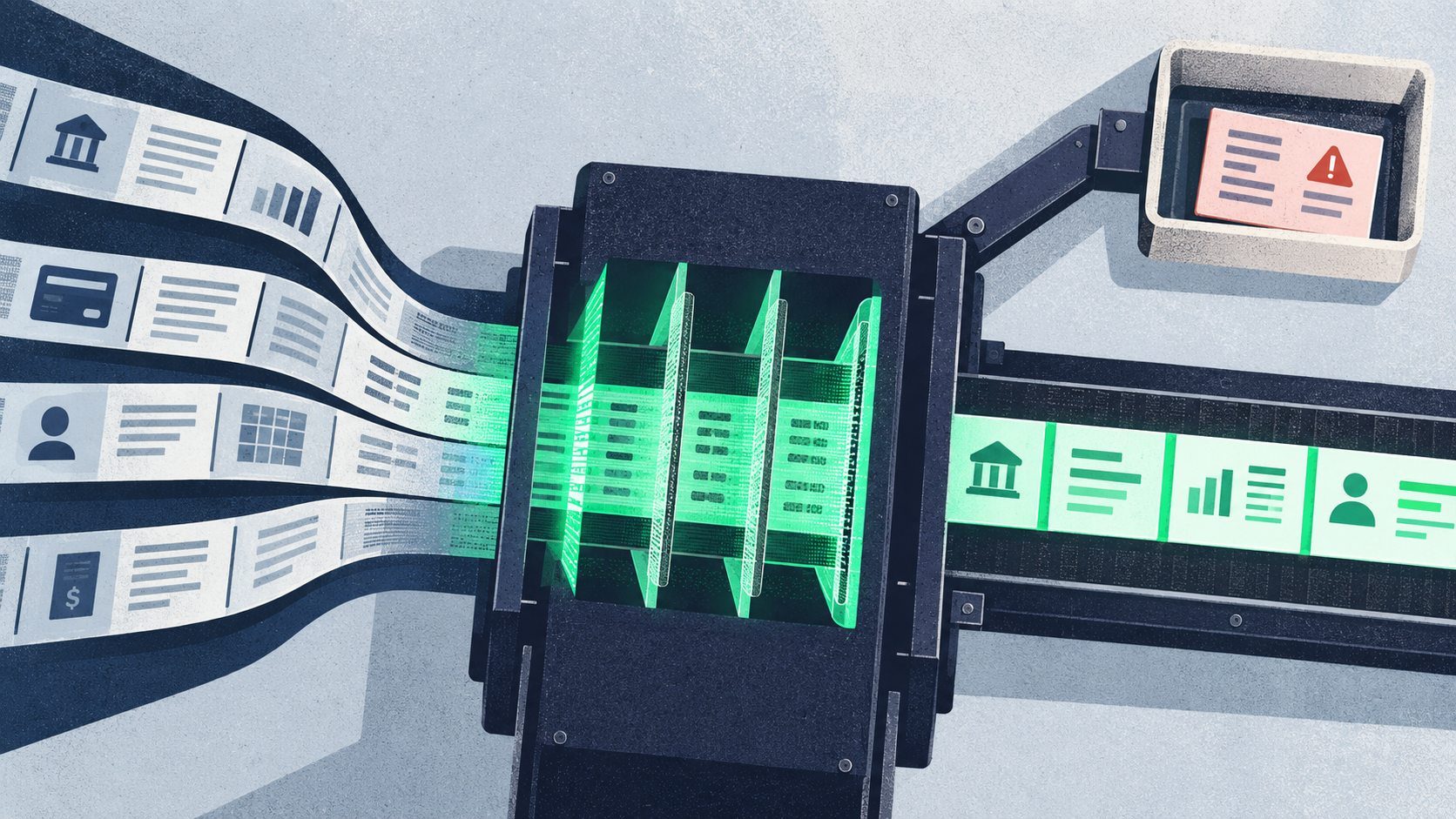
Taken together, the themes from Ai4 point toward a broader transformation in how financial institutions think about AI. The future is not a chatbot sitting beside an existing lending workflow, but intelligence embedded throughout the workflow itself.
In this model, connected infrastructure brings data together, AI interprets that information, decisioning systems determine what should happen next, and agents execute repetitive work. Humans remain involved where judgment or additional review is required, while governance provides visibility and control across the process.
This is also reflected in Lendflow's broader platform strategy. Connect brings lenders, borrowers, and data together, Intelligence turns that data into decisions and insights, and Automate helps turn those decisions into action. Rather than operating as separate point solutions, these capabilities are designed to work together across the lending lifecycle.
Ai4 2026 reinforced where the market is heading. AI agents are becoming more operational, proprietary data is becoming more strategic, underwriting is becoming more intelligent and real-time, governance is becoming part of the underlying architecture, and organizations are demanding measurable returns from their AI investments.
For lending organizations, the opportunity is larger than automating individual tasks. It is about creating a lending operation where data, intelligence, decisioning, automation, and human expertise work together as one connected system.