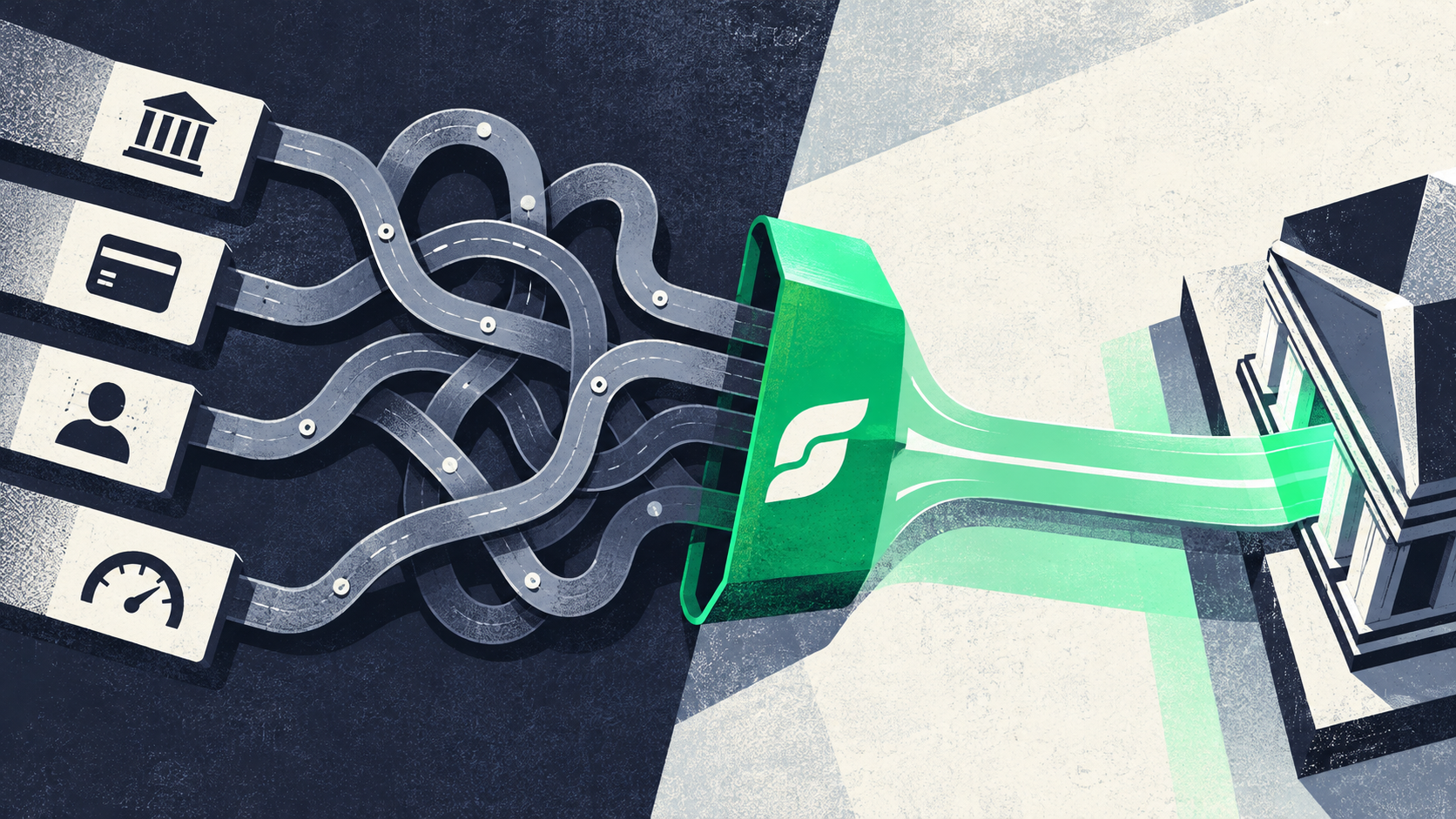
[.green-span]How to Integrate Alternative Data into Lending and Underwriting Workflows[.green-span]

Many small business applicants look riskier on paper than they really are. Their bureau files are thin, stale, or focused on the owner instead of the business, so good deals get declined or underpriced. Alternative data closes part of that gap by showing how a business actually earns, spends, and repays.
This guide explains how to integrate alternative data into lending and underwriting workflows without rebuilding your stack. You will learn which data types matter, how to judge signal quality, and a six-step process for putting them to work. We also cover the compliance guardrails that keep alternative data underwriting defensible.
What Alternative Data Means for Lending and Underwriting
To integrate alternative data into lending and underwriting workflows, start by defining the credit question you need to answer. Next, connect permissioned sources through APIs, map each signal to ability or intent to pay, and layer those signals into decision rules alongside bureau data. Finally, govern and monitor the process so results stay accurate, fair, and explainable.
Alternative data is any credit-relevant information that sits outside a traditional credit bureau report. Bureau data covers tradelines, payment history, and inquiries, while alternative credit data includes bank transactions, income records, and business identity details. For small business lending, it also includes know-your-business (KYB) checks, which confirm that a company is real and properly registered.
Small business credit shows the need. The Fed Small Business Credit Survey found: "Forty-two percent of applicants received the full amount of financing they sought, 36% received some or most, and 22% received none." The survey uses a convenience sample of employer firms, so treat it as directional.
Why Bureau-Only Models Fall Short
Bureau scores work well for borrowers with long, active credit histories. They struggle with stale files and thin-file borrowers, meaning people or businesses with few reported accounts. They also update slowly, so a business whose revenue doubled last quarter can still look risky.
In June 2025, the CFPB cut its earlier estimate of consumers with no credit record roughly in half. According to the CFPB's updated credit invisibles estimate, "The estimated share of credit invisibles in December 2020 was 2.7 percent (7.0 million consumers)." The same report found another 9.8% of adults had an unscored credit record, meaning the file was stale or too thin.
These are 2020 consumer figures. Many SMB lenders also underwrite the owner's personal credit, so the same blind spots carry into business lending.
Types of Alternative Data Lenders Use
Each alternative data source answers a different underwriting question. The table below maps common types to what they signal, so you can match sources to the decisions you need to make.
NAICS, short for the North American Industry Classification System, lets lenders compare a borrower to sector peers. Bank statement data and cash-flow data usually carry the most weight because they show money moving in near real time.
The last row is the hardest to get. Loan stacking, when a business takes several advances from different lenders in a short window, rarely shows up in one lender's portfolio. See how lenders use ecosystem intelligence data to spot stacking and repayment trends across the wider market.
Strong vs. Weak Signals
More data does not automatically lead to better decisions. Strong alternative data signals are stable, verifiable, and tied to how a business manages money. Weak signals are noisy, easy to game, or loosely linked to repayment.
- Recurring deposits: Consistent revenue over six to twelve months is a strong sign of capacity to repay.
- Verified income: Income confirmed through payroll or tax records is much harder to fake than self-reported figures.
- Overdraft patterns: Frequent non-sufficient funds (NSF) events point to cash stress that a credit score may miss.
- Social or device data: Browsing habits and similar signals have a weak link to repayment and raise fairness questions.
Independent research backs cash-flow data in particular. FinRegLab analyzed over 38,000 small business loans originated by two fintech lenders between 2015 and 2024. The FinRegLab small business cash-flow study found: "Models that added cash-flow variables to personal credit scores and other traditional inputs predicted default risk more accurately across all borrower segments analyzed."
Because the sample covers two fintech lenders, results may not carry over to banks or other products. The study also measured prediction accuracy, which differs from proven approval or loss outcomes.
Step-by-Step: Integrating Alternative Data into Your Underwriting Workflow
Lendflow Intelligence customers see 85% faster time-to-decision, a 60% application conversion lift, and 35% operational cost savings, according to Lendflow. Those results come from one connected workflow: Lendflow Connect for data, Lendflow Intelligence for decisions, and Lendflow Automate for execution. The six steps below follow that sequence.
Step 1: Define the Credit Question and Products
Start with the decision you want to improve, such as approving more thin-file applicants or cutting manual review time. The right data depends on the product. A merchant cash advance (MCA) relies on daily receivables, while an equipment loan leans on collateral and time in business.
Write down the target segment, the decision you are changing, and the metric that will prove success. This focus keeps you from paying for data you do not need.
Step 2: Connect and Enrich Data Sources
Next, connect your chosen sources through APIs or ready-made connectors instead of manual uploads. Permissioned bank data, where the borrower grants account access, delivers live cash-flow detail and a clear consent record.
Lendflow's business data enrichment tools fill gaps in business identity and firmographic details at intake. To combine bank statements and cash-flow feeds into one view, read our financial data aggregation guide.
Step 3: Extract and Standardize Documents
Lendflow Automate delivers 80% faster document review, according to Lendflow. Many SMB applicants still send PDFs of bank statements, tax returns, and IDs, and keying them in by hand is slow.
AI document analysis pulls structured data from those files and returns it in a standard format your rules can read. Mapping every statement to the same fields lets you compare applicants fairly and feed models consistent inputs.
Step 4: Sequence Data Calls with a Waterfall
Not every application needs every data source. A waterfall is a set of rules that calls sources in order, running cheaper checks first and costlier ones only when needed.
A credit data waterfall lets you stop early on clear approvals or declines and spend more only on borderline files. Decline waterfalls apply the same logic to routing, so a deal one lender passes on can move to another. Lendflow Connect links brands to 75+ specialty and bank lenders through a single integration.
Step 5: Map Signals to Decision Rules
Now translate each signal into a rule or model input tied to ability or intent to pay. For example, require three months of consistent deposits, cap offers at a share of monthly revenue, or flag frequent NSF events.
Keep bureau data in the mix and let alternative data refine the decision, especially for applicants near a cutoff. With configurable credit decisioning, credit teams can adjust thresholds and add new data fields as their strategy evolves.
Step 6: Pilot, Measure, and Scale
Test new rules on a portion of your applications before you change the whole portfolio. A champion/challenger test runs your current model (the champion) against the new one (the challenger) on a slice of traffic. You can then compare approvals, losses, and speed side by side.
- Start with small limits: Offer lower amounts to newly approved thin-file borrowers while you collect performance data.
- Graduate good performers: Raise limits automatically after a set number of on-time payments.
- Track segment metrics: Measure approval rate, default rate, time-to-decision, and funded rate for each segment.
- Expand in stages: Add new products or segments only after the pilot meets its targets.
Governance, Compliance, and Fairness
Alternative data only helps if you can defend how you use it. In December 2019, the Fed, CFPB, FDIC, NCUA, and OCC issued a non-binding statement focused on consumer protection.
The 2019 interagency alternative data statement notes that "cash flow data...may present lower risks than other data." The agencies also urged sound compliance and model risk management.
An adverse action notice tells an applicant why they were declined or offered worse terms. The Equal Credit Opportunity Act (ECOA), its Regulation B, and the Fair Credit Reporting Act (FCRA) set these requirements.
- Consent records: Capture when and how each borrower permissioned access to their data.
- Data provenance: Log the source, date, and version of every data point used in a decision.
- Adverse action reasons: Make sure each decline maps to specific, plain-language reasons.
- Fairness testing: Review outcomes across groups to catch proxies for protected traits.
- Model monitoring: Watch for drift as economic conditions and your applicant mix change.
Explainability ties these controls together. An explainable Trust Score shows which factors drove a composite risk score, which makes reason codes easier to produce and audit.
Open Banking Rules in Flux
Open banking refers to the rules and tools that let consumers share their bank data with third parties. The CFPB finalized its Section 1033 Personal Financial Data Rights rule in October 2024, and law firm Cozen O'Connor tracks the litigation. Its Section 1033 rule status update says "A federal court has enjoined the CFPB from enforcing the rule while the Bureau undertakes a reconsideration process."
The rule covers only consumer accounts, so it does not create federal data-access rights for business accounts. Recheck the status before building on it, and rely on documented borrower consent in the meantime.
Best Practices and Common Pitfalls
Lenders that get the most from alternative data share a few habits and avoid a few traps. The list below covers both.
- Supplement bureau data: Use alternative data alongside bureau data, because each one covers blind spots in the other.
- Start narrow: Pick one product and one segment first, then expand once the results hold.
- Favor real-time feeds: Live bank connections catch revenue drops that a monthly batch file can miss.
- Document everything: Keep written records of data sources, rules, and changes for auditors and partners.
- Validate before trusting: Test new signals on your own portfolio instead of assuming results from other lenders apply.
The most common failure is treating integration as a one-time project. Signals drift and regulations shift, so schedule regular reviews of rules and model performance.
Conclusion: Turning Alternative Data Into Better Credit Decisions
Alternative data gives lenders a fuller, more current view of small business borrowers, especially those with thin or stale bureau files. It works best when you define the credit question, connect permissioned sources, standardize documents, sequence data calls, and map signals to explainable rules.
Governance and monitoring keep that process fair while open banking rules change. The key takeaway is to start small, prove the lift on your portfolio, and scale with automation.
Frequently Asked Questions About Alternative Data in Lending
What Is Alternative Data in Lending?
Alternative data in lending is credit-relevant information outside a traditional bureau report, such as bank transactions, payment history, income records, and business identity details. Lenders use it to assess ability and intent to pay when bureau files are thin or out of date.
Is Using Alternative Data Legal Under Fair Lending Laws?
It can be, as long as lenders follow fair lending and credit reporting laws, including ECOA, Regulation B, and FCRA adverse action requirements. Federal regulators addressed the topic in a non-binding 2019 statement, and lenders should still test for fairness and keep clear records.
What Are the 5 C's of Underwriting?
The 5 C's are character, capacity, capital, collateral, and conditions, which together describe a borrower's willingness, ability, and resources to repay. Alternative data strengthens several of them, especially capacity, by adding detailed cash-flow evidence.
How Does Alternative Data Help Thin-File Borrowers?
It gives lenders more evidence to evaluate applicants whose bureau files are too limited or stale to score well. Bank deposits, verified income, and payment records can show repayment capacity that a thin file may not capture.
How Long Does Integration Take?
Timelines depend on your systems and data sources, and connector-based platforms shorten the work. Lendflow Intelligence can be configured and launched in roughly two to four weeks, with model configuration and testing built into onboarding.
See how Lendflow Intelligence turns alternative data into faster, explainable credit decisions.