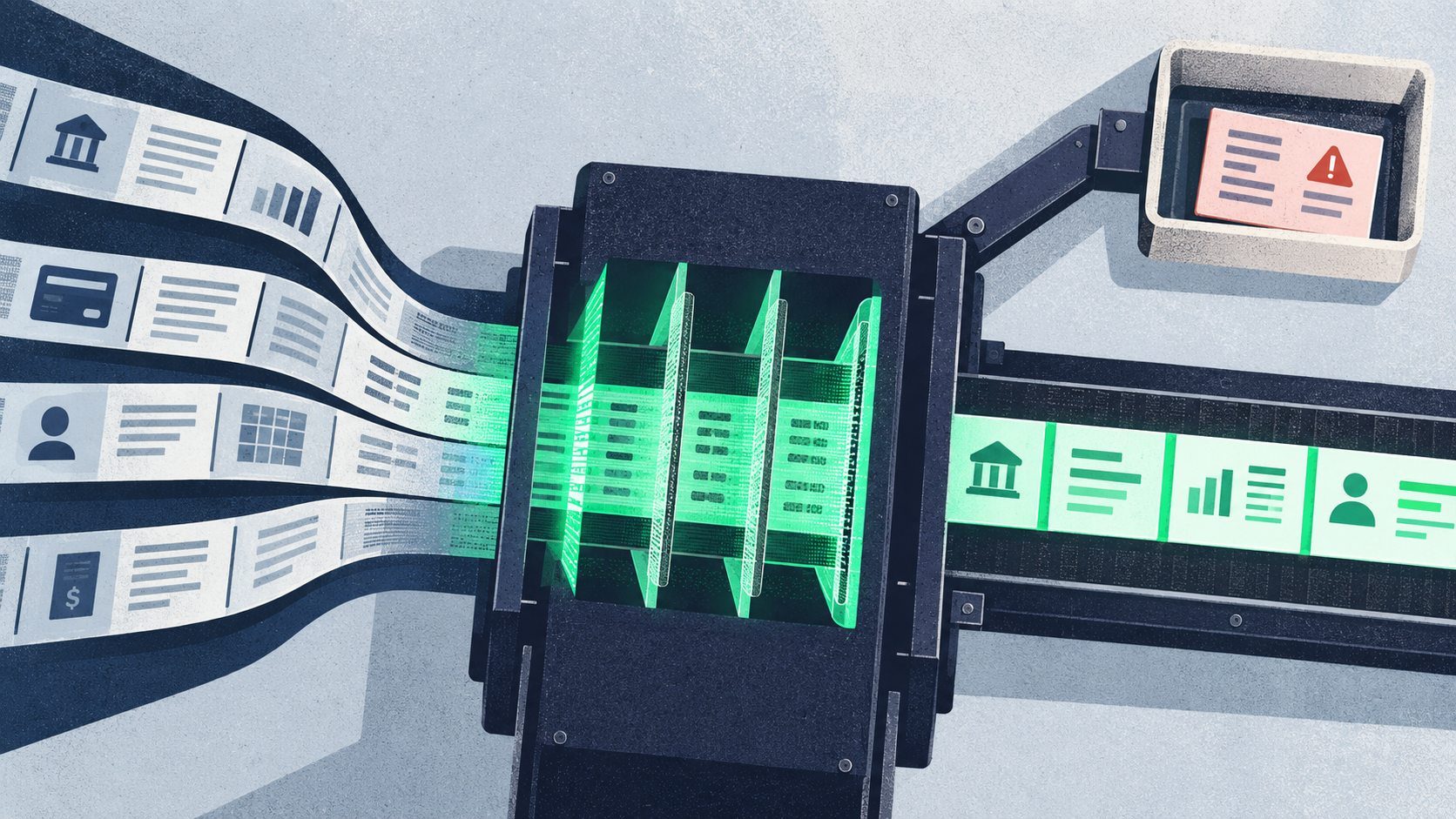
[.green-span]How Does Financial Data Aggregation Help Underwriting?[.green-span]

For lenders, the benefit goes beyond convenience. Aggregated financial data can provide a more complete picture of a borrower's ability to repay, reduce manual underwriting work, and give automated decisioning models consistent data to evaluate.
This is especially important in small business lending, where there is no single data point that tells the entire story. Understanding an SMB often requires combining cash flow, credit history, business information, financial statements, and other signals before making a decision.
What Is Financial Data Aggregation?
Financial data aggregation is the process of collecting financial information from multiple sources and consolidating it into a standardized dataset or interface.
In lending, those sources can include:
- Bank accounts: Transactions, balances, deposits, expenses, and cash flow
- Credit bureaus: Credit scores, tradelines, payment history, and outstanding obligations
- Accounting platforms: Revenue, expenses, profit and loss statements, and balance-sheet information
- Financial documents: Bank statements, tax returns, financial statements, and other uploaded documents
- KYC and KYB providers: Identity and business verification information
- Fraud providers: Identity, document, and application risk signals
- Payroll data: Payroll expenses, employee information, and related business activity
- Alternative data: E-commerce, point-of-sale, invoicing, and other operational information
The goal isn't simply to collect more information. It's to turn information coming from different systems and formats into usable underwriting inputs. Without aggregation, an underwriter may have to access several vendor portals, review PDFs, reconcile conflicting information, and manually transfer data into an underwriting system. With aggregation, those inputs can flow into one underwriting workflow automatically.
Why Financial Data Aggregation Matters for Underwriting
Underwriting depends on understanding risk, and risk is difficult to evaluate when borrower information is fragmented. A credit report might show that a business has historically paid its obligations. Bank transactions might reveal whether it currently generates enough cash to support another payment. Accounting data can show profitability and longer-term business performance. Individually, each source provides part of the picture.
Together, they provide substantially more context.
Financial data aggregation helps lenders combine these signals so underwriting decisions aren't dependent on one isolated score, document, or point-in-time snapshot.
It Creates a More Complete Borrower Profile
One of the biggest advantages of aggregation is visibility.
Consider two businesses with similar credit scores.
The first has consistent monthly deposits, healthy average balances, manageable existing debt, and growing revenue. The second has declining deposits, frequent negative balance events, and increasing debt obligations.
A traditional credit score alone may not fully expose that difference.
Aggregating credit information with bank transaction data, financial statements, and other business signals gives the underwriting model more context for distinguishing between borrowers.
This is particularly useful in SMB underwriting, where lenders commonly combine bank transactions, bureau data, tax returns, and alternative data rather than relying on a universal business equivalent of a consumer FICO score.
It Improves Cash Flow Analysis
Cash flow is one of the most useful signals for understanding whether a borrower can support a new financial obligation.
Aggregated banking data can help lenders analyze:
- Average monthly revenue
- Deposit consistency
- Revenue trends
- Average daily balances
- Expense patterns
- Negative balance events
- Existing loan payments
- Cash flow volatility
- Seasonal changes
These signals can reveal changes in financial health that may not yet appear in traditional credit data.
For example, a borrower could have strong historical credit but experience a sharp recent decline in deposits. Access to current bank transaction data gives an underwriter another signal to consider before approving the application.
It Helps Lenders Verify Information Across Sources
Aggregation also makes it easier to compare information rather than evaluating every source independently. Suppose an applicant reports $150,000 in monthly revenue. An underwriting workflow could compare that figure against bank deposits, accounting data, tax documents, and other available information. Significant discrepancies could trigger additional review.
This creates a more robust verification process. Instead of asking whether one piece of information looks reasonable, lenders can ask whether multiple independent signals tell a consistent story.
How Financial Data Aggregation Works in an Underwriting Workflow
Aggregation is most valuable when it's integrated directly into the underwriting process rather than treated as a separate data-gathering exercise. A modern workflow typically looks something like this.
Step 1: Collect Borrower Information
The borrower submits an application and connects or provides the requested financial information. Depending on the credit product, this could include bank accounts, financial documents, business information, accounting data, or authorization to retrieve credit information.
Step 2: Pull Data From Multiple Sources
The underwriting platform requests information from the appropriate data providers. Instead of requiring an underwriter to retrieve every source manually, integrations can pull the required information programmatically. This could include a bank data provider, commercial credit bureau, KYB service, fraud provider, accounting integration, or document analysis tool.
Step 3: Standardize the Data
Raw financial data rarely arrives in the same format. One provider might call a field annual_revenue, another might return gross_sales, and a financial document may contain the same information inside a PDF. Normalization converts those inputs into consistent fields that underwriting rules and models can use. This step is critical because automated decisioning requires structured, predictable data.
Step 4: Enrich the Borrower Profile
Once the foundational information is collected, lenders can add additional signals where necessary. For example, a lender could enrich an application with industry information, business credit data, fraud indicators, or additional cash flow metrics. Not every application necessarily requires every data source. More sophisticated workflows can request additional information only when earlier checks indicate it's needed.
Step 5: Apply Underwriting Rules
The standardized information can then feed into underwriting models and decision rules.
A lender might evaluate criteria such as:
- Minimum monthly revenue
- Time in business
- Credit score
- Existing debt
- Average bank balance
- Negative balance frequency
- Revenue consistency
- Industry
- Debt service capacity
These rules can generate an approval, decline, conditional decision, risk score, or request for additional review.
Step 6: Route Exceptions for Manual Review
Automation doesn't have to eliminate human underwriting. Instead, aggregation can help reserve manual review for applications that actually need it. Straightforward applications can move through automated rules, while incomplete information, conflicting data, unusual financial patterns, or borderline credit profiles can be routed to an underwriter. The underwriter receives the aggregated borrower information rather than starting the investigation from scratch.
Financial Data Aggregation vs. Manual Underwriting
The difference between the two approaches becomes clearer when comparing the workflow.The goal isn't necessarily to automate every credit decision. It's to eliminate repetitive data collection and preparation so credit teams can spend more time on the decisions that require judgment.
How Financial Data Aggregation Improves Underwriting
The impact of aggregation generally falls into several categories.
Faster Credit Decisions
Manual data collection creates delays before underwriting even begins. If a credit analyst has to retrieve a credit report, download bank statements, review accounting information, verify a business, and enter the results into another system, a significant portion of underwriting time is spent moving information rather than analyzing it. Aggregation compresses those steps. Data can be collected and standardized automatically, allowing decision rules to begin evaluating the application as soon as the necessary inputs are available.
More Consistent Underwriting
Manual processes introduce variability. Two underwriters may interpret the same information differently or calculate a metric in slightly different ways. Structured data allows lenders to apply the same definitions and underwriting policies across applications. For example, every applicant can be evaluated using the same calculation for monthly revenue or the same threshold for negative balance events. Human judgment can still be incorporated where appropriate, but the foundational analysis becomes more consistent.
Better Risk Visibility
More data isn't automatically better underwriting. Relevant, well-structured data is. Aggregation makes it possible to evaluate multiple dimensions of borrower risk simultaneously rather than relying heavily on one indicator. When these signals are evaluated together, lenders can build a more complete view of repayment capacity and risk.
Lower Operational Costs
Every separate data provider can create operational overhead.
Teams may need to manage individual integrations, contracts, billing structures, schemas, and maintenance requirements. Credit teams can also spend substantial time switching between systems.
A data aggregation layer can consolidate parts of that infrastructure. The operational advantage becomes increasingly important as lenders add products, data providers, and underwriting requirements.
More Automated Decisions
Automated underwriting depends on structured inputs. A decision engine can't efficiently evaluate information trapped inside PDFs, spreadsheets, emails, or disconnected vendor portals. Aggregation turns those inputs into standardized data that can feed decision logic.
For example:
IF monthly revenue exceeds the minimum threshold
AND time in business exceeds 24 months
AND credit score meets policy
AND cash flow volatility is acceptable
THEN continue to the next underwriting stage.
Applications that fail a rule can be declined, routed elsewhere, or sent for additional review depending on the lender's policy.
Why Data Standardization Matters as Much as Aggregation
Collecting data is only the first half of the problem. The information also needs to be usable.
Different providers structure data differently. Documents introduce another layer of complexity because important information may exist in PDFs or scans rather than structured API fields. Standardization creates a common data model across these sources. That makes it easier for lenders to:
- Compare information across providers
- Build reusable underwriting rules
- Change data vendors
- Create consistent risk metrics
- Feed information into automated decisioning
- Maintain underwriting workflows as products evolve
Without normalization, lenders can end up with a large amount of data but still require manual work to make sense of it.
What Data Should Lenders Aggregate?
There isn't one universal dataset that every lender should collect. The right combination depends on the product, borrower type, loan amount, risk appetite, and underwriting policy. For SMB lending, common categories include:
Bank and Cash Flow Data
Bank transactions can provide current visibility into deposits, expenses, balances, and payment behavior. This is particularly valuable when repayment capacity depends heavily on the business's ongoing cash flow.
Credit Data
Consumer and commercial credit information provides historical insight into repayment behavior, existing obligations, utilization, and credit performance. Credit remains an important underwriting input, but it can be more powerful when interpreted alongside current financial information.
Accounting Data
Accounting systems can provide deeper visibility into business performance, including revenue, expenses, assets, liabilities, and profitability. This can help lenders evaluate the financial condition of more complex businesses.
Financial Documents
Tax returns, bank statements, P&Ls, balance sheets, and other documents remain central to many underwriting processes. Document analysis technology can extract important fields and convert unstructured documents into information that can be evaluated alongside API data.
Identity, Business, and Fraud Data
Before evaluating repayment capacity, lenders often need to verify that the applicant and business are legitimate. KYC, KYB, identity, and fraud signals can therefore be integrated into the same data workflow.
What Is Intelligent Data Aggregation?
Traditional aggregation asks:
What information can we collect about this borrower?
Intelligent aggregation asks:
What information do we need next to make this decision?
That difference matters because data has a cost. Pulling every available data source for every applicant can create unnecessary expenses and slow the application process.Instead, lenders can sequence data requests.
For example, an underwriting workflow might:
- Run basic business and identity checks.
- Evaluate minimum eligibility requirements.
- Pull bank data for qualified applicants.
- Run credit checks after initial thresholds are met.
- Request additional financial documents only for borderline applications.
If an applicant fails an early eligibility requirement, the lender may not need to purchase more expensive downstream data. This turns aggregation from a collection exercise into part of the underwriting strategy.
Data Aggregation and Real-Time Underwriting
Another advantage of connected financial data is freshness. Traditional underwriting often relies on point-in-time information. A financial statement may describe the previous quarter or year, while a credit report primarily reflects historical behavior. Connected data sources can add more current signals.
Bank transaction activity, for example, can reveal whether revenue is increasing or declining, whether balances are deteriorating, or whether payment obligations have changed recently.That matters because borrower financial health isn't static. Combining historical information with more current financial signals can give lenders a better view of both where the borrower has been and where the business stands today.
Does More Data Always Mean Better Underwriting?
No. Collecting every available data point can increase costs and complexity without necessarily improving a decision. The objective should be to collect the right data at the right stage of underwriting. Strong data aggregation strategies consider:
- How predictive a data source is
- How much the data costs
- How current the information is
- Whether another source already provides the same signal
- Where the data belongs in the underwriting sequence
- Whether it materially changes the credit decision
That is why aggregation and orchestration increasingly work together. Aggregation brings information into the system. Orchestration determines when that information should be requested and what happens after it arrives.
How Lendflow Helps Aggregate Financial Data for Underwriting
Lendflow brings financial data aggregation, standardization, and decisioning into a unified lending infrastructure. Instead of building and maintaining separate workflows around each provider, lenders and fintechs can use Lendflow to connect multiple data and service providers and incorporate those inputs into configurable underwriting workflows.
Aggregated information can include traditional sources such as credit, KYC, KYB, and fraud data alongside bank, accounting, payroll, document, and other financial signals. Once collected, that information can be standardized and used throughout the underwriting process. Teams can then sequence data checks according to their credit policies, automate straightforward decisions, and route exceptions for additional review.
The result is a different approach to underwriting infrastructure: rather than making credit teams gather and reconcile borrower information manually, the data comes together around the decision. For lenders trying to make faster and more consistent credit decisions, that's the core value of financial data aggregation.
Frequently Asked Questions About Financial Data Aggregation
How does financial data aggregation help underwriting?
Financial data aggregation brings information from sources such as bank accounts, credit bureaus, accounting systems, financial documents, and verification providers into a unified underwriting workflow. This gives lenders a more complete borrower profile while reducing manual data collection and making automated decisioning possible.
What financial data is used for underwriting?
Common sources include bank transactions, credit reports, accounting data, tax returns, financial statements, KYC and KYB information, fraud signals, payroll data, and alternative business data. The appropriate sources depend on the lender's product and credit policy.
Can financial data aggregation speed up loan approvals?
Yes. Aggregation can eliminate manual steps such as retrieving information from multiple portals, extracting information from documents, and re-keying borrower data. Once information is standardized, automated underwriting rules can evaluate applications more quickly.
How does data aggregation improve credit risk assessment?
Aggregation lets lenders evaluate multiple dimensions of borrower risk together. Historical credit behavior can be analyzed alongside current cash flow, business performance, existing obligations, verification data, and other relevant signals to create a more comprehensive assessment.
What's the difference between financial data aggregation and credit decisioning?
Financial data aggregation collects and standardizes the information needed for underwriting. Credit decisioning applies rules, models, or policies to that information to determine what action to take. Modern lending infrastructure often connects both processes in the same workflow.