[.green-span]Credit Bureau Data vs Alternative Data: What Lenders Should Know[.green-span]
Choosing how to weigh credit bureau data vs alternative data is a core underwriting decision for lenders and fintech product teams. This neutral lender guide compares both sources, covers 2026 compliance updates, and shows how to combine them in one decision waterfall.
Credit Bureau Data vs Alternative Data: The Short Answer
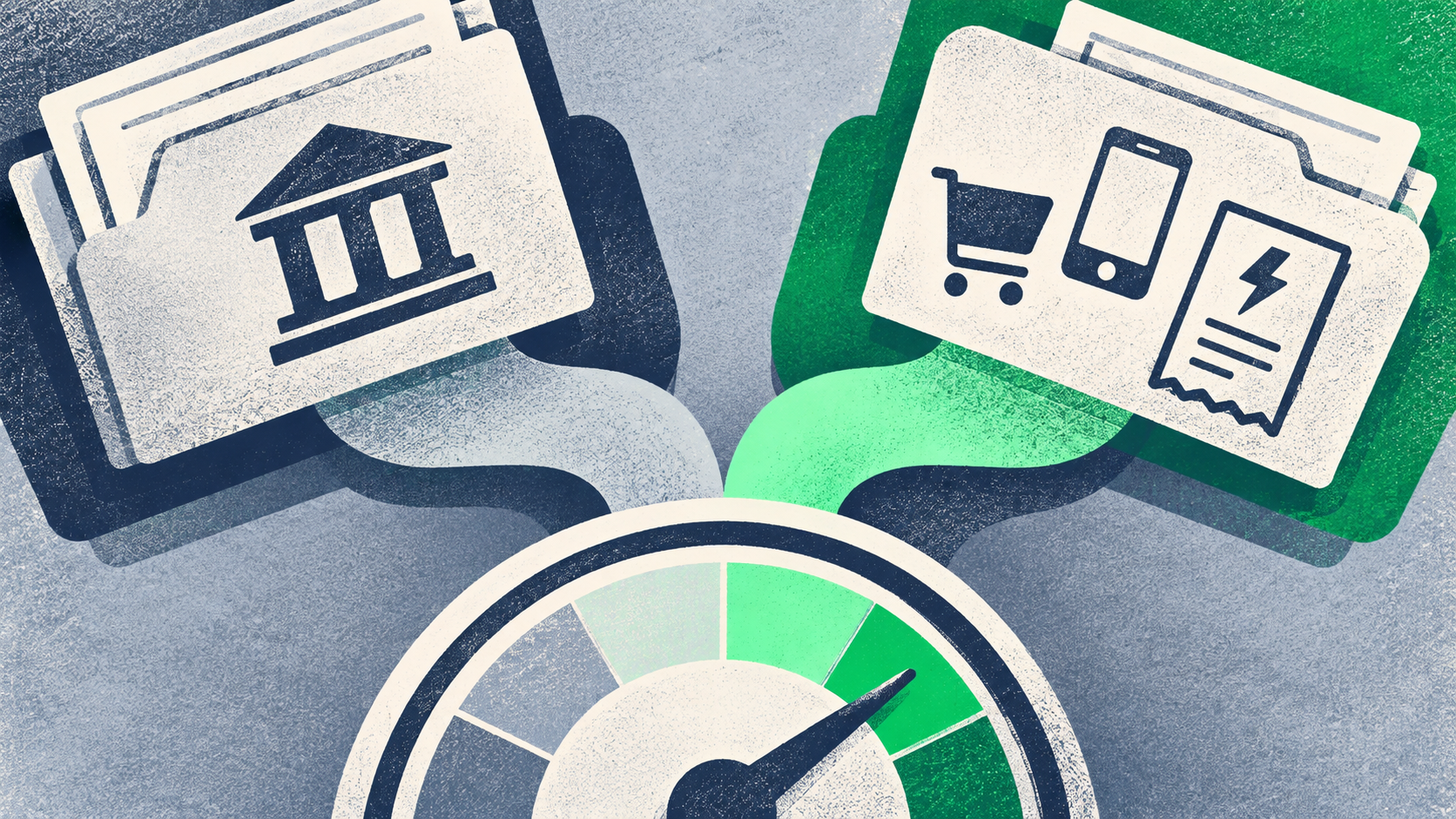
Credit bureau data is a borrower's past borrowing history, as reported to Equifax, Experian, and TransUnion. Alternative data is financial information outside those files, such as bank transactions, cash flow, rent, utility bills, and accounting records. In practice, lenders usually add alternative data to bureau data rather than swapping one for the other.
Federal regulators set out a formal definition in the 2019 interagency statement on alternative data. In its words, "alternative data means information not typically found in the consumer's credit files of the nationwide consumer reporting agencies or customarily provided by consumers as part of applications for credit." That line matters because each side of it comes with different data quality checks and compliance duties.
What Credit Bureau Data Includes
Credit bureau data comes from furnishers, which are lenders and servicers that report account activity to the bureaus. Furnishers typically report on a regular cycle, often monthly.
A consumer credit file usually holds five main parts:
- Tradelines: Each credit account, such as a card, auto loan, or mortgage, with its limit and status.
- Payment history: A record of whether each payment arrived on time, late, or not at all.
- Balances and utilization: The amount owed and the share of available revolving credit in use.
- Inquiries: A list of recent credit applications that pulled the file.
- Collections and public records: Debts sent to collectors and court items such as bankruptcies.
Scoring models such as FICO and VantageScore turn these fields into one number. Trended data shows balances and payments across many months, so lenders can see whether a borrower pays down debt or only makes minimum payments.
Many teams reach this data through credit bureau API integrations that return reports and scores inside the application flow.
For SMB lenders, business bureaus, including Experian Business, Dun & Bradstreet, and Equifax Business, track trade payments, liens, judgments, and basic company details. For a field-by-field breakdown, see what a business credit report shows.
What Counts as Alternative Data
Alternative data, also called supplemental data or alternative financial data, reaches lenders in two main ways.
Consumer-permissioned data is shared directly by the borrower, often by linking a bank account through a data aggregator. Furnished data is sent by a third party, such as a rent reporting service, to a data vendor or bureau. Some rent and utility payments now appear in bureau files, which blurs the line.
Bank Transactions and Cash Flow Data
Cash flow data is the record of money moving in and out of a borrower's accounts. Lenders review deposits, average balances, and NSF events, which are payments returned for non-sufficient funds. These signals show income stability and how a borrower handles everyday bills.
This data usually arrives through a permissioned bank connection, so it can be current to recent account activity. For fields and setup, read about bank data in underwriting.
Rent and Utility Payments
This category covers on-time rent, utility, and telecom payments. On-time payments for these bills often are not reported to bureaus, so positive history can go unseen.
Lenders can collect this history through reporting services, landlord records, or bank statements. Treat it as one more input to test in your own models.
Accounting and Commerce Data
For small businesses, alternative data often comes from the tools owners use to run the company. Accounting ledgers, open invoices, payment processor deposits, and marketplace sales can show revenue trends and how much income depends on a few customers.
These sources can fill gaps when a young company has a thin file, meaning too little credit history to score. Compare the options in this guide to SMB underwriting data sources.
Side-by-Side Comparison of Bureau and Alternative Data
Bureau data and alternative data answer different questions about the same borrower. The table compares them on the factors risk teams review most.
A permissible purpose is a legal reason to pull a report, such as a credit application. A credit invisible consumer has no record at a nationwide bureau.
The CFPB's corrected credit invisibles estimate updated older, widely cited figures. "We estimate the share of the U.S. adult population who are credit invisible in 2020 to be 2.7 percent," the CFPB wrote. That equals about 7.0 million people as of December 2020, which shifts focus toward thin files and stale bureau snapshots.
Where Each Data Source Adds Predictive Lift
Bureau data brings depth and shared standards, while alternative data brings speed and reach.
- Standardized fields: Bureau reports use a shared format, so one credit policy can read every file the same way.
- Dispute rights: Consumer reporting data must be accurate and disputable under the FCRA, which builds in a correction process.
- Long history: Files can span years and show how a borrower handles debt over time.
- Real-time signals: Bank and commerce data can reveal a recent job change, revenue dip, or new income stream.
- Thin-file reach: Cash flow and bill payment data give lenders more to evaluate when a file is sparse.
Two recent FinRegLab studies tested combining both sources. Each is a single study, so validate the findings on your own portfolio.
The consumer results come from FinRegLab's consumer underwriting study, supported by Capital One and JPMorgan Chase. The study's headline result: "the machine model that combined credit bureau data with cash flow data was the most predictive overall and across all subgroups."
The small business findings used loans from two fintech lenders, as described in FinRegLab small business research. "Models that added cash-flow variables to personal credit scores and other traditional inputs predicted default risk more accurately across all borrower segments analyzed," FinRegLab reported.
Alternative credit scoring models apply the same idea by blending bureau and cash flow inputs into one alternative data credit score. Results depend on the data, the borrower mix, and model design.
Bureau data still anchors SMB lending because many owners back business loans personally. The Federal Reserve Banks' 2026 Small Business Credit Survey found: "Of firms that have debt, 59% used a personal guarantee to secure their debt." A personal guarantee makes the owner liable, so their consumer credit file stays part of the decision.
Compliance Considerations for Each Data Source
The rules depend on where the data comes from and how you use it. This section is a general overview and is not legal advice, so review your program with counsel.
FCRA and ECOA
The Fair Credit Reporting Act (FCRA) governs consumer reports. Under the FCRA, consumer reporting data must be accurate and disputable. Alternative data can fall under the FCRA when a third party assembles it for credit decisions.
The Equal Credit Opportunity Act (ECOA) and its rule, Regulation B, ban credit discrimination. When you deny credit or change terms, you must send a notice that lists the specific principal reasons. Review adverse action notice requirements before adding new data fields, since reasons tied to new data must still be specific and accurate.
On May 12, 2025, the CFPB withdrew two adverse action circulars issued in 2022 and 2023. The adverse action requirements under Regulation B and the FCRA remain in place.
Under the CFPB's 2026 Regulation B rule, "the CFPB removed the 'effects test' from the regulation." The effects test, also called disparate impact, looked at whether a neutral policy had an outsized effect on a protected group. The CFPB issued the final rule on April 22, 2026, and it took effect July 21, 2026.
Disparate treatment, which means treating applicants differently because of a protected trait, is still prohibited. State laws may also apply.
The Interagency Statement and Section 1033
The 2019 interagency statement came from five federal agencies, including the CFPB and the Federal Reserve. It noted that cash flow data "can generally be explained and disclosed to the borrower," including in adverse action notices. It also described second look programs, which re-review applicants who would otherwise be declined, and urged lenders to manage consumer protection risks.
Section 1033 of the Dodd-Frank Act gives consumers the right to access and share their financial data. The rule is codified, but an October 29, 2025, court order in the Eastern District of Kentucky bars the CFPB from enforcing it during reconsideration.
The CFPB's personal financial data rights page tracks that process. It notes, "On August 22, 2025, the CFPB released an Advance Notice of Proposed Rulemaking on Personal Financial Data Rights Reconsideration."
In August 2026, the CFPB's revised proposal was sent for White House review at OIRA. Check the CFPB's site for the latest status.
How Lenders Combine Both in a Decision Waterfall
A decision waterfall runs each application through ordered data checks and lender options. A decline at one step can become an offer at the next. For the mechanics, see how a credit waterfall works. A typical flow follows five steps:
- Pull the bureau file: Start with consumer or business bureau data, plus the owner's file when a personal guarantee applies.
- Apply credit rules: Run knockout rules and score cutoffs to approve, decline, or flag each file for review.
- Enrich with alternative data: Add bank, cash flow, or accounting data with borrower consent for thin files and borderline scores.
- Run a second look: Re-review declined applicants with the added data against a separate, documented policy.
- Route to the right lender: Send the file to a lender whose credit box fits and log the reasons for every decline.
Lendflow's Data Orchestration makes this flow simple. Lenders can connect with top integration partners in minutes and build decline waterfalls that ensure no deal leaves money on the table. Because Lendflow does not sell data, teams choose the bureau and alternative sources that fit their own credit policy.
Skip hard-coded vendor logic and use credit underwriting and decisioning tools to set rules, enrichment steps, and routing in one workflow. When a first lender declines a file, Lendflow's Second Look Marketplace gives that application another path to an offer.
Frequently Asked Questions About Bureau and Alternative Data
What is the difference between credit bureau data and alternative data?
Credit bureau data is past borrowing history reported to Equifax, Experian, and TransUnion, while alternative data is credit-relevant information outside those files. Examples include bank transactions, rent, and accounting records.
Can alternative data replace credit bureau data?
Alternative data usually supplements bureau data instead of replacing it. FinRegLab's single-study findings favored models that combined both sources.
Do lenders need consent to use alternative data?
Bank and accounting data usually requires the borrower to link accounts and grant permission. Furnished data from vendors may instead fall under FCRA permissible purpose rules.
Which type of alternative credit data gets the most attention?
Bank transaction and cash flow data gets the most attention in research and guidance, including FinRegLab's studies and the 2019 interagency statement.
Is alternative data riskier for fair lending?
It can be, because any variable may act as a stand-in for a protected trait. Test models closely and document clear reasons for every decision, since disparate treatment remains prohibited.
Does alternative data help SMB lending?
FinRegLab's small business research, based on loans from two fintech lenders, found that adding cash flow variables improved default prediction across the segments studied. Lenders should validate that result on their own portfolios.
Build Smarter Credit Decisions With Both Data Sources
The real choice in credit bureau data vs alternative data is how to layer them. Test both sources together, document every decision reason, and track 2026 rule changes.
Ready to connect every data source in one waterfall? Book a demo to see how Lendflow can help you scale smarter.