[.green-span]How Is AI Used in Lending? 7 Use Cases Shaping the Industry in 2026[.green-span]

What has changed is the scope of those applications. AI is increasingly moving beyond individual productivity tools and becoming part of the infrastructure connecting lenders, borrowers, data, and distribution partners. Experian found that 89% of surveyed lenders believe AI will play a critical role across the lending lifecycle, while new technologies such as AI agents and Model Context Protocol (MCP) are creating additional ways to automate lending workflows.
Here are seven ways AI is being used in lending in 2026.
1. Finding and reaching the right borrowers
AI's role in lending can begin before an application is ever submitted.
Lenders can use AI to analyze audiences, identify potential customer segments, generate educational and marketing content, and personalize campaigns around specific financing needs. Forrester identifies personalized marketing as an emerging lending use case, including using predictive and generative AI to map and generate content for different customers.
This is becoming particularly important as the way borrowers discover financial products changes. PwC's 2026 Consumer Lending Radar found that nearly a third of borrowers now use AI tools to research loans, and 67% expect AI to inform their next borrowing decision.
For lenders, digital positioning therefore increasingly extends beyond traditional SEO and paid acquisition. Content needs to be structured so that search engines, answer engines, AI assistants, and other digital channels can understand which borrowers and financing scenarios a product is designed to serve.
2. Using AI to route better-fit deals to lenders
AI can also change how lenders source deals.
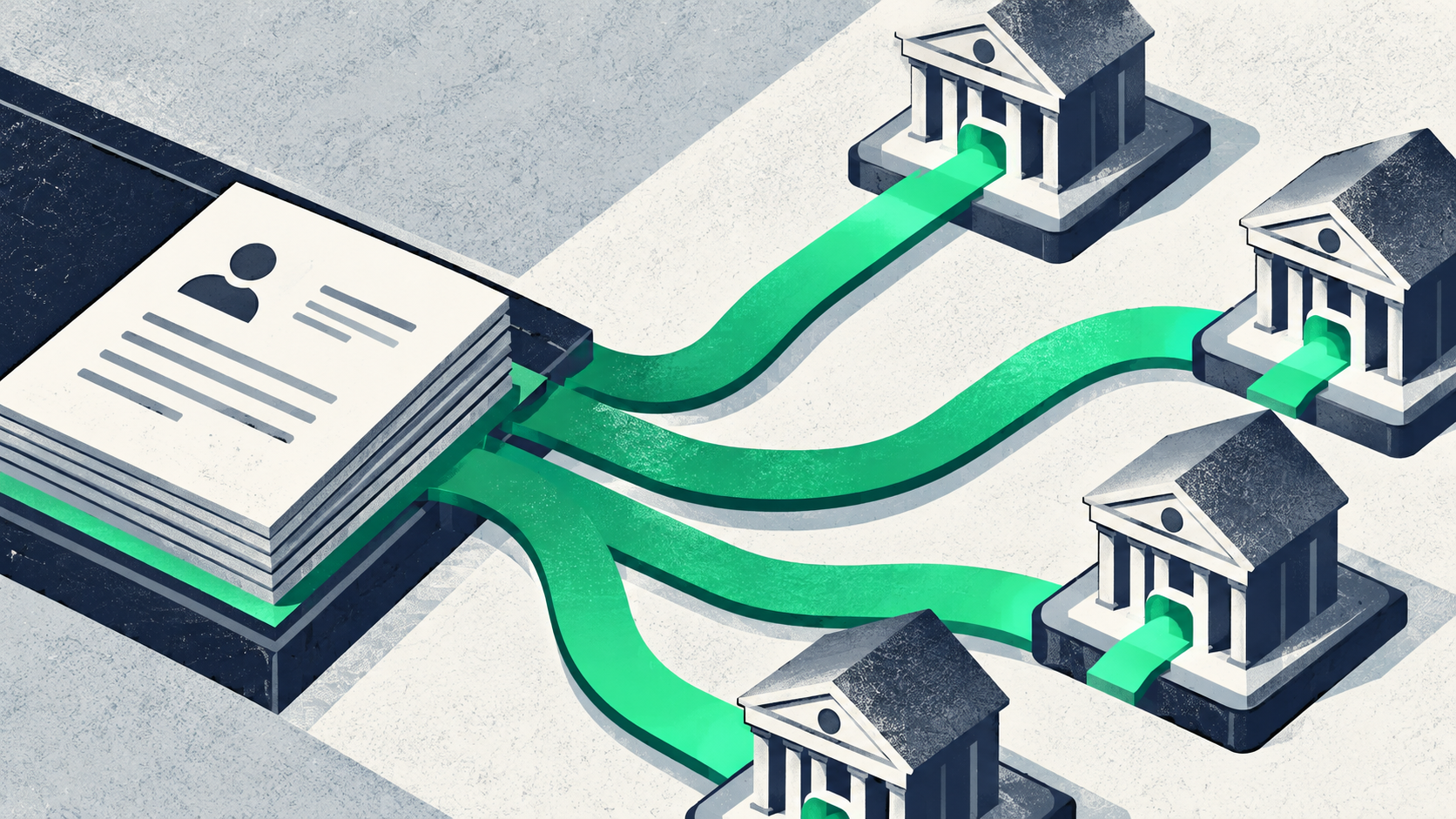
Rather than relying entirely on direct borrower acquisition or traditional referral relationships, lenders can partner with technology platforms that use data and automated criteria to determine which financing options may fit an application.
A lender can define parameters such as loan size, industry, geography, revenue, time in business, credit characteristics, and other eligibility requirements. Applications can then be evaluated against those criteria and routed toward appropriate lending partners.
For lenders, this creates a new type of AI-enabled distribution channel. Instead of simply generating more leads, technology can help improve the fit of opportunities entering the lender's pipeline.
Lendflow Connect supports this model through multi-lender orchestration and routing infrastructure, helping platforms connect applications with lending partners based on their respective criteria.
3. Making underwriting more dynamic
Underwriting remains one of the most established uses for AI in lending, but its role continues to evolve.
AI and machine learning can help lenders analyze larger sets of traditional and alternative data, identify relevant attributes, classify businesses, detect patterns, and support credit decisions. More advanced workflows can combine these capabilities with scorecards, pricing models, and multi-stage underwriting.
In 2026, the emphasis is increasingly on combining automation with explainability. Rather than treating AI as an independent decision-maker, lenders can use it to prepare information, surface risks, automate straightforward cases, and send exceptions to an underwriter.
This is where capabilities such as Lendflow Intelligence can help lenders orchestrate data and decisioning while maintaining configurable credit policies and human oversight.
4. Turning documents into usable lending data
Documents have traditionally created one of the biggest manual bottlenecks in lending. Bank statements, identification, tax documents, contracts, and other files may need to be collected, classified, reviewed, and entered into other systems.
Document AI changes that process by turning unstructured files into structured information that downstream workflows can use.
In practice, an AI system can identify document types, extract relevant fields, check whether required information is present, and flag exceptions for review. Some of the latest systems go further by combining document analysis with other underwriting tasks. For example, AI underwriting agents introduced in 2026 are being used to analyze bank statements, tax information, public records, and other information as part of a broader assessment.
This allows lenders to spend less time processing files and more time reviewing the information that actually requires judgment.
5. Creating always-on borrower engagement
AI is also becoming a front-line communication tool.
Voice, email, SMS, and chat agents can answer common questions, follow up on incomplete applications, request missing information, qualify prospects, and route borrowers to employees when human assistance is needed.
These systems are increasingly being connected directly with lender workflows rather than operating as standalone chatbots. For example, AI voice agents are already being used in mortgage lending to qualify borrowers and route qualified opportunities to loan officers.
Lendflow Automate applies this model across voice, SMS, email, and chat, giving lending teams a way to automate repetitive communication while keeping humans involved when escalation is necessary.
6. Giving AI agents access to lending infrastructure
One of the biggest changes in 2026 is not a single AI use case. It is how AI connects with lending software.
Model Context Protocol provides a standardized way for AI applications and agents to interact with external systems. Multiple lending technology providers introduced MCP capabilities in 2026, reflecting a broader movement toward making lending infrastructure accessible to AI agents.
Lendflow launched its own hosted MCP server earlier this year, allowing users to interact with Lendflow through compatible AI environments without installing their own server.
Lendflow MCP is now also live on Claude and Grok, expanding the environments through which current and future users can access Lendflow capabilities. The long-term opportunity is a more conversational lending experience where employees can ask an AI assistant for information or initiate supported workflows without navigating through multiple screens and systems.
7. Moving from task automation to agentic lending operations
The broader shift behind many of these developments is agentic AI.
Traditional automation follows predefined steps. AI agents can interpret information, determine what should happen next, use available tools, and escalate situations that require human review.
For lending teams, this can connect previously separate activities. An agent might identify missing application information, contact the borrower, process the resulting documents, update the application, and prepare the deal for its next stage.
Early production deployments suggest this model is moving beyond experimentation. In August 2026, Blend reported that its pre-underwriting agent had processed more than 50,000 live production loans, with participating lender cohorts seeing shorter loan-cycle times and more fulfillment work automated.
What AI in lending looks like in 2026
The most important change in 2026 is that AI is expanding beyond underwriting.
It can help lenders find borrowers, position products in AI-driven discovery channels, receive better-fit opportunities from distribution partners, analyze documents, communicate with applicants, support credit decisions, and automate operational workflows.
The next competitive advantage may therefore come from how well these capabilities work together. Lendflow's approach brings distribution through Connect, data and decisioning through Intelligence, and AI-powered workflow automation through Automate into a connected lending infrastructure.
As MCP and agentic AI continue to mature, the line between lending software and AI will likely become increasingly difficult to separate. Instead of logging into individual tools to complete every step, lending teams will increasingly be able to tell AI what they need to accomplish and let connected infrastructure help execute the work.