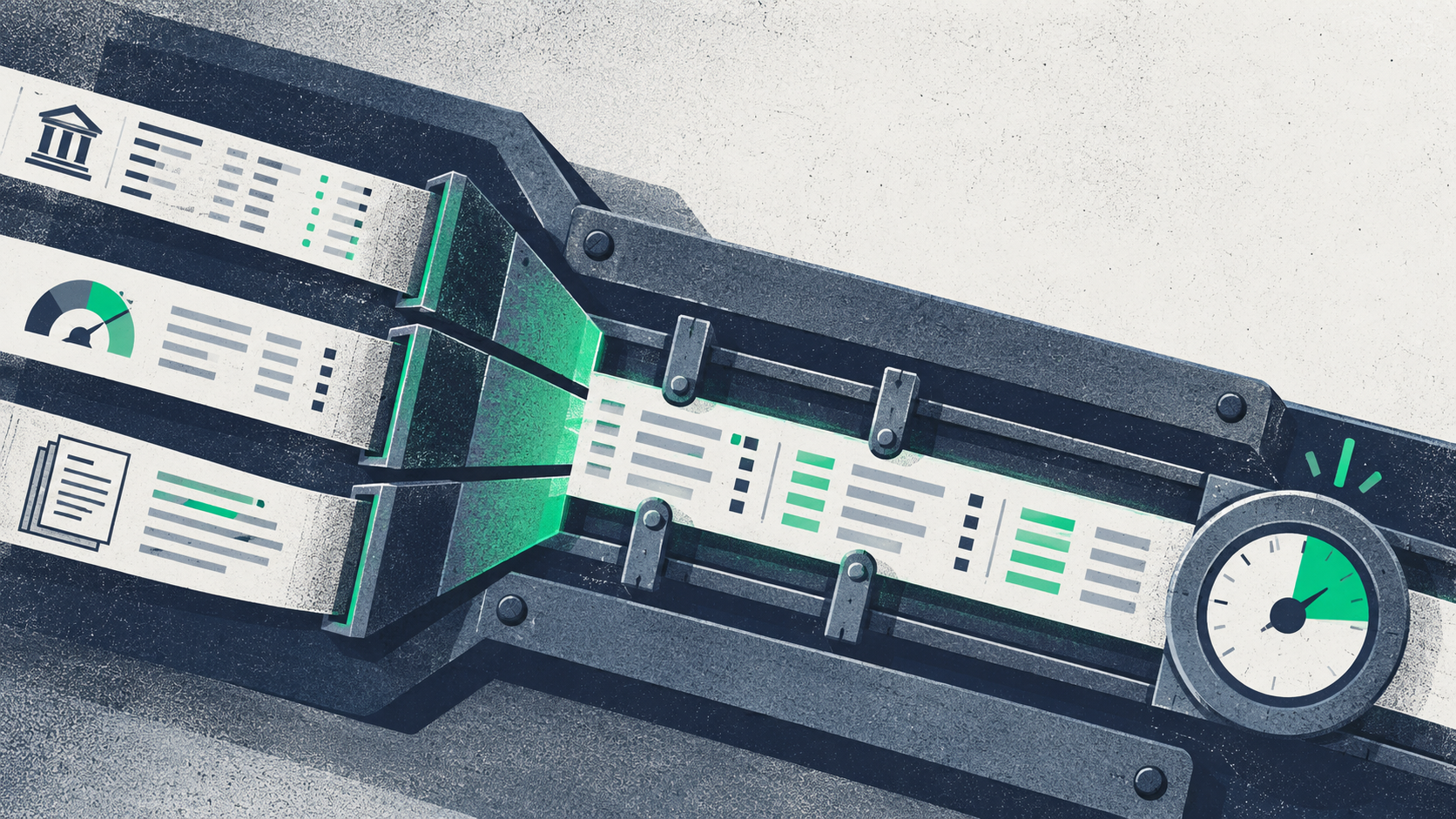
[.green-span]How Does Financial Data Aggregation Help Underwriting?[.green-span]
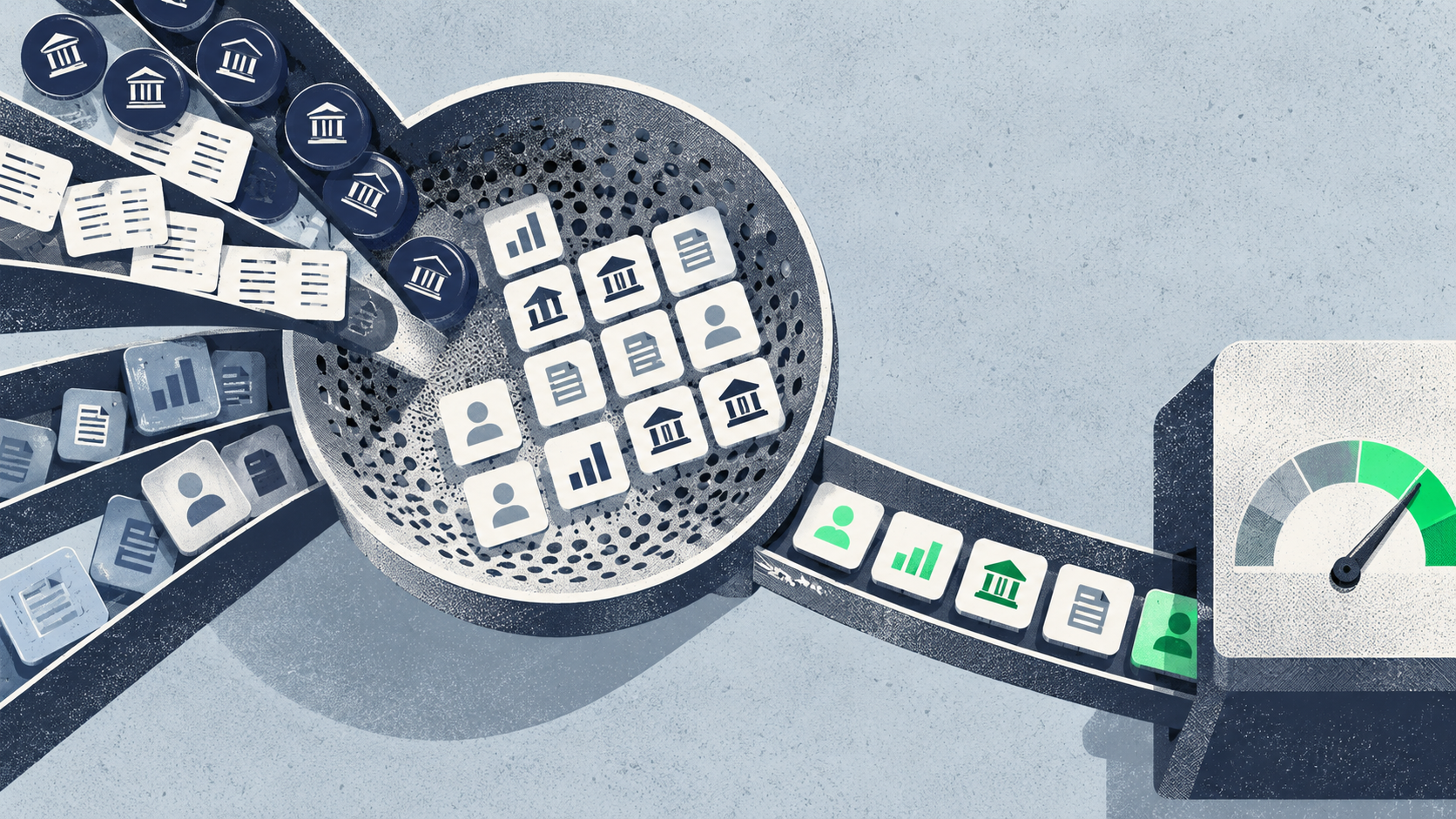
For lenders, the value is not simply having more data. The goal is to make the right information available at the right stage of underwriting so teams can assess risk faster, apply policies consistently, and reserve human review for applications that genuinely require judgment.
What financial data can be aggregated?
The right data mix depends on the product, applicant, loan size, and credit policy. Common sources include:
- Consumer and commercial credit reports
- Bank transactions, balances, and cash flow
- Accounting and payroll platforms
- Tax returns, bank statements, and financial documents
- KYC, KYB, ownership, and fraud data
- Industry, business registration, and alternative data
Each source answers a different question. Credit data describes historical repayment behavior, while current bank activity can reveal revenue consistency, liquidity, and recent financial pressure. Business and identity data help verify that the applicant is legitimate, and accounting records can provide a deeper view of profitability and obligations.
How aggregation improves underwriting decisions
It creates a more complete borrower view
A credit score alone rarely tells the full story, especially in small business lending. A business may have a limited credit file but stable deposits and healthy balances. Another applicant may have strong historical credit but declining revenue or frequent negative balance events.
Aggregation allows those signals to be evaluated together. That additional context can help lenders distinguish between applicants who appear similar when viewed through only one source.
It reduces data preparation
Manual underwriting often includes work that is necessary but not analytical: retrieving reports, downloading files, calculating revenue, and re-keying values into a loan operating system. Aggregation can retrieve and normalize those inputs automatically, allowing analysts to focus on exceptions and risk.
It supports consistent policies
Structured data makes it easier to calculate the same metrics in the same way for every application. Lenders can define consistent treatments for monthly revenue, average balances, utilization, time in business, or existing obligations, then document how those fields influence the decision.
It enables automated decisioning
Decision engines require predictable inputs. Information trapped in PDFs or disconnected portals cannot easily trigger a rule. Once aggregated and normalized, data can drive approvals, declines, conditional decisions, pricing, requests for more information, or manual-review queues.
What an aggregated underwriting workflow looks like
A modern workflow commonly follows these steps:
- The borrower submits an application and authorizes the required data access.
- The platform performs initial identity, business, and eligibility checks.
- Relevant providers return bank, credit, accounting, or verification data.
- The platform maps different formats into standardized fields.
- Rules, scorecards, or models evaluate the consolidated profile.
- Clear cases proceed automatically while exceptions reach an underwriter with supporting context.
This sequence can also be progressive. A lender might run lower-cost eligibility checks first, retrieve bank data for qualified applicants, and request additional documents only when earlier signals are inconclusive. That helps control both data costs and borrower friction.
Why standardization matters
Collection is only half of aggregation. Providers may use different names, formats, and definitions for similar information. Documents introduce additional complexity because important values may appear in tables, scans, or inconsistent layouts.
Normalization creates a shared data model that rules and systems can use. It also makes it easier to compare providers, change vendors, reuse policies across products, and audit how an input moved from its source into a decision.
Does aggregation eliminate manual underwriting?
Not necessarily. It changes where human effort is applied. Straightforward applications can move through predefined rules, while incomplete, contradictory, borderline, or unusual files can be escalated.
The underwriter starts with a consolidated profile rather than an empty worksheet. This human-in-the-loop model can improve speed without forcing a lender to automate decisions that fall outside its risk appetite.
How Lendflow supports financial data aggregation
Lendflow Intelligence brings data access, normalization, scorecards, and decision workflows into one lending infrastructure. Teams can combine traditional and alternative sources, sequence checks based on policy, create derived attributes, and use the resulting information in configurable underwriting stages.
Lendflow can also connect the decision to the rest of the borrower journey. Connect supports intake and lender orchestration, while Automate can extract information from documents and manage follow-up through AI-powered communications. Together, these capabilities help move data around the decision instead of making credit teams assemble every file manually.
Frequently asked questions
What is financial data aggregation in lending?
It is the process of collecting information from multiple financial and verification sources, converting it into a consistent structure, and making it available for underwriting.
Can aggregated data speed up approvals?
Yes. It reduces retrieval, re-keying, and calculation work, allowing decision rules or analysts to evaluate an application sooner.
Is more data always better?
No. A strong strategy prioritizes information that materially improves the decision and sequences data requests to manage cost and friction.