[.green-span]Data Aggregation Platform: Definition, Architecture, and Use Cases[.green-span]

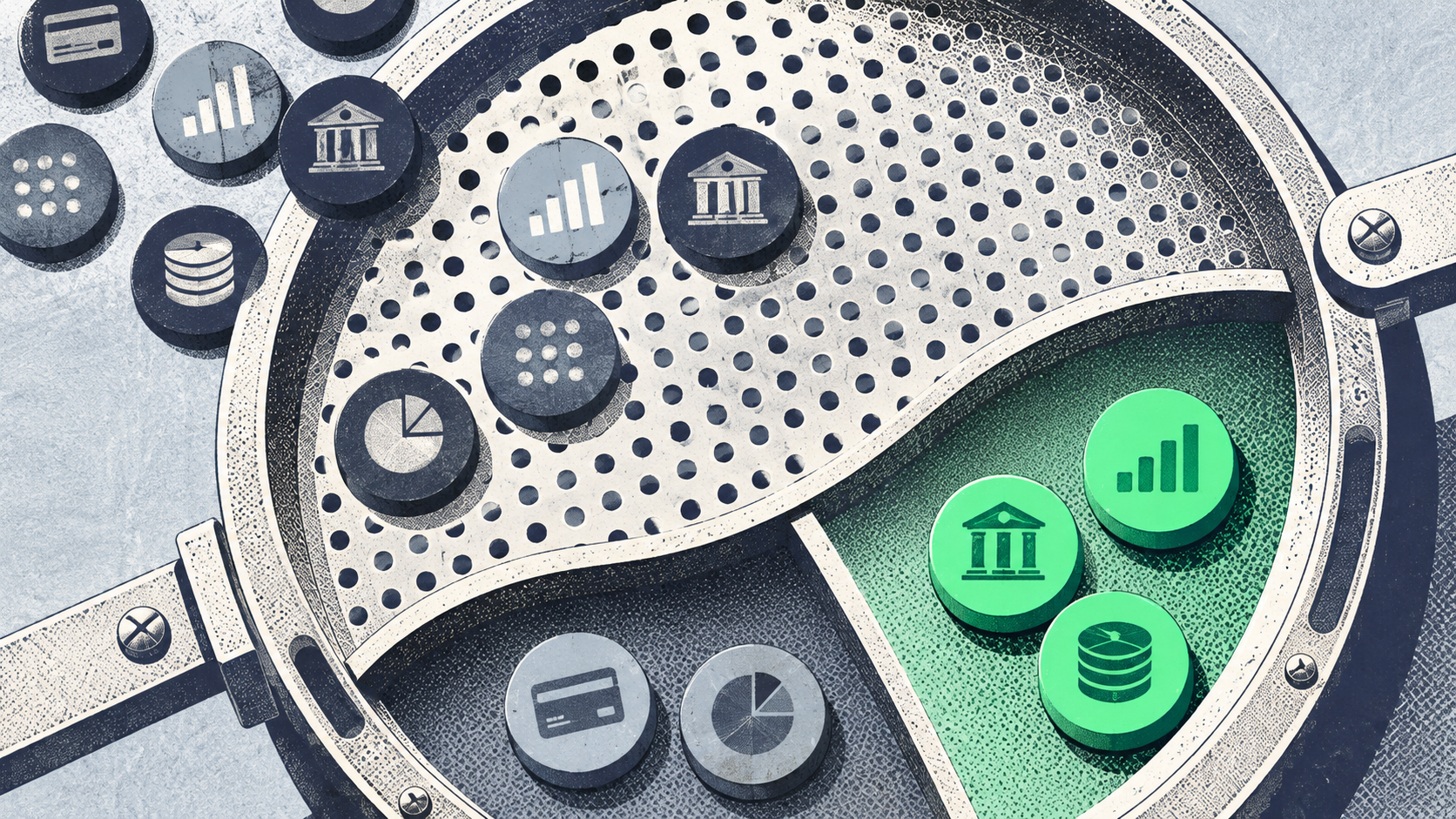
A data aggregation platform is software that connects to many data sources and combines their records into one consistent, usable dataset. In simple terms, aggregation means gathering scattered information into one organized view that you can analyze or act on.
The term appears in finance, analytics, healthcare, and connected devices, and its meaning shifts slightly in each one. This guide explains how a data aggregation platform works and how it compares with ETL tools, data warehouses, and data lakes. It also covers how to evaluate a platform and avoid common mistakes, using lending as the main example.
What a Data Aggregation Platform Means in Plain Language
A data aggregation platform gives a team one reliable place to get data that would otherwise live in many separate systems. The definition builds on the broader idea of data aggregation.
TechTarget defines data aggregation as "any process whereby data is gathered and expressed in a summary form." It calls the tools that do this work data aggregators, which typically collect, process, and present the combined data.
No single industry standard defines a data aggregation platform as a product category. At Lendflow, we use the term for software that connects to sources and delivers data that is complete, consistent, and ready for a decision.
What "Aggregation" Means in Simple Terms
Aggregation means combining pieces of data that belong together. A small business might keep revenue in a bank account, invoices in accounting software, and ownership details on a tax return, and aggregation joins them.
The word carries three common senses, so it helps to know which one a writer intends:
- Summarizing data: analytics teams roll detailed records up into totals, averages, or trends for reporting.
- Connecting accounts: fintech companies pull a person's or business's financial accounts into one feed with permission.
- Combining regulated records: HIPAA uses the term narrowly for one type of health information sharing, covered later in this guide.
Why Scattered Data Is Expensive to Ignore
When the same customer or business looks different in each system, teams spend significant time reconciling records by hand before they can make a decision. Overlaps, gaps, and inconsistencies between sources also raise the risk that a decision rests on incomplete or conflicting information.
A dedicated aggregation platform addresses both problems by resolving those differences before the data reaches the teams and systems that use it.
Core Components of a Data Aggregation Platform
Most platforms can be understood as five connected layers that move data toward the place where it gets used. This five-part model is Lendflow's framing for explaining the architecture, and other vendors may group or name the layers differently.
Connectors Reach Every Source You Rely On
Connectors are the links between the platform and each source, such as bank APIs, credit bureaus, accounting systems, payroll providers, and document uploads. Strong coverage lets the platform reach the sources your decisions depend on without a custom build for each one.
Ingestion Brings Data In on a Reliable Schedule
Ingestion pulls data through those connectors, either in real time when an event happens or in scheduled batches. A good ingestion layer handles failed requests, retries, and partial responses, so missing records get flagged instead of silently dropped.
Normalization Makes Every Source Speak the Same Language
Normalization converts records into one shared format, with consistent field names, dates, currencies, and categories. Without this step, a "deposit" at one bank and a "credit" at another look different, even when both describe the same transaction.
Enrichment Adds the Context Decisions Need
Enrichment adds information that raw data lacks, such as transaction categories, industry codes, or calculated metrics like average monthly revenue. For example, the Industry Map Agent in Lendflow Automate assigns NAICS and SIC codes to businesses automatically.
Delivery Puts Clean Data Where Teams Work
Delivery sends the finished dataset to the systems that use it, such as a decisioning engine, a CRM, a dashboard, or a data warehouse. Common delivery methods include APIs, webhooks, file exports, and direct connections to downstream tools.
How Data Aggregation Works Step by Step
The process follows the same basic sequence whether the data describes loan applicants, marketing campaigns, or machine sensors. The steps below use a small business loan application as the running example.
- Define the decision first. Decide what question the data must answer, such as whether an applicant can support a monthly payment.
- Map and permission the sources. List every source you need, and capture the applicant's consent wherever access requires it.
- Connect and ingest the data. The platform pulls records through APIs or parses uploaded documents, and it logs any failed pulls.
- Normalize records into one schema. Fields from each source map to a shared format, and duplicate accounts or businesses get matched.
- Enrich and validate the dataset. The platform adds categories and metrics, then flags conflicts such as revenue that differs between bank data and tax returns.
- Deliver the result for a decision. The unified file goes to underwriting rules, a credit model, or a reviewer, with each data point's source attached.
- Refresh and monitor over time. The team refreshes connections when new data is needed and tracks failure rates and freshness by source.
Documents are often the slowest step for lenders, because bank statements and tax returns usually arrive as PDFs. The Data Extraction Agent in Lendflow Automate turns PDFs, IDs, tax returns, and bank files into standardized JSON outputs.
Lendflow reports that Lendflow Automate delivers 80% faster document review. That speed matters because extraction feeds every later step in the sequence.
Types of Data Aggregation Platforms and Common Use Cases
The same architecture supports very different jobs depending on the industry and the data involved. Financial data aggregation is the deepest use case, so it gets the most detail here.
Financial and Lending Data Aggregation
The Financial Data Exchange (FDX) reported more than 114 million customer accounts connected through APIs aligned with FDX technical standards as of April 2026. That figure counts accounts rather than people, and it covers only FDX-aligned connections.
In lending, aggregation combines bank transactions, credit bureau data, business records, and documents into one view of an applicant. A July 2025 FinRegLab study found that a model combining bureau and cash-flow data was the most predictive overall and across all subgroups.
That study used one nationwide bureau plus bank account data from a data aggregator, tested on consumer accounts opened in 2018 and 2019. Its results apply to that scope, but it still shows how some signals only appear when separate sources sit side by side.
Lendflow splits this work across connected products. Lendflow Intelligence aggregates credit and business data and turns it into lending decisions through automated credit decisioning.
Lendflow reports 85% faster time to decision with Lendflow Intelligence. Lendflow Connect provides the embedded lending infrastructure, linking brands to a network of 75+ specialty and bank lenders through a single integration.
For a lender-specific view, read what a data aggregation platform does for lenders.
Our practical guide to financial data aggregation for underwriting goes deeper on building the underwriting workflow itself.
Where Section 1033 Stands for Financial Data Sharing
Section 1033 of the Dodd-Frank Act gives consumers a right to access their financial data and share it with third parties they authorize. Bloom Credit's plain-language guide explains the rule's current position for financial institutions.
The CFPB released a final rule implementing that right on October 22, 2024. The Congressional Research Service notes that the rule is the subject of litigation and reconsideration by new CFPB leadership.
A federal court in the Eastern District of Kentucky stayed the compliance deadlines and enjoined enforcement until the CFPB completes its reconsideration. As a result, the first compliance date of April 1, 2026 passed without effect.
The CFPB sent a revised proposal for OIRA review in August 2026. As of October 2026, the revised proposal was still under White House (OIRA) review, according to Bloom Credit. Confirm the current status before making compliance decisions.
Business Intelligence and Marketing Data Aggregation
Analytics and marketing teams aggregate data from ad platforms, web analytics, CRMs, and sales systems to report on performance in one place. This use matches TechTarget's summary-focused definition, where detailed records roll up into totals and trends.
Healthcare Data Aggregation Under HIPAA
HIPAA gives the term a narrow legal meaning. Under 45 CFR 164.501, it means a business associate combining protected health information received from more than one covered entity.
The combined data must permit "data analyses that relate to the health care operations" of those covered entities. Because the definition is this specific, healthcare teams should read the regulation itself rather than rely on the general meaning of the term.
IoT and Sensor Data Aggregation
Connected devices produce continuous streams of readings that need to be combined before anyone can analyze them. AWS lists Internet of Things (IoT) sensors among the common sources organizations collect data from, alongside applications, vendors, and other third parties.
Data Aggregation Platform vs. ETL, Data Warehouse, and Data Lake
These four terms overlap, and organizations often use them together, but each handles a different part of the data journey. The adjacent definitions below follow AWS, and the aggregation platform row reflects Lendflow's framing.
AWS notes that a warehouse typically requires preprocessing, with ETL tools cleaning, filtering, and structuring data before storage. Lakes typically use ELT instead, which loads raw data first and transforms it afterward.
An aggregation platform often feeds a warehouse or lake, or sits alongside them, because its focus is reaching sources and producing consistent data. Many organizations use all four, and AWS notes that most large organizations combine lakes, warehouses, and data marts.
How to Evaluate a Data Aggregation Platform
No industry standard defines how to compare platforms, so the criteria below are Lendflow's editorial recommendations. Weigh each one against the decisions your team actually needs to make.
- Source coverage: Confirm native connectors exist for every source you need, including bank data, bureau reports, accounting systems, and document uploads.
- Consent and permissioning: Check how the platform captures, stores, and honors user consent, and how easily users can revoke access.
- Normalization quality: Request sample outputs from several sources and verify that fields, categories, and duplicates resolve into one clean schema.
- Enrichment depth: Look for added context, such as transaction categories, industry codes, and calculated metrics that match your decision rules.
- Freshness and reliability: Ask how often data refreshes, how failed connections get reported, and what uptime and latency the vendor commits to.
- Security posture: Review independent attestations such as SOC 2 Type II, and confirm how data is encrypted, retained, and deleted.
- Delivery flexibility: Make sure data can reach your systems through APIs, webhooks, or exports without heavy custom work.
- Data lineage: Confirm that each data point traces back to its source and timestamp, which matters for audits and disputes.
Best Practices for Reliable Data Aggregation
The strongest aggregation programs treat data quality as an ongoing process rather than a one-time setup. These practices help teams get dependable results from any platform.
Practices That Keep Aggregated Data Trustworthy
- Start with the decision: Choose sources based on the question you need answered, and skip data that adds cost without changing outcomes.
- Agree on one schema early: Define shared field names and categories before connecting sources, so every new source maps to the same structure.
- Keep source lineage: Store where and when each data point arrived, so reviewers can explain any decision built on it.
- Validate across sources: Compare overlapping values, such as revenue in bank data and tax returns, and flag large differences for review.
- Monitor connections continuously: Track failure rates and freshness by source, because a broken connector can quietly degrade every downstream decision.
Common Pitfalls to Avoid
- Treating aggregation as storage: A pile of raw data in one place still needs normalization before anyone can trust it.
- Ignoring partial data: Missing months of transactions distort cash-flow metrics, so flag incomplete pulls instead of processing them as complete.
- Assuming one legal meaning: "Data aggregation" has a specific HIPAA definition, and federal financial data sharing rules remain under reconsideration.
- Collecting more than you need: Extra sources add consent, security, and cost burdens, so add them only when they improve a decision.
Key Takeaway: Aggregation Is the Foundation for Better Decisions
A data aggregation platform connects separate sources, standardizes their records, adds context, and delivers one dataset that teams can act on. It complements ETL tools, warehouses, and lakes, because its job is to reach sources and make their data consistent.
The meaning of aggregation changes by industry, and HIPAA gives it a particularly narrow legal definition. In lending, the value is clearest when bank, credit, and business data sit side by side, giving credit teams a complete picture instead of fragments.
Frequently Asked Questions About Data Aggregation Platforms
What Is an Aggregator Database?
An aggregator database stores the combined, normalized records that a data aggregator collects from multiple sources. It gives applications one place to query instead of calling every original source each time.
How Is a Data Aggregation Platform Different From a Data Warehouse?
A data aggregation platform connects to sources and produces consistent data, while a data warehouse stores curated, structured data for reporting. Many organizations use an aggregation platform to collect data, then load the results into a warehouse for analysis.
What Data Sources Can a Data Aggregation Platform Connect To?
Platforms commonly connect to bank accounts, credit bureaus, accounting and payroll systems, CRMs, analytics tools, uploaded documents, and IoT sensors. The exact list depends on each vendor's connectors, so check coverage against the sources your process needs.
What Does Data Aggregation Mean Under HIPAA?
Under 45 CFR 164.501, data aggregation means a business associate combining protected health information from more than one covered entity. The combined data supports analyses related to those entities' health care operations, which makes the legal definition much narrower than everyday usage.
What Is the Simple Meaning of Data Aggregation?
Data aggregation means gathering information from several places and combining it into one organized view. That view can be a summary report, a single financial profile, or a unified dataset ready for a decision.
To see how Lendflow approaches connected lending data, explore the Data Graph.