[.green-span]Build vs buy: should you build your own decision engine?[.green-span]
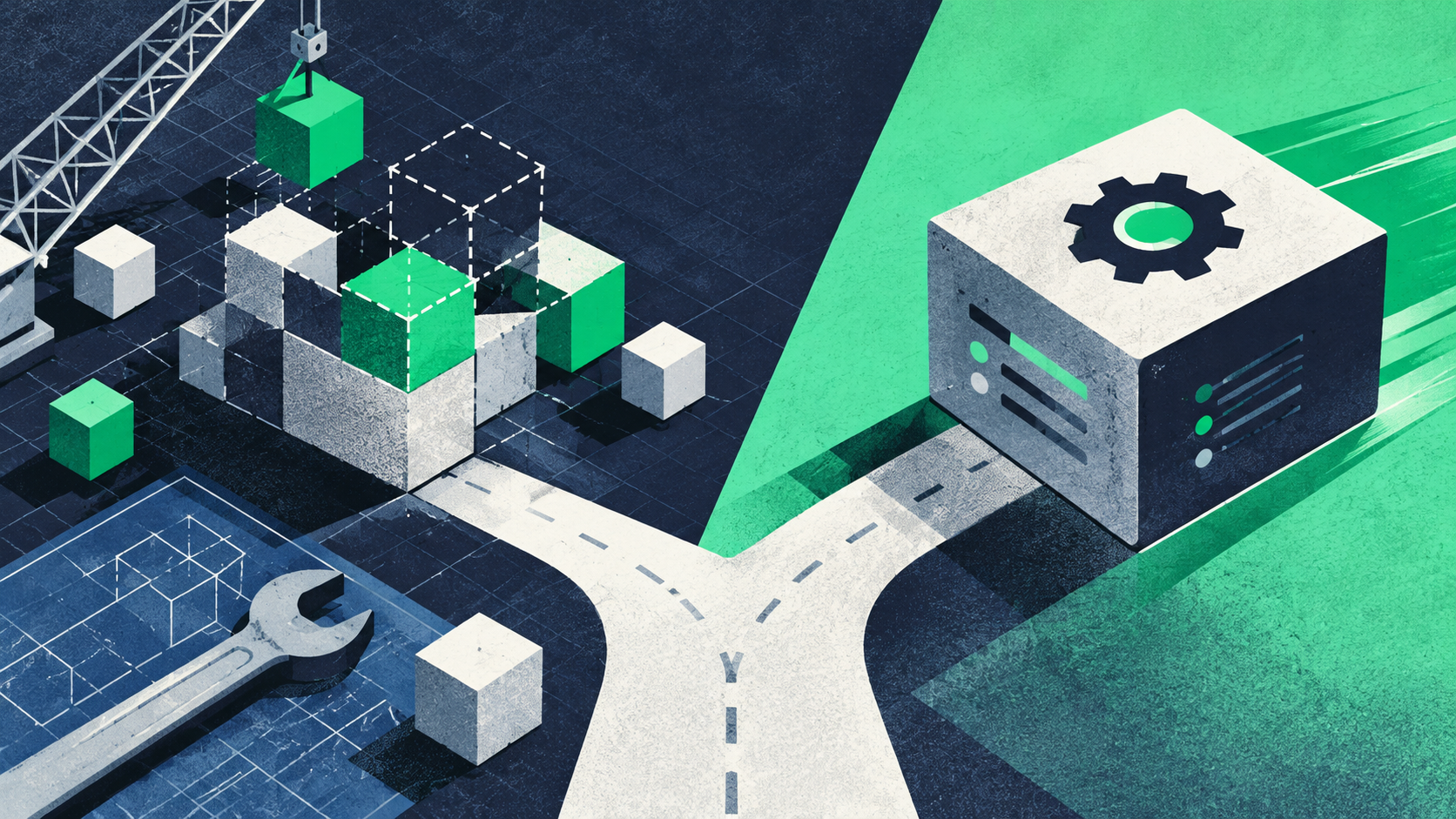
Should you build your own decision engine? For most US lenders, fintechs, and platforms embedding lending, the answer is no. Buy the decisioning infrastructure, data connections, and governance tooling, then build what sets you apart: your credit policy, scorecards, and models.
Build the full engine only when two things are true. Your decisioning logic is a real competitive moat, and you have the engineering, risk, and compliance team to own it for years.
This guide gives you a lending-specific way to answer the build vs buy decision engine question. It covers three-to-five-year cost, a differentiation test, hidden costs, compliance as of October 2026, a scoring framework, and AI-assisted development.
Build vs buy a decision engine: know which layers you own
The useful question is which layers of decisioning you should own. Most lenders win by owning policy and buying the plumbing.
A decision engine is a stack of layers
A production credit decision engine does far more than run rules. It typically stacks these layers:
- Data connections to bureaus, bank transaction data, and business data sources
- Credit policy rules, knockouts, and decline waterfalls
- Scorecards and models, including any machine learning components
- Reason-code generation for adverse action notices
- Workflow routing to manual review, offers, and funding
- Version control, audit logs, and decision records
- Monitoring, testing, and champion-challenger tooling
In our view, only one or two of these layers usually set a lender apart. The rest is plumbing every lender needs.
Run the strategic differentiation test
Ask one question for each layer: would a competitor with the same layer win your customers? If not, buy it and free your team for higher-value work.
In our view, a lender's edge usually lives in credit policy, data choices, model features, and pricing. It rarely lives in the code that calls a bureau.
Compare total cost over three to five years
Upfront price misleads. Compare options over three to five years, using your own inputs for each category below.
Add opportunity cost to the build column: sprints spent on plumbing are sprints taken from your borrower experience.
Hidden costs show up on both sides
Building hides costs in years two through five, when the engine becomes an internal product with its own roadmap and regulatory change queue. Buying hides costs in the contract: per-decision pricing that outpaces revenue, logic you cannot explain, and data you cannot export.
Compliance stays with you either way
Buying a decision engine does not move regulatory responsibility to the vendor. Here is the US picture as of October 2026; confirm specifics with counsel.
Model risk guidance changed in April 2026
On April 17, 2026, the Fed's SR 26-2 superseded SR 11-7, and OCC Bulletin 2026-13 rescinded OCC Bulletin 2011-12. The replacement is guidance, not law, and it is most relevant to banks with over $30 billion in assets.
Its model definition excludes deterministic rule-based processes. In our reading, that suggests rules-only engines carry lighter model-risk exposure than scorecards or machine learning.
Under SR 26-2, vendor models stay in scope, even without access to vendor code. Banks also apply risk-based third-party oversight to vendors.
Fintechs are not directly bound by this guidance. In our experience, expect bank partners to ask for validation evidence anyway.
Reg B still requires specific reasons
Under 12 CFR 1002.9, saying an applicant failed to reach a qualifying score is insufficient. Any engine you build or buy must produce specific principal reasons.
The CFPB withdrew Circulars 2022-03 and 2023-03 on May 12, 2025, but the Reg B duty remains. Vendors can send notices, yet each creditor stays responsible and must be named in the notice.
Business credit notices follow tiers. At $1 million or less in revenue, the notice of action taken may be oral. The right-to-reasons disclosure can be given at application, and reasons otherwise follow the standard rules.
Above $1 million, and for trade credit and factoring at any revenue, written reasons are due if the applicant asks in writing within 60 days. Your engine should apply the right tier per application, so confirm the details with counsel.
Fair lending and FCRA still need attention
The CFPB removed the effects test from Reg B, effective July 21, 2026. That is a federal ECOA change only, and the rule is in force. It faces a lawsuit filed May 27, 2026 in federal district court in D.C., National Fair Housing Alliance v. CFPB.
Per Ballard Spahr, briefing is scheduled into January 2027, and the outcome is uncertain. Keep fair lending monitoring in place and check its status with counsel.
Decisions using consumer reports also carry duties under FCRA section 615(a). Ask counsel how this applies to guarantor pulls.
AI-assisted development changes the first-version math
AI coding assistants can speed up writing code for rules services, integrations, and tests. Validation evidence, reason-code accuracy, audit trails, and on-call coverage still recur every year you run the engine.
AI rules are also still forming. SR 26-2 places generative and agentic AI outside its scope. The OCC said in April 2026 that the agencies plan to issue an AI request for information. As of October 2026, we have found no sign it has been issued.
Where Lendflow fits on the hybrid path
Launch decisioning in weeks. Per Lendflow, most clients launch Lendflow Intelligence in 2 to 4 weeks, with model configuration and testing built into onboarding.
Lendflow offers three products you can adopt alongside your own credit policy:
- Lendflow Connect is an embedded lending marketplace: connect once to reach 75+ lenders through one unified API, hosted flow, or widget, per Lendflow.
- Lendflow Intelligence turns credit and business data into decisions with configurable models and ready-made CRM and banking connectors.
- Lendflow Automate plugs into existing systems via APIs, with AI agents for document extraction, NAICS/SIC classification, and an explainable Trust Score.
Lendflow reports 80% faster document review with its Automate document-analysis agent. Your team keeps ownership of credit policy, risk appetite, and compliance.
Make the build vs buy call in five steps
This framework turns the decision into a scored comparison. Run it with credit risk, engineering, product, and compliance in the room.
1. Map your decisions and data
List every decision point, such as prequalification, approval, pricing, line assignment, and second look. For each one, note the data sources, volume, products, and the adverse action notice tier that applies.
2. Separate moat from plumbing
Run the differentiation test on each layer of the stack. Mark each layer as build, buy, or either.
Policy and models are the usual candidates for build. Data connections, audit logs, and workflow routing are the usual candidates for buy.
3. Model total cost over three to five years
Fill in the cost table above with your own figures for build, buy, and hybrid. Include engineering salaries, vendor quotes, data fees, audit costs, and the revenue you defer while building.
Run a downside case too. Assume the build takes longer than planned and vendor pricing rises with volume.
4. Score each option on weighted criteria
Rate build, buy, and hybrid on a 1 to 5 scale for each criterion below. Weight each criterion by how much it matters to your business, then compare totals.
A close score usually points to hybrid. Buy the layers where buying wins, and build the layers where your moat lives.
5. Pressure-test with risk, compliance, and partners
Share the scorecard with credit risk, compliance, and any bank partner before you commit. Ask counsel to confirm adverse action handling for consumer and business products.
Then pilot. Run the chosen engine in shadow mode against live applications, and compare decisions before you switch over.
Match your score to a path
Build when:
- Decisioning logic is your core product or moat
- You have engineering, risk, and compliance staff to own it long term
- Your products need logic no vendor can configure
- You can produce your own validation, monitoring, and reason-code evidence
Buy when:
- Speed to market matters more than custom plumbing
- Your team is small or focused on the borrower experience
- Your policy fits configurable rules and models
- You want vendor-maintained data connections and audit tooling
Go hybrid when:
- Your edge lives in credit policy and models
- You want control over risk appetite without owning every integration
- You need to launch fast and keep iterating on policy in-house
A McKinsey case study from September 2018 describes this pattern, though it is a single, dated example. In it, one global bank used a fintech's workflow engine but "retained control over risk appetite by implementing its own decision logic and criteria."
McKinsey reported the project was up and running in four months. The bank's own internal estimate for building it was a year or more.
Keep decisioning fast and auditable with these practices
Whichever path you choose, these habits keep decisions explainable and your team in control.
Practices to adopt
- Keep credit policy authorship with your risk team, whatever you buy.
- Test reason codes against Reg B's specific-reasons standard before launch.
- Request validation documentation, monitoring outputs, and model documentation from every vendor.
- Version every policy change with an effective date, author, and approval record.
- Negotiate data portability and exit terms before you sign.
- Run new policies in shadow mode or champion-challenger tests before full rollout.
- Recheck regulatory status each quarter, including the planned federal AI request for information.
Pitfalls to avoid
- Treating a build as a one-time project instead of a product with a permanent roadmap.
- Assuming a vendor carries your compliance obligations.
- Choosing on license price without a three-to-five-year cost view.
- Letting fast AI-assisted prototypes stand in for production readiness.
- Citing SR 11-7 or the withdrawn CFPB circulars as current requirements.
Own the credit policy, buy the plumbing
Most lenders should buy decisioning infrastructure, data connections, and governance tooling, then build their own credit policy and models. Build the full engine only when decisioning logic is your moat and you can own it for years.
Either way, compliance stays with you. Reg B still requires specific reasons, and SR 26-2 replaced SR 11-7 as non-binding guidance in April 2026.
Use the five-step framework to score build, buy, and hybrid with your own numbers. Then put your team's time where it wins customers: policy, pricing, and the borrower experience.
Decision engine build vs buy FAQs
What is a credit decision engine?
A credit decision engine applies your credit policy, rules, and models to applicant data. It approves, declines, prices, or routes each application and records the reasons behind each decision.
Does SR 11-7 still apply to decision engines?
No. As of October 2026, SR 26-2 and OCC Bulletin 2026-13 have replaced SR 11-7 and OCC Bulletin 2011-12. The new guidance is non-binding and most relevant to banks over $30 billion in assets. In our experience, expect bank partners to still ask for model evidence.
If we buy a decision engine, is the vendor responsible for adverse action notices?
No. A vendor can generate reason codes and send notices on your behalf, but each creditor remains responsible under Reg B. Notices sent by a third party must name each creditor involved.
Can we buy now and build later?
Yes, if you plan for it. Negotiate data and logic portability up front, keep policy authorship in-house, and log every decision so you can migrate history later.
Do AI coding tools make building a decision engine worth it?
They can speed up writing code for a first version. Validation, reason-code accuracy, monitoring, and regulatory change still sit with you, so weigh the full three-to-five-year cost before you decide.
Ready to buy the plumbing and build your edge? Learn More