


[.green-span]What Is Agentic AI in Credit Decisioning? A Guide for Lenders[.green-span]
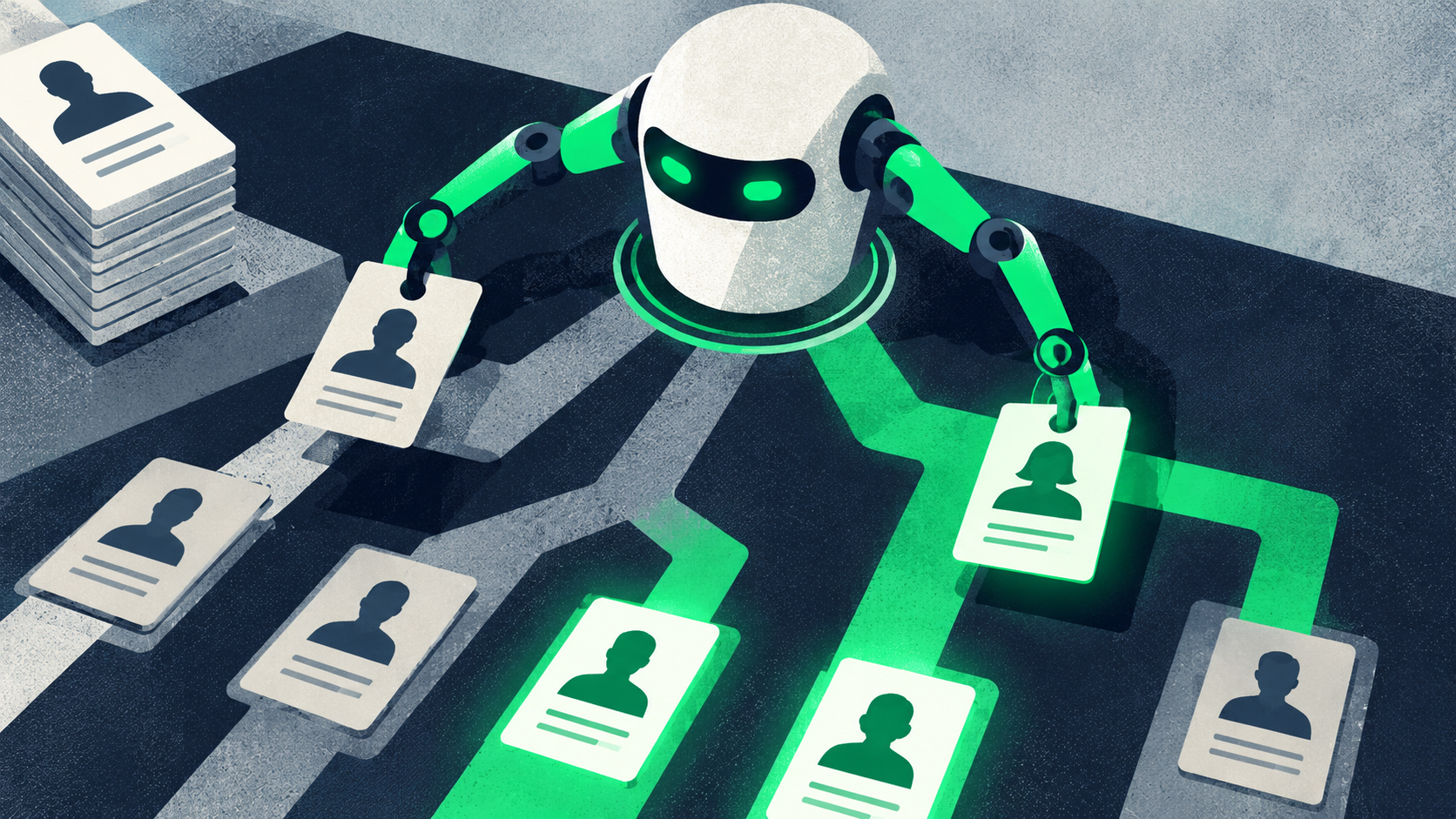
Agentic AI in credit decisioning uses AI agents to plan and complete multi-step tasks, such as gathering data and analyzing documents, with little human intervention. McKinsey defines agentic AI as AI that "can perform a series of tasks independently and end to end across complicated workflows." In lending, agents move an application from intake to a decision-ready file, while scoring models, credit policy, and people keep authority over the final decision.
This guide compares agentic AI with rules engines, predictive models, and generative AI, then walks through each step of an agentic credit workflow. It also maps agents to the 5 C's of credit and covers US regulation as of October 2026, benefits, risks, and adoption practices.
How Agentic AI Differs From Rules Engines, Predictive ML, and Generative AI
Agentic AI works as an orchestration layer that directs the credit tools lenders already use. According to McKinsey's research on agentic AI, agents can understand goals, break them into subtasks, work with people and systems, and adapt in real time.
The same research describes large language models as passive tools that act only when prompted. Agents add memory, planning, orchestration, and system integration on top of those models.
| Approach | What it does | Typical credit role | US bank model-risk framing (SR 26-2) |
|---|---|---|---|
| Rules engine | Applies fixed if/then logic, so the same input always returns the same output | Eligibility checks, knockout rules, and policy limits | Deterministic rule-based processes are excluded from the "model" definition |
| Predictive ML | Estimates quantities, such as default risk, from historical data using statistical methods | Credit scores, risk grades, and fraud scores | Falls within the "model" definition |
| Generative AI | Produces text or summaries when a person prompts it | Drafting credit memos and summarizing documents | Out of scope of the guidance |
| Agentic AI | Pursues a goal across many steps, calls tools, and adapts as new data arrives | Coordinating intake, document review, data pulls, and case routing | Out of scope of the guidance |
The regulatory column comes from SR 26-2, the April 2026 model risk guidance from the Federal Reserve, OCC, and FDIC. It applies to supervised banks, so non-bank lenders should treat it as context rather than as a rule that binds them.
In practice, agents call rules engines and predictive models instead of replacing them. In BCG's retail banking example, traditional underwriting models still assess credit risk, affordability, and policy compliance while the agent prepares the case.
Why Agents Depend on Connected, Real-Time Data
An agent can only reason over the data and tools it can reach, so fragmented systems limit its value. Lendflow's platform supports live credit signals, intelligent workflows, and AI agents that adapt as data flows in. Lendflow reports that more than $1.5B in offers were made on its platform in the 12 months to March 2025.
The work spans Lendflow Connect for data, Lendflow Intelligence for decisions, and Lendflow Automate for agent-driven execution.
How Agentic AI in Credit Decisioning Works, Step by Step
The six steps below follow how McKinsey and BCG describe agent roles in credit workflows. Both keep human review and established underwriting models in charge of the decision itself.
1. Application Intake and Triage
At intake, an agent checks the application for completeness, classifies the business, and asks the borrower for missing items. Lendflow Automate uses specialized AI agents to automate document handling and borrower communication across the lending workflow.
2. Document Analysis
A document agent reads bank statements, tax returns, and IDs, converts them into structured data, and flags figures that do not reconcile. Lendflow's Doc Analyzer, part of Lendflow Automate, brings document analysis into the workflow to reduce manual review.
3. Data Gathering and Pre-Review
Next, an agent collects third-party data and condenses it into one view for the underwriter. In BCG's example, the agent reviews identity, sanctions, fraud, and credit bureau data, then produces a structured risk summary with a confidence assessment.
Integration work usually decides success here, because each missing data source creates a manual gap. Lendflow Intelligence aggregates information from available sources into an up-to-date borrower picture, so agents work from current information.
4. Scoring and Policy Checks
The agent then passes the assembled file to the lender's scoring models and policy rules, which produce the risk assessment. Lendflow Intelligence turns credit and business data into lending decisions through configurable decision models.
5. Decision, Routing, and Adverse Action
Decision authority should match risk, so low-risk files may move quickly while complex cases go to a credit officer. McKinsey notes that a credit officer still reviews and edits the agent's draft before approval. It also expects the most complex, highest-risk processes to remain mostly manual.
When an application is declined, the adverse action notice must state reasons drawn from the factors the lender actually considered or scored. For declined applications, the Second-Look Marketplace in Lendflow Connect applies waterfall rules, so viable deals are not left on the table.
6. Monitoring and Feedback
After launch, the agents themselves need ongoing measurement. BCG recommends continuous tracking of output quality, routing accuracy, exception rates, latency, and drift, which warns risk teams when agent behavior changes.
Mapping Agentic AI to the 5 C's of Credit
The 5 C's of credit are character, capacity, capital, collateral, and conditions, and they remain the standard frame for underwriting judgment. The table below is Lendflow's view of where agents can prepare evidence for each C and where models and people should keep control.
| C | What the lender assesses | Where an agent can help | What stays with models and people |
|---|---|---|---|
| Character | Credit history and record of meeting obligations | Pull bureau data, verify identity, and summarize fraud signals | Judging context behind past delinquencies |
| Capacity | Ability to repay from income or cash flow | Extract deposits, revenue, and existing debt from bank statements and tax returns | Affordability thresholds and the scoring model's output |
| Capital | Owner equity and financial reserves | Reconcile balance sheet figures across submitted documents | Minimum equity or reserve requirements |
| Collateral | Assets that secure the loan | Gather asset documents and flag missing items | Valuation and advance rates |
| Conditions | Loan purpose, terms, industry, and economic context | Classify the industry and check loan purpose against policy | Credit appetite and concentration limits |
Across all five C's, agents gather and organize evidence while the lender's policy turns that evidence into a decision. This division also makes adverse action reasons easier to trace to specific factors.
Explainability and US Regulation as of October 2026
As of October 2026, we found no US federal guidance specific to agentic credit decisioning, so existing consumer-law duties apply regardless of technology. Lenders should confirm the details below with counsel.
ECOA and Regulation B Still Require Specific Reasons
Under ECOA and Regulation B, a creditor that takes adverse action must give a statement of specific reasons. The CFPB's 2023 circular explained, before its withdrawal, that reasons must "relate to and accurately describe the factors actually considered or scored by a creditor."
In practice, the stated reasons must be specific and tie back to the factors the lender actually considered. The FCRA adds separate notice duties when adverse action relies on a consumer report. These include credit score and key factor disclosures when a score is used (15 U.S.C. 1681m; 15 U.S.C. 1681g).
CFPB Circulars 2022-03 and 2023-03 Were Withdrawn
The CFPB issued circulars in 2022 and 2023 on adverse action notices for complex algorithms and on the use of sample reason forms. The Bureau withdrew both on May 12, 2025 and called the withdrawal "not necessarily final." The underlying ECOA and Regulation B duty remains unchanged.
SR 26-2 Replaced SR 11-7 and Excludes Agentic AI
On April 17, 2026, the Federal Reserve, OCC, and FDIC replaced SR 11-7 with SR 26-2. The new guidance is principles-based, does not set enforceable standards, and is most relevant to banks with more than $30 billion in assets.
SR 26-2 explicitly places generative and agentic AI outside its scope, so banks govern agents under their own risk practices. Fintechs and embedded lenders will likely feel this through bank partner expectations rather than through direct supervision.
The EU AI Act Treats Creditworthiness AI as High-Risk
Under the EU AI Act, AI used to evaluate the creditworthiness of natural persons is high-risk, with obligations applying from December 2, 2027. The Act can reach US firms when their AI output is used in the EU.
A Practical Design Principle for Explainability
No authoritative source yet confirms that an agent's reasoning trace can serve as a compliant adverse action reason. Lendflow's view is that a governed scoring and decision layer should produce the reasons, while agents prepare inputs and log every action for audit. State laws may add further duties, so this section warrants legal review before you apply it.
Benefits Show Up First in Productivity and Cycle Time
McKinsey reports a 40% to 80% productivity uplift per use case from multiagentic AI, based on its experience guiding financial institutions in corporate credit work. These figures come from consulting engagements rather than independent audits.
The same McKinsey report describes one institution whose agentic system cut the time required for financial-risk analyses by 50%. In a proof of concept, McKinsey's research on agentic AI cites a potential 20% to 60% productivity gain, with a 30% improvement in credit turnaround.
BCG projects that AI agents could potentially raise retail bank profitability by 30% and reduce costs by 30% to 40% by 2030. BCG produced that report jointly with OpenAI, which has a commercial interest in agent adoption.
These numbers point to faster credit memo drafting and pre-review work. None of the sources report audited loss, approval, or fair-lending outcomes for agentic credit decisioning.
Limitations and Risks of Agentic AI in Credit
Gartner predicts that over 40% of agentic AI projects will be canceled by the end of 2027. It cites escalating costs, unclear business value, and inadequate risk controls, based on a January 2025 poll of 3,412 webinar attendees across industries.
Gartner also flags "agent washing," estimating that only about 130 of the thousands of agentic AI vendors are real. Buyers should test whether a product actually plans and acts across steps.
Data and governance readiness is the larger gap. A Deloitte survey of 501 US leaders at organizations already piloting agentic AI, published in August 2026, reported the following gaps:
- 72% say they lack unified, accessible data.
- 70% say they do not feel they can trust and govern agents.
- 67% say integration is too costly and complex.
- 15% say they have scaled, orchestrated, multi-agent adoption.
Adoption is also earlier than headlines suggest. In McKinsey's State of AI 2025 global, all-industry survey, 23% of respondents were scaling an agentic AI system somewhere in their enterprise. No more than 10% were scaling agents in any single business function.
McKinsey lists the operational risks agents introduce, including uncontrolled autonomy, fragmented system access, weak traceability, a wider attack surface, and agent sprawl. Agents can also hallucinate, producing plausible but inaccurate outputs that become serious once they reach a credit file.
Best Practices for Adopting Agentic AI in Credit
Each practice below addresses a failure point named by Gartner, Deloitte, McKinsey, or BCG.
- Start with preparation tasks. Deploy agents first on intake, document extraction, and pre-review, where people can catch errors before a decision.
- Keep decisions in a governed layer. Let scoring models and policy rules produce decisions and adverse action reasons, with officers reviewing high-risk cases.
- Unify data before adding agents. Connect bureau, banking, document, and fraud data first, since 72% of Deloitte respondents lack unified, accessible data.
- Give each agent a narrow role. Assign each agent a defined task and only the system access it needs, which limits sprawl and access risk.
- Log every agent action. Record inputs, tool calls, and outputs so auditors and bank partners can trace how each file was prepared.
- Measure agent quality continuously. Track output quality, routing accuracy, exception rates, latency, and drift, as BCG recommends.
- Map obligations early. Review ECOA, Regulation B, FCRA, bank partner expectations, and any EU exposure with counsel before launch.
- Vet vendors for real agency. Ask vendors to show multi-step execution, permission controls, and audit trails on your own sample files.
A common pitfall is letting an agent's narrative summary stand in for documented decision reasons. Another is launching agents on top of fragmented data, which shifts manual work to exception queues instead of removing it.
Key Takeaways on Agentic AI for Credit Leaders
Agentic AI in credit decisioning uses goal-driven agents to run multi-step credit work such as intake, document analysis, data gathering, routing, and monitoring. Current evidence supports faster preparation and review, while final decisions and adverse action reasons stay with governed models, policy, and people.
As of October 2026, the CFPB circulars on AI adverse action notices are withdrawn and SR 26-2 excludes agentic AI from its scope. The ECOA and Regulation B duty to give specific, accurate reasons still applies. Lenders that pair agents with unified data and a clear decision layer will be best placed to scale safely.
Frequently Asked Questions About Agentic AI in Credit
What Is Agentic AI in Simple Terms?
Agentic AI is software that takes a goal, breaks it into steps, and completes those steps by using other tools and systems. In credit, an agent might collect documents, extract the numbers, and assemble a file for an underwriter.
What Is the Difference Between Predictive, Generative, and Agentic AI?
Predictive AI estimates outcomes, such as default risk, from historical data. Generative AI creates text or summaries when prompted. Agentic AI pursues a goal across many steps and can call predictive and generative tools along the way.
Can AI Agents Make Final Credit Decisions?
The sources reviewed here keep humans and established underwriting models in charge of the final decision, especially for complex or high-risk cases. Decision authority should be designed to match risk, with clear escalation paths to credit officers.
Are Agentic AI Credit Decisions Compliant With ECOA?
Compliance depends on how the system is designed, because ECOA applies regardless of the technology a lender uses. Adverse action reasons must accurately describe the factors actually considered or scored, and no authoritative source yet confirms that agent reasoning alone meets that standard.
What Are the 5 C's of Credit?
The 5 C's are character, capacity, capital, collateral, and conditions. Lenders use them to judge a borrower's track record, ability to repay, financial reserves, pledged assets, and the context of the loan.
To see how Lendflow brings real-time data, document analysis, and decision support into one lending workflow, Learn More.


